For the past two decades, a dark cloud has hung over the American shopping mall. Headlines have continuously warned us about the “retail apocalypse,” tracking the slow demise of indoor suburban shopping centers as department store anchors shuttered their doors. It felt like a foregone conclusion that digital storefronts, powered by algorithmic convenience and direct-to-door delivery, would eventually turn physical retail into an ancient relic of the late twentieth century.
But a funny thing happened on the way to the graveyard. Physical retail didn’t die; it evolved.
Nowhere is this evolution more obvious than in the explosive growth of National Outlet Shopping Day. Spanning four consecutive days from Thursday, June 11, through Sunday, June 14, 2026, this annual event—celebrating its milestone fifth anniversary—is transforming 90 premier shopping destinations across the United States into high-energy hubs. With over 500 participating global brands offering roughly 6,000 exclusive deals, the event is tracking a massive 65 percent increase in shopper participation since its 2022 debut.
However, viewing this event solely as a massive weekend sale misses the bigger picture. It is actually a fascinating masterclass in modern corporate strategy, a direct counteroffensive against online shopping, and a vivid blueprint for the future of physical retail.

The Strategic Spark: Why the Event Was Created
To truly appreciate the genius behind National Outlet Shopping Day, you have to look at the traditional retail calendar through the eyes of a real estate developer. Historically, the summer season has featured a massive, barren promotional desert.
Memorial Day sales provide a healthy spike in late May, but once June arrives, the retail landscape goes quiet. Back-to-school shopping—the second-most lucrative spending window of the year—does not truly ramp up until late July or early August. This left a multi-week dead zone in June where retail traffic completely stalled. Consumers were stuck at home, distracted by the onset of warm weather, summer vacations, and backyard barbecues, lacking a major reason to head out to a physical shopping center.
Recognizing this vacuum, Simon Property Group—the country’s largest owner of shopping, dining, and entertainment destinations—partnered with the National Day Calendar in 2022 to officially proclaim and launch National Outlet Shopping Day on the second Saturday of June.
The creation of the holiday solved three critical problems simultaneously:
- Filling the Dead Zone: It injected a high-volume shopping weekend directly into the slowest stretch of the summer calendar, driving consumer urgency when it was needed most.
- Inventory Clearing: It gave major apparel and footwear brands a highly visible, concentrated window to clear out residual spring inventory, freeing up valuable warehouse and floor space for the massive influx of fall goods.
- Economic Relief: Arriving during an era of persistent inflation, it established a dedicated weekend where value-conscious shoppers could actively find a safety valve for their household budgets.
By turning a sluggish trading period into a highly anticipated, Black Friday-style phenomenon, developers managed to engineer artificial demand during a historical low point.
Fighting the Algorithm: The Battle with Online Competition
The biggest existential threat to any physical retail destination is the frictionless convenience of e-commerce. Why spend gas money, hunt for parking, and navigate crowds when you can open an app on your phone, click twice, and have an item arrive at your doorstep tomorrow morning?
Online competition has fundamentally altered consumer expectations. E-commerce platforms leverage data algorithms to serve personalized recommendations, while ultra-fast fashion operations can turn digital designs into shippable garments within days. To survive, physical outlet centers had to lean heavily into the things an online algorithm can never replicate.
Physical shopping provides a multi-sensory, tangible feedback loop that digital screens cannot match. You cannot touch the weight of a premium leather handbag, feel the weave of a high-end cotton shirt, or accurately test the arch support of a running shoe through a glass screen. Online shopping replaces the joy of exploration with a cold, transactional scroll. Outlet centers capitalize on this by turning the physical trip into a literal treasure hunt.
Furthermore, the e-commerce model is plagued by a hidden, incredibly expensive problem: the return cycle. Up to 30% of apparel ordered online is ultimately returned due to poor sizing or unexpected material quality, forcing consumers to deal with the annoying chore of boxing up items, printing labels, and waiting weeks for refunds. Physical outlet centers eliminate this friction completely. Shoppers walk into a fitting room, try on five different sizes, purchase the one that fits perfectly, and experience the instant gratification of walking out of the store with the item in hand.
During National Outlet Shopping Day, this advantage is supercharged by a pricing mechanism that online retailers struggle to match: true value stacking. Because outlets are designed from the ground up to sell overstock and factory-exclusive lines, their everyday baseline prices are already marked down by up to 65 percent. By layering event-specific event coupons, buy-one-get-one offers, and loyalty perks on top of those baselines, physical outlets create a localized value proposition that makes online alternatives look expensive.
The Transformation: What the Future of Malls Looks Like
If the classic, enclosed neon-lit malls of the 1980s are dead, what is taking their place? The answer can be found in the structural layout and experiential design of modern premium outlets and lifestyle centers. The future of the mall belongs to experiential retail—the art of transforming a shopping center from a simple row of cash registers into a vibrant community town square.
Modern consumers, particularly Millennials and Gen Z, actively prioritize experiences over material accumulation. They want social validation, memorable moments, and communal interaction. If a shopping center only offers products, it will fail. If it offers a memorable day out, it thrives.
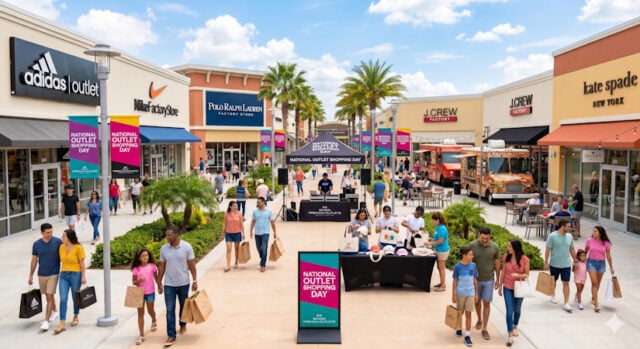
During the 2026 celebration, participating locations are completely abandoning the traditional transactional model. Centers are transforming their open-air pathways into community block parties. Instead of quiet corridors, visitors encounter:
- Live local DJs and acoustic musical performances.
- Interactive, gamified spin-to-win prize wheels.
- Creative DIY customization stations where buyers can personalize apparel with embroidery or custom patches.
- Upscale food trucks and experiential beverage pop-ups, such as custom Coach Coffee Shops.
- Strategic experiential partnerships, like Simon’s recent collaboration with Adidas to host global soccer-themed fan activation zones.
This transition from a transactional space to a mixed-use social environment represents the ultimate survival strategy for physical brick-and-mortar real estate. By integrating premium dining, interactive entertainment, and social gathering spaces directly into the retail footprint, developers are creating resilient ecosystems that digital retail cannot disrupt.
Navigating the 2026 Event: Offers and Flagship Epicenters
For those planning to participate in the upcoming four-day stretch, the sheer volume of choices requires an organized approach. Over 500 premier brands—including iconic names like Polo Ralph Lauren, Kate Spade New York, Nike, and J.Crew Factory—are offering a deep variety of promotional tiers.
The 2026 Promotional Landscape
| Savings Tier | Core Strategy | Best Applied To |
| Stacked Percentages | Extra 20% to 40% off existing clearance baselines | Premium denim and designer footwear |
| Volume Incentives | Save $20 extra for every $100 spent across total ticket | Complete seasonal wardrobe refreshes |
| BOGO Merchandising | Buy one, get one free structures on selected items | Summer basics, activewear, and children’s apparel |
| Loyalty Multipliers | Double points for Simon+ app loyalty program members | Tech accessories and high-end luxury goods |
While these promotions are running nationwide, the core spirit of this retail renaissance is most visible at three iconic flagship properties that have mastered the art of experiential design.
Woodbury Common Premium Outlets (Central Valley, New York)
Nestled beautifully within the Hudson Valley just an hour north of Manhattan, this sprawling complex features more than 250 high-end designer stores. It operates less like a shopping center and more like a picturesque, walkable European village, drawing millions of international tourists annually who seek a scenic luxury experience.
Desert Hills Premium Outlets (Cabazon, California)
Framed by the dramatic, sun-drenched mountains of the Southern California desert, this open-air paradise hosts one of the largest collections of luxury outlet stores in the world. Its striking architectural integration with the natural landscape turns a simple wardrobe refresh into a visual, resort-style excursion.
Sawgrass Mills (Sunrise, Florida)
As a massive indoor-and-outdoor value-retail mega-center in South Florida, Sawgrass Mills showcases the ultimate blend of scale and diversity. Featuring over 350 stores, including the high-end Colonnade Outlets, it shields visitors from the mid-June tropical heat while providing an extensive, all-day entertainment and dining environment that draws shoppers from across the Americas.
The Ultimate Retail Renaissance
The explosive success of National Outlet Shopping Day proves that the narrative surrounding the death of physical retail was entirely wrong. Brick-and-mortar stores were never destined for extinction; they simply needed to remember what made them special in the first place. By weaponizing tactile sensory experiences, addressing the inconvenient flaws of e-commerce returns, and transforming static physical layouts into interactive community hubs, modern retail developers are successfully securing their place in the modern economy. The physical mall isn’t a relic of the past—it is actively inventing the future.
Sources and Links:
- PR Newswire: Simon Premium Outlets® Announces Retail’s Biggest Experiential Shopping Event, National Outlet Shopping Day®, at 90 Destinations
- Stock Titan: Simon Premium Outlets sets National Outlet Shopping Day | SPG Stock News
- Barchart: Simon Premium Outlets® Announces Retail’s Biggest Experiential Shopping Event, National Outlet Shopping Day®, at 90 Destinations
- Awareness Days: National Outlet Shopping Day 2026
- GuruFocus: Simon Property Group Inc (SPG) Expands National Outlet Shopping
Disclaimer
Artificial Intelligence Disclosure & Legal Disclaimer
AI Content Policy.
To provide our readers with timely and comprehensive coverage, South Florida Reporter uses artificial intelligence (AI) to assist in producing certain articles and visual content.
Articles: AI may be used to assist in research, structural drafting, or data analysis. All AI-assisted text is reviewed and edited by our team to ensure accuracy and adherence to our editorial standards.
Images: Any imagery generated or significantly altered by AI is clearly marked with a disclaimer or watermark to distinguish it from traditional photography or editorial illustrations.
General Disclaimer
The information contained in South Florida Reporter is for general information purposes only.
South Florida Reporter assumes no responsibility for errors or omissions in the contents of the Service. In no event shall South Florida Reporter be liable for any special, direct, indirect, consequential, or incidental damages or any damages whatsoever, whether in an action of contract, negligence or other tort, arising out of or in connection with the use of the Service or the contents of the Service.
The Company reserves the right to make additions, deletions, or modifications to the contents of the Service at any time without prior notice. The Company does not warrant that the Service is free of viruses or other harmful components.