Home Accuweather.com Bermuda Disturbance Could Yield Atlantic’s First Hurricane as El Niño Limits Broader...

Bermuda Disturbance Could Yield Atlantic’s First Hurricane as El Niño Limits Broader Risks

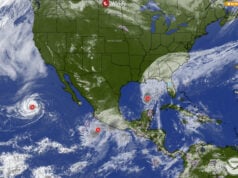
The potential tropical threat near Bermuda remains the most immediate area to watch in the Atlantic where conditions are conducive to producing the season’s first Atlantic hurricane.

“This could be the system that finally produces the first hurricane of the Atlantic season,” said AccuWeather Lead Hurricane Expert Alex DaSilva. “If it becomes organized, conditions near Bermuda could support strengthening and potentially allow the system to reach hurricane strength.”

An area of disorganized showers and thunderstorms has a medium risk of tropical development near Bermuda from Sept. 19-22. Interests in Bermuda should continue to closely monitor the area.

In the United States, AccuWeather hurricane experts expect any additional direct impacts this season to most likely fall on the lower end of the AccuWeather RealImpact™ Scale for Hurricanes.

Faith Based Events

About Two Additional U.S. Atlantic Impacts Forecast This Season

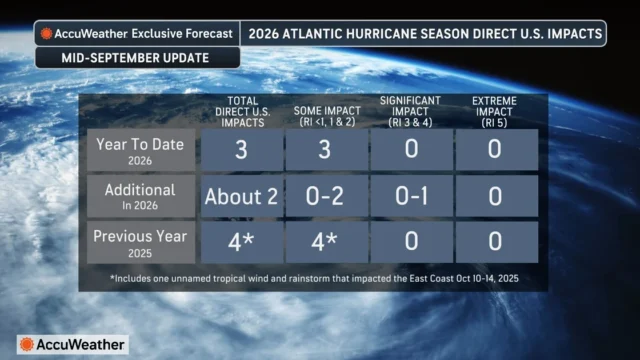
AccuWeather forecasts about two additional direct U.S. impacts through the remainder of the Atlantic Hurricane season and is now providing more detail on how severe the impacts could be:

Forecast for the Remainder of the Season

AccuWeather RealImpact Scale for Hurricanes Rating Forecasted Impacts Through End of Hurricane Season
Some Impact Less than 1, 1 or 2 0–2 storms
Significant Impact 3 or 4 0–1 storms
Extreme Impact 5 0 storms

Historically, moderate-to-strong El Niño conditions have reduced the number of Atlantic hurricane days by about 60 percent on average,” said DaSilva.

That reduced opportunity for long-track powerful hurricanes helps explain why AccuWeather’s forecast for additional U.S. impacts is weighted toward the lower end of the RealImpact Scale.

“Think of El Niño as reducing the number of chances the Atlantic gets to produce a long-track hurricane. More wind shear means more disturbances can be disrupted before they have time to organize,” DaSilva said. During La Niña, lower wind shear typically allows more tropical systems coming off Africa to survive and spend longer periods of time developing over warm Atlantic waters, increasing the potential for significant or extreme impacts.”

The enhanced forecast incorporates the AccuWeather RealImpact™ Scale for Hurricanes, which considers damaging winds, flooding rainfall, storm surge and total economic damage and loss. This is in contrast to the Saffir-Simpson Hurricane Wind Scale, used by most other sources, that only accounts for wind speed.

“While El Niño can certainly put a ceiling on how strong a storm becomes and how many storms develop, it’s hard to directly compare the potential impact between El Niño and La Niña,” explained DaSilva. “There are so many factors that can allow a storm to rapidly intensify near land. Hurricane Idalia in 2023 came during a moderate El Niño and caused devastation across Florida’s panhandle and was rated a 4 on the RealImpact Scale.”

2026_atlantic_direct_u.s._impacts-1

For perspective, Hurricane Melissa was rated a 5 in 2025 on the AccuWeather RealImpact™ Scale after causing catastrophic impacts across the Caribbean. Hurricane Milton in 2024 was the most recent U.S. storm to be a 5 on the AccuWeather RealImpact™ Scale. All three direct U.S. impacts this season, Arthur, Bertha and Edouard, fall into the “some impact” category under the enhanced forecast.

El Niño Suppresses Activity, But U.S. Risk Remains

The Atlantic has reached its historical average peak last week without producing a single hurricane, setting a new satellite-era record for going the longest into a season without a hurricane. The previous record was set in 2013, when Hurricane Humberto became the season’s first hurricane on Sept. 11.

Strong El Niño conditions are already present in the Pacific; with nearly 100% confidence a Super El Niño will develop by late in the hurricane season. El Niño typically increases disruptive wind shear across portions of the Atlantic, making it more difficult for tropical systems to strengthen.

But exceptionally warm waters closer to the United States could provide opportunities for development even as El Niño suppresses activity across much of the basin.

“El Niño is putting the brakes on tropical development across much of the Atlantic, but that does not eliminate the threat closer to the United States,” DaSilva added. “A tropical wave could struggle over the open Atlantic and then find much more favorable conditions as it approaches the exceptionally warm waters near the coast. That could give people less time to prepare.”

AccuWeather continues to highlight the northern and eastern Gulf Coast and the Carolinas as facing a higher-than-historical average risk of direct tropical impacts through the remainder of the season. The central and lower Texas coast, south of Houston, faces a lower-than-historical-average risk of significant tropical impacts later this fall.


Disclaimer

Artificial Intelligence Disclosure & Legal Disclaimer

AI Content Policy.

To provide our readers with timely and comprehensive coverage, South Florida Reporter uses artificial intelligence (AI) to assist in producing certain articles and visual content.

Articles: AI may be used to assist in research, structural drafting, or data analysis. All AI-assisted text is reviewed and edited by our team to ensure accuracy and adherence to our editorial standards.

Images: Any imagery generated or significantly altered by AI is clearly marked with a disclaimer or watermark to distinguish it from traditional photography or editorial illustrations.

General Disclaimer

The information contained in South Florida Reporter is for general information purposes only.

South Florida Reporter assumes no responsibility for errors or omissions in the contents of the Service. In no event shall South Florida Reporter be liable for any special, direct, indirect, consequential, or incidental damages or any damages whatsoever, whether in an action of contract, negligence or other tort, arising out of or in connection with the use of the Service or the contents of the Service.

The Company reserves the right to make additions, deletions, or modifications to the contents of the Service at any time without prior notice. The Company does not warrant that the Service is free of viruses or other harmful components.