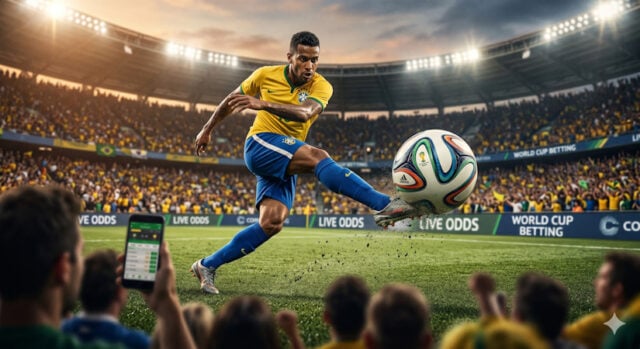
As the U.S., Canada and Mexico prepare to host the 2026 FIFA World Cup, millions of people are getting in on the action with wagers on the matches, goals and eventual champion. If the latest predictions are right, the betting figures will smash records.
New forecasts project that soccer fans will bet nearly $3 billion in the U.S. through online sportsbooks, while billions more could be traded on prediction market platforms.
H2 Gambling Capital, a market intelligence provider, predicts $2.9 billion will be wagered with U.S. sportsbooks. That’s only a fraction of the $60 billion that could be bet globally, representing a 71% increase over the 2022 World Cup in Qatar. (H2’s U.S. estimate covers “legal sportsbooks only, excluding dot-com sites,” says Ed Birkin, the firm’s managing director.)
Eilers & Krejcik Gaming released a separate forecast, with a base case of $2.82 billion in U.S. online wagers for the 2026 World Cup. This estimate assumes that the U.S. men’s national team (USMNT) reaches the Round of 32 or the Round of 16, where the Americans would bow out.

This summer, the World Cup expands into a new format with 48 teams, up from 32 in the past. The change means more games (104 vs. 64), more action and more betting. Combine the expansion with the explosive growth of app-based sports betting and the rise of prediction markets, and it’s a perfect storm for this to be one of the biggest moments ever for sports gambling.
Eilers & Krejcik Gaming forecasts worst-case and best-case scenarios ranging from $2.32 billion and $4.33 billion in total U.S. wagers, with more betting expected in the event of a deeper USMNT run. However, the team has not advanced to the quarterfinals since 2002.
As a reference point, Eilers & Krejcik Gaming projected $1.62 billion in bets for the Super Bowl in February and estimated $900 million to $1 billion in bets for the last World Cup.
About 70% of the World Cup bets will be wagered on two platforms: DraftKings (accounting for $1.02 billion) and FanDuel ($945 million), the firm said in its forecast.
World Cup winner odds for 2026
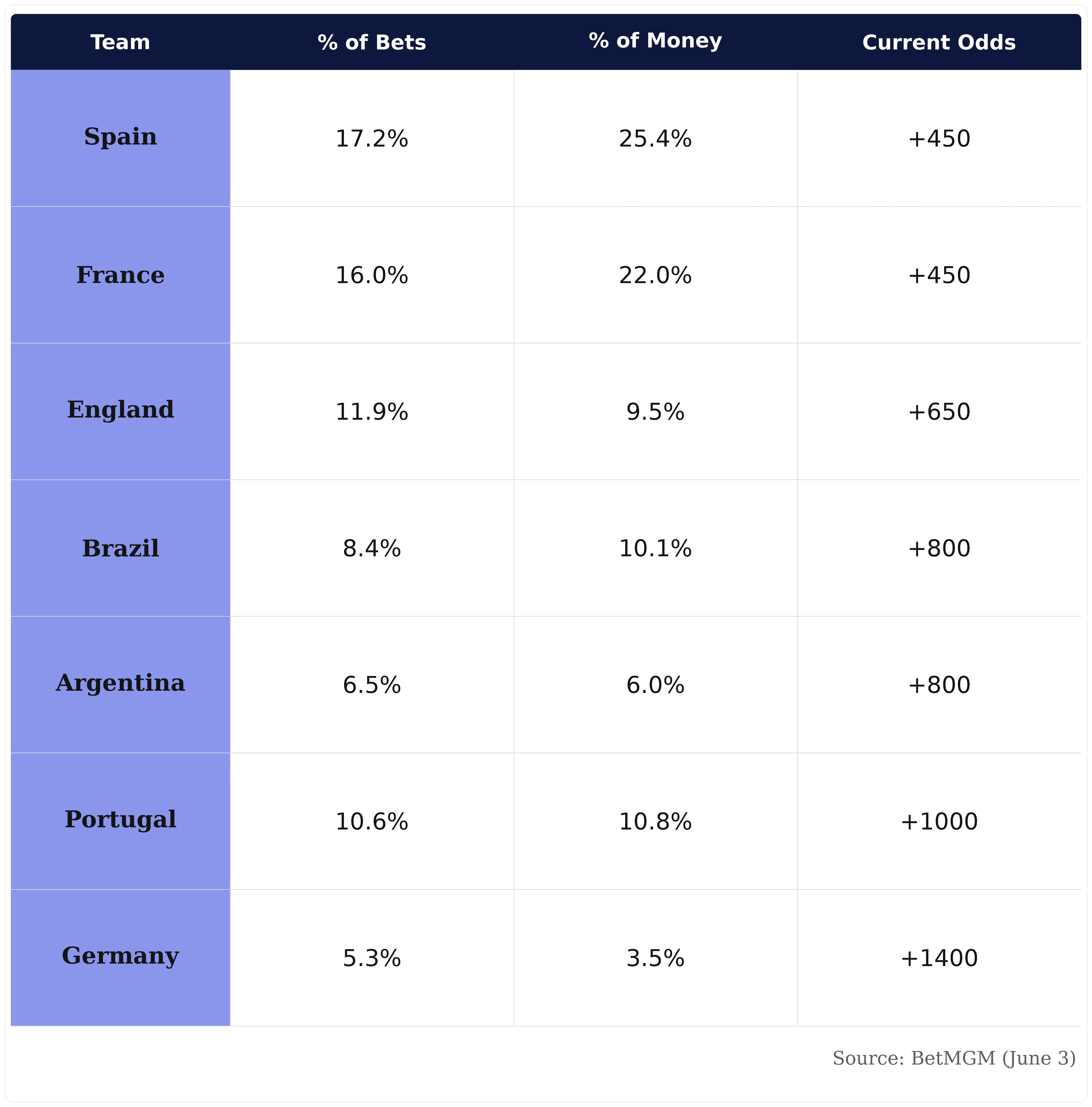
So far, the most betting action on the tournament winner is behind Spain and France, and to a lesser extent, England, Brazil and Portugal, according to BetMGM.
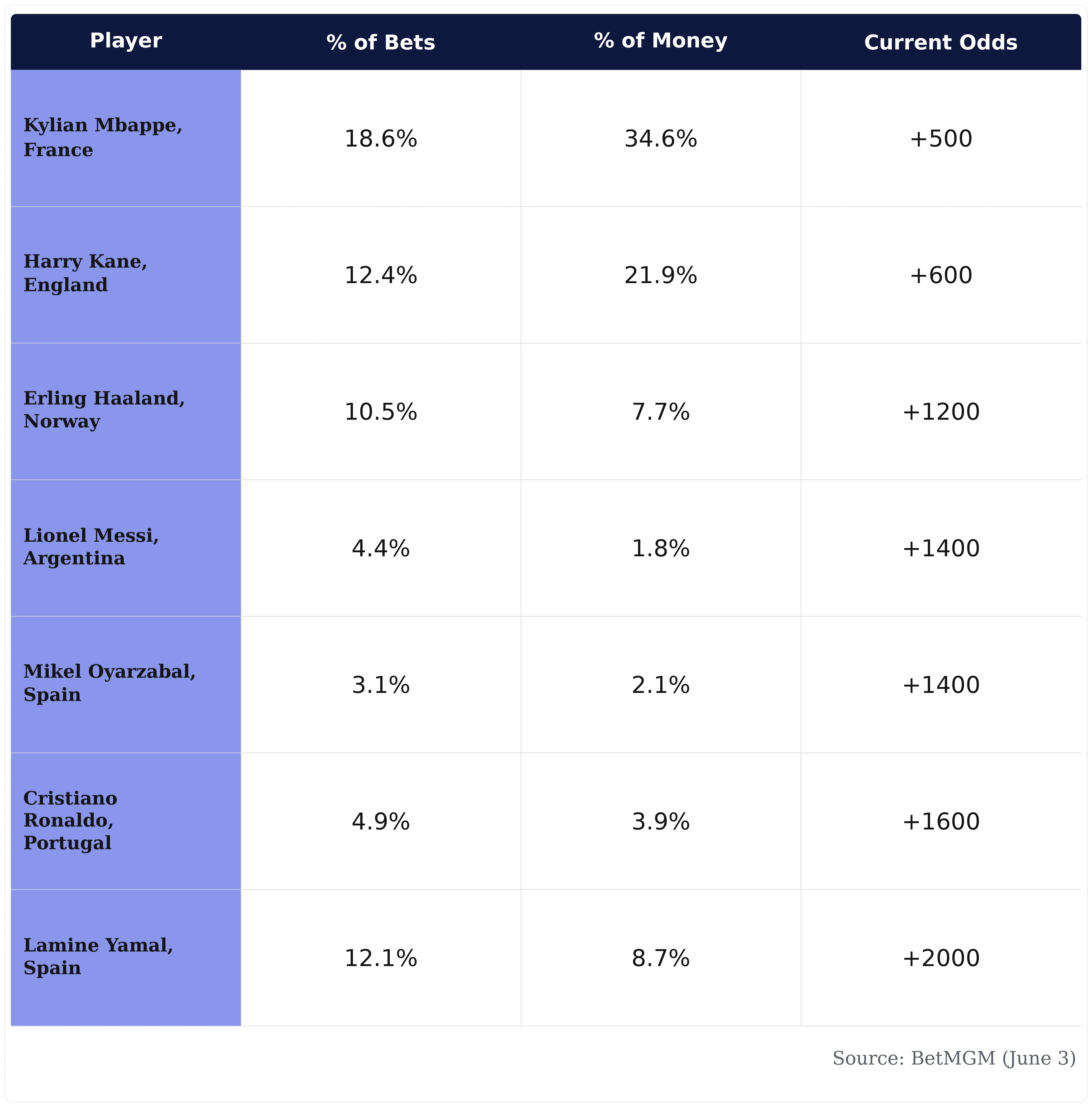
Who will score the most goals and win the “Golden Boot” in the 2026 World Cup? The most bets have come in on France’s Kylian Mbappe, England’s Harry Kane, Norway’s Erling Haaland, Portugal’s Cristiano Ronaldo and Spain’s Lamine Yamal.
Prediction market platforms have exploded onto the scene since the last World Cup, largely due to the Trump administration granting them permission to operate nationwide. Users 18 and older can essentially sports-bet on these sites by purchasing “yes” or “no” contracts on sports-related event markets, which resolve to a value of $1 per contract if the pick is correct.
Analysts say prediction market volume cannot be compared head-to-head with sports-betting figures. One reason for this is that a trade on a prediction market counts toward volume on both the buy and sell sides of a trade. Also, traders are constantly buying and selling contracts, meaning the volume numbers that are reported end up being larger than the actual money at stake on the games.
The trends still show clear growth. DeFi Rate, a research and analytics website covering prediction markets, estimated Monday that American customers will trade $2.5 billion on prediction market platforms for the World Cup, with Kalshi projected to see $1.47 billion of that volume.
“The key driver will be the individual matchups — they account for roughly 80% of the projected volume, and our data shows most of the action will happen on game day,” Cheryle Shepstone, director of content at DeFi Rate, said in a news release.
Future-looking bets on prediction markets are also popular, allowing users to cash out their trades as the tournament progresses.
DeFi Rate projected $253 million in volume on the World Cup winner market on Kalshi. That would comfortably beat the comparable market for the winner of the 2026 March Madness tournament, which had an estimated $169 million of volume.
Disclaimer
Artificial Intelligence Disclosure & Legal Disclaimer
AI Content Policy.
To provide our readers with timely and comprehensive coverage, South Florida Reporter uses artificial intelligence (AI) to assist in producing certain articles and visual content.
Articles: AI may be used to assist in research, structural drafting, or data analysis. All AI-assisted text is reviewed and edited by our team to ensure accuracy and adherence to our editorial standards.
Images: Any imagery generated or significantly altered by AI is clearly marked with a disclaimer or watermark to distinguish it from traditional photography or editorial illustrations.
General Disclaimer
The information contained in South Florida Reporter is for general information purposes only.
South Florida Reporter assumes no responsibility for errors or omissions in the contents of the Service. In no event shall South Florida Reporter be liable for any special, direct, indirect, consequential, or incidental damages or any damages whatsoever, whether in an action of contract, negligence or other tort, arising out of or in connection with the use of the Service or the contents of the Service.
The Company reserves the right to make additions, deletions, or modifications to the contents of the Service at any time without prior notice. The Company does not warrant that the Service is free of viruses or other harmful components.