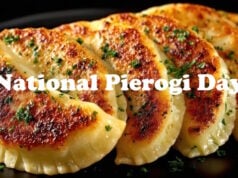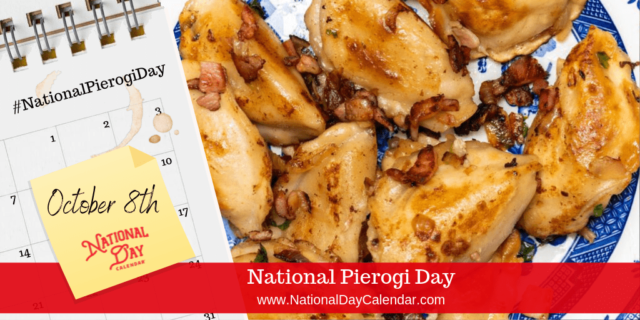
On October 8th, National Pierogi Day recognizes an international dish that is a type of dumpling.
- Pierogi is the plural form of the rarely used Polish word pierog. In English, we spell pierogi several ways, including perogi and pierogy.
- The Eastern European immigrants popularized pierogi in the United States. At first, immigrants served pierogi to only their families. However, ethnic restaurants also served pierogi.
- After World War II, ethnic churches sold pierogi as a staple fundraiser.
- By the 1960s, grocery stores marketed pierogi for the frozen food aisles in many parts of the United States. In fact, grocery stores still sell them today.
- The Pittsburgh Pirates hold a pierogi race at every home game. Six pierogi costume-wearing runners (Potato Pete, Jalapeño Hannah, Cheese Chester, Sauerkraut Saul, Oliver Onion and Bacon Burt) race to the finish line between innings.
- Whiting, Indiana celebrates an annual Pierogi Fest each July. There are tons of fun activities including a Polka Parade, a Mr. Pierogi songfest, a pierogi toss, a pierogi eating contest, and more. They even have a Polish Idol singing contest where contestants choose from a preapproved list of songs all about food. This festival draws almost 200,000 people each year!
- Glendon, Alberta, Canada, is home to a 6000-pound pierogi standing 25 feet tall and is made of sturdy fiberglass and steel. Piercing the giant pierogi, built-in 1991, is an equally giant fork.
- Pierogi enjoyed a brief popularity as a sports food when Paula Newby-Fraser adopted them as her food of choice for the biking portion of the 1989 Hawaii Ironman Triathlon.
- Pierogi have been made in Poland since the 13th century. However, claims have been staked by the Poles, Romanians, Russians, Lithuanians, Ukrainians, and Slovaks.
- Some suggest that the original form came from China through Italy during the Marco Polo expeditions.
- Others suggest that the Tartars brought the recipe to the West from the former Russian Empire.
- Although nothing is confirmed, one thing we do know is that the word pierogi first appeared in Polish cookbooks and literature in the second half of the 17th century.
- We also know that back then, pierogi was prepared for holidays such as Christmas, Easter, and weddings. Each holiday actually had its own designated pierogi flavor.
- Ten students from a catering school in Wroclaw, Poland were entered into the Guinness World Records Book for making 1,663 pierogi (90 pounds) in 100 minutes. They donated the pierogi to children’s homes.
- Poland has its own dedicated pierogi restaurants called “Pierogarnia.” You can see them on many street corners.
- At the 2007 Pierogi Festival in Kraków, 30,000 pierogi were consumed daily.
- Ted Twardzik Sr. founded Mrs. T’s Pierogies October 8, 1952, producing the first samples for a local grocery store. Mrs. T’s remains the largest producer of (frozen) pierogi in the U.S.
Sources:

Disclaimer
Artificial Intelligence Disclosure & Legal Disclaimer
AI Content Policy.
To provide our readers with timely and comprehensive coverage, South Florida Reporter uses artificial intelligence (AI) to assist in producing certain articles and visual content.
Articles: AI may be used to assist in research, structural drafting, or data analysis. All AI-assisted text is reviewed and edited by our team to ensure accuracy and adherence to our editorial standards.
Images: Any imagery generated or significantly altered by AI is clearly marked with a disclaimer or watermark to distinguish it from traditional photography or editorial illustrations.
General Disclaimer
The information contained in South Florida Reporter is for general information purposes only.
South Florida Reporter assumes no responsibility for errors or omissions in the contents of the Service. In no event shall South Florida Reporter be liable for any special, direct, indirect, consequential, or incidental damages or any damages whatsoever, whether in an action of contract, negligence or other tort, arising out of or in connection with the use of the Service or the contents of the Service.
The Company reserves the right to make additions, deletions, or modifications to the contents of the Service at any time without prior notice. The Company does not warrant that the Service is free of viruses or other harmful components.