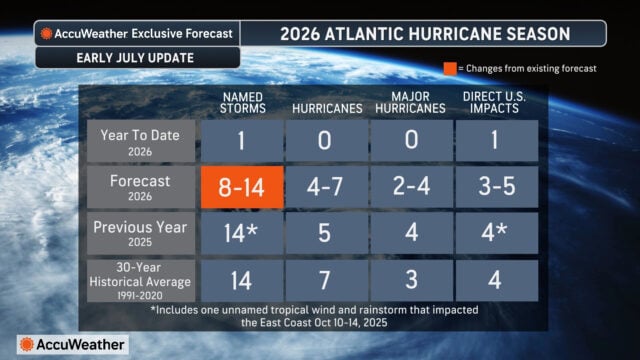
Though the total risk to the United States remains unchanged, AccuWeather® hurricane experts have slightly reduced the range of named storms predicted to develop in the Atlantic Basin this year and are available for interviews to discuss the change, which is largely driven by quickly developing El Niño conditions.
- Slight reduction in total named storms, tied to early onset El Niño and 70 percent chance of Super El Niño
- No change to direct U.S. impact with 3-5 storms forecast to impact, same as initial March forecast
- The highest U.S. impact risk remains focused on the northern and eastern Gulf Coast, Southeastern Coast and the Caribbean
- Texas/Western Gulf states facing lower-than-historical average risk of significant impact
- Dangerous storms can still develop close to the U.S., leaving little time to prepare
AccuWeather Storm Predictions:
| Most Likely | Projected Range | |
| Named Storms | 11 | 8-14 |
| Hurricanes | 5 | 4-7 |
| Major Hurricanes | 2 | 2-4 |
| Direct U.S. Impacts | 4 | 3-5 |
Early onset El Niño triggers slight downward adjustment to the total number of named storms
AccuWeather® Global Weather Center (July 7, 2026) — AccuWeather hurricane experts are slightly reducing the numbers of named storms expected to develop this season, after the early June arrival of El Niño, and a 70 percent chance of a Super El Niño developing.
AccuWeather® now forecasts 8-14 named storms during the Atlantic hurricane season, a small decrease for the initial AccuWeather 2026 Hurricane Season Forecast, which initially forecasted 11-16 named storms in March.
“El Niño conditions have always been the driver for why we’re expecting numbers near or below the historical average this year,” said Alex DaSilva, AccuWeather lead hurricane expert. “The stronger the El Niño gets, the fewer named storms we’re likely to get. Back in 2015, we had a strong El Niño and got 11 named storms. I think that is the sweet spot again this year.”

“AccuWeather hurricane experts are constantly refining and integrating new data into our predictions. In addition to slightly lowering the named storm prediction, this update also provides a most likely number of named storms, hurricanes, major hurricanes, and direct U.S. impacts — something that other sources do not provide,” said Vice President of Forecasting Operations Dan DePodwin.
AccuWeather released its preliminary Atlantic Seasonal Hurricane Forecast on March 25, well ahead of any other known sources.
AccuWeather experts still expect 4-7 Atlantic hurricanes, 2-4 major hurricanes, with 3-5 direct U.S. impacts expected. The highest U.S. impact risk remains focused on the northern and eastern Gulf Coast, Southeastern Coast and the Caribbean where storms can develop rapidly.
“When tropical storms and hurricanes form close to the coast instead of tracking across the open Atlantic from Africa, there’s a real difference in warning time,” DaSilva explained. “As a result, residents may have significantly less time to prepare. That’s why we stress having a hurricane plan in place before the season starts, rather than waiting until a storm is already offshore.”
Driving the Forecast Change
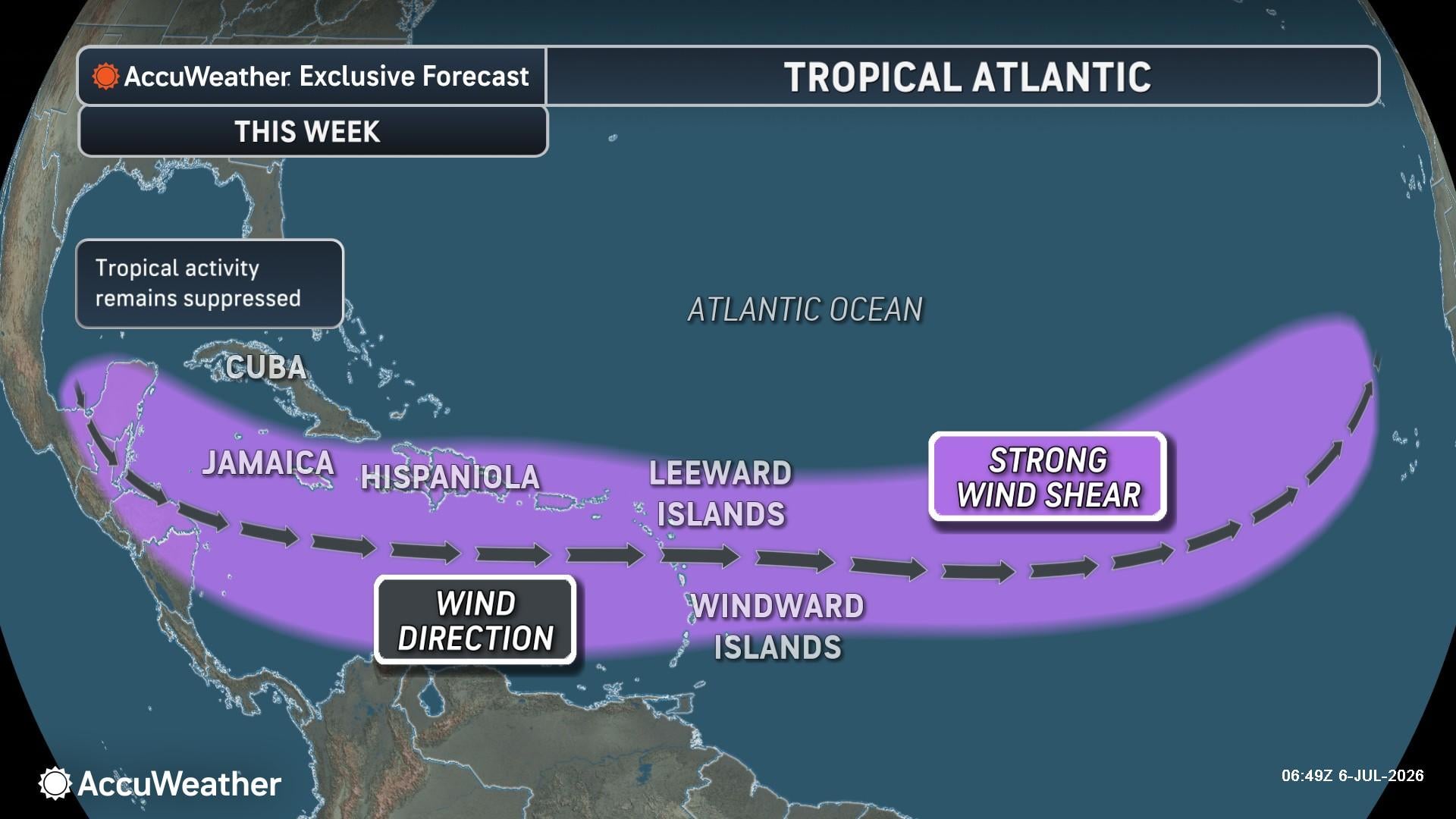
El Niño’s early June arrival and forecasted strength will inhibit tropical development. AccuWeather is forecasting a 70 percent chance that a Super El Niño will develop later during the Hurricane season and last into early 2027. El Niño generates more frequent periods of wind shear across the Atlantic Basin, which helps to prevent tropical systems from organizing and intensifying.
The overall pattern this summer and fall favors a lower-than-average risk of significant tropical impacts on the central and lower Texas coast
Warm Atlantic waters near the U.S. coastline could let storms form and rapidly intensify closer to shore, giving residents less time to prepare than storms that track across the Atlantic from near Africa
Impacts can extend hundreds of miles inland through flooding rain and tornadoes, so residents well away from the coast should also monitor the forecast closely
Tropical Storm Arthur Was the First Named Storm of the Season
Tropical Storm Arthur made landfall in Texas on June 17 and brought extensive flooding across the Gulf Region.
Arthur dumped more than 20 inches of rain in spots, causing an estimated $4-6 billion in total damage and economic loss, according to a preliminary estimate from experts at AccuWeather. Flooding, property and infrastructure damage, hundreds of flight delays, financial losses from extended power outages, and business interruptions contributed to the economic impacts from the storm.
“Arthur is another reminder that tropical systems do not need to reach hurricane strength to cause significant, expensive and even deadly damage and economic losses,” said AccuWeather Vice President of Forecasting Operations Dan DePodwin. “Flooding, travel disruptions, power outages and business interruptions can quickly add up to billions of dollars in impacts for families, businesses and communities.”
AccuWeather RealImpact™ Scale for Hurricanes
In contrast to the Saffir-Simpson Hurricane Wind Scale, which classifies storms by wind speed only, the AccuWeather RealImpact™ Scale is based on a broad range of important factors. In order to better communicate a more comprehensive representation of the potential impact of a storm to lives and livelihoods, the scale covers not only wind speed but also flooding rain, storm surge and economic damage and loss.
Disclaimer
Artificial Intelligence Disclosure & Legal Disclaimer
AI Content Policy.
To provide our readers with timely and comprehensive coverage, South Florida Reporter uses artificial intelligence (AI) to assist in producing certain articles and visual content.
Articles: AI may be used to assist in research, structural drafting, or data analysis. All AI-assisted text is reviewed and edited by our team to ensure accuracy and adherence to our editorial standards.
Images: Any imagery generated or significantly altered by AI is clearly marked with a disclaimer or watermark to distinguish it from traditional photography or editorial illustrations.
General Disclaimer
The information contained in South Florida Reporter is for general information purposes only.
South Florida Reporter assumes no responsibility for errors or omissions in the contents of the Service. In no event shall South Florida Reporter be liable for any special, direct, indirect, consequential, or incidental damages or any damages whatsoever, whether in an action of contract, negligence or other tort, arising out of or in connection with the use of the Service or the contents of the Service.
The Company reserves the right to make additions, deletions, or modifications to the contents of the Service at any time without prior notice. The Company does not warrant that the Service is free of viruses or other harmful components.