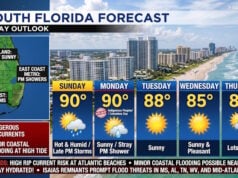
It is the last week of August, the stretch of the calendar when South Florida usually starts watching the tropics in earnest, and the Atlantic is doing almost nothing. Two named storms so far this year, both of them tropical storms, both in the Gulf, neither of them close to here. No hurricanes at all.
If you run trucks in Miami-Dade, Broward or Palm Beach, that quiet is the part worth thinking about.
What the forecast actually says
NOAA’s August update was another step down. Forecasters now expect seven to 13 named storms for the full season, of which two to six could reach hurricane strength, including zero to two major hurricanes. The agency put the odds of a below-normal season at 75%, up from 55% in the May outlook. A strong El Niño is the main reason, since it drives wind shear across the tropical Atlantic and makes it harder for storms to organize.
Those numbers include Arthur and Bertha, which already came and went. An average season produces 14 named storms and three major hurricanes, so this is a genuinely slow year by any measure.

Here is the part that does not change. Mid-August through mid-October accounts for the overwhelming majority of Atlantic major hurricane activity, and the climatological peak lands around September 10. The season being quiet through August tells you very little about the next seven weeks. It takes exactly one storm to find South Florida, and a below-normal season has never protected anybody from the one that shows up.
Quiet seasons are when preparation decays
Households in this region are generally good at this. Shutters get checked, supplies get bought, and plenty of people were already clearing yard debris and dealing with the property side of storm prep months ago. That habit is deeply built into life here.
Business continuity plans are a different story, and the ones covering vehicles are usually the thinnest of the lot.
A plan that never gets used is a plan nobody has audited. The phone numbers go stale. The person who knew the process left in March. The vendor who was going to prioritize your equipment has been bought by somebody else. None of that surfaces during a calm August. It surfaces at 6 a.m. on the second day after landfall, when a delivery van is dead in a parking lot in Hialeah and the fleet contact list is three years old.
South Florida runs on wheels more than most places
This is a region built around moving things. PortMiami and Port Everglades both feed enormous volumes of cargo into a metro area with limited north-south road capacity and no realistic alternative to I-95 and the Turnpike. Miami International handles more international freight than any other airport in the country. A very large share of the fresh produce that reaches American grocery stores from Latin America comes through here first.
Beyond the ports, the everyday economy sits on top of small commercial fleets. Food distributors, beverage wholesalers, medical supply couriers, pharmacy delivery, building suppliers, fuel haulers, waste contractors, landscaping crews. Most of them run somewhere between five and fifty vehicles. Most of them don’t think of their trucks as critical infrastructure until something goes wrong.
A storm creates three distinct operational problems for those businesses, and they do not all occur at the same time.
Before. Demand spikes hard in the 72 hours ahead of landfall. Grocery restocking, water, fuel, plywood, generators. Your fleet runs more miles in three days than it usually does in a week, often with drivers working longer than normal, in traffic that gets worse by the hour.
During. Everything stops. Vehicles need to be somewhere they will not flood, drivers need to be home, and the question of where each asset is parked turns out to matter enormously.
After. This is the phase most plans underestimate. Roads are damaged and partly closed. Traffic signals are out. Debris is everywhere. Fuel is scarce and the stations that have it have long lines. Restocking demand is at its highest point of the year. And your equipment has just been through the hardest week it will face all year.
The two questions that decide how the week goes
Talk to anyone who has run a fleet through a Florida storm and the same two problems come up.
Where is everything, and who is legally able to drive?
That sounds basic until you try to answer it during a power outage with a partly unreachable staff. Which trucks are where. Which ones are in a flood zone. Which drivers are already at or near their hours limits after three days of surge work. Which units still have fuel. When a governor or FMCSA issues an emergency declaration, carriers providing direct assistance can receive temporary relief from certain federal rules including hours of service, but that relief is conditional and time-limited, and it does not cover every kind of trip. Knowing exactly where your drivers stand on the clock is what lets you use that relief properly instead of guessing.
The eld fleet management systems that handle routine hours-of-service logging turn out to be the fastest way to answer all of those questions at once, because the data is already being collected. A fleet with live location and duty-status visibility can make decisions in ten minutes that would otherwise take a day of phone calls. A fleet without it is reconstructing its own position from memory at the exact moment that is hardest to do.
What happens when something breaks?
Storm weeks are hard on equipment in ways that compound. Extended running in extreme heat. Standing water, which is worse for brakes and electrical systems than most operators assume. Debris on the road, which means tire damage. Overloaded vehicles. Drivers who are exhausted. Then add the fact that every shop in the region is dealing with the same surge at the same time, many of them with power problems of their own, while the local recovery and towing capacity gets absorbed by emergency work.
The businesses that come through this well are usually the ones that arranged coverage before the season started rather than making calls afterward. That means having a semi truck roadside assistance arrangement in place that works outside your home market and outside business hours, with pricing agreed in advance so nobody is negotiating an emergency rate at midnight with a vehicle full of perishable freight.
What is worth doing in the next two weeks
None of this requires a large budget. Most of it is an afternoon of administrative work that keeps getting pushed back because the sky is clear.
Test the contact list. Actually call the numbers. Vendors, drivers, the towing provider, the shop. Find out now which ones are dead.
Decide where vehicles go. Not the general idea of higher ground, but named locations, agreed in advance, that you know will not flood and that somebody has keys to.
Confirm your service coverage in writing. Ask your provider directly what happens if you need help during a declared emergency, whether you have any priority, and what the pricing looks like. Ambiguous answers now become expensive answers later.
Move up any preventive maintenance due in September or October. Brakes, tires, batteries, cooling systems. Doing it in a calm week costs a fraction of what it costs during a regional surge.
Write down who can authorize a repair. If a driver is stuck at 11 p.m. and the owner is unreachable, somebody needs the authority to spend money. Decide who and set a dollar threshold.
Check your fuel position. Both what is in the tanks and where you can realistically get more when half the region’s stations are dry.
The season is not over
South Florida has had an easy summer, and there is a reasonable chance that holds. A below-normal forecast is genuinely good news and nobody should talk themselves into dread over it.
But the forecast describes a season, and businesses experience storms one at a time. Homestead in 1992 came during a year with seven named storms in total. The count was never the thing that mattered.
The advantage of a quiet August is that it hands you time you would not otherwise have. The businesses that spend a little of it now, while nothing is happening, are the ones that spend the week after a storm delivering to their customers rather than trying to find a working phone number.
Disclaimer
Artificial Intelligence Disclosure & Legal Disclaimer
AI Content Policy.
To provide our readers with timely and comprehensive coverage, South Florida Reporter uses artificial intelligence (AI) to assist in producing certain articles and visual content.
Articles: AI may be used to assist in research, structural drafting, or data analysis. All AI-assisted text is reviewed and edited by our team to ensure accuracy and adherence to our editorial standards.
Images: Any imagery generated or significantly altered by AI is clearly marked with a disclaimer or watermark to distinguish it from traditional photography or editorial illustrations.
General Disclaimer
The information contained in South Florida Reporter is for general information purposes only.
South Florida Reporter assumes no responsibility for errors or omissions in the contents of the Service. In no event shall South Florida Reporter be liable for any special, direct, indirect, consequential, or incidental damages or any damages whatsoever, whether in an action of contract, negligence or other tort, arising out of or in connection with the use of the Service or the contents of the Service.
The Company reserves the right to make additions, deletions, or modifications to the contents of the Service at any time without prior notice. The Company does not warrant that the Service is free of viruses or other harmful components.