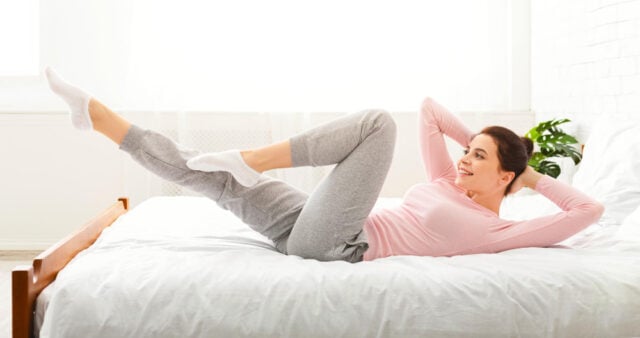
- A 10-minute lying-down routine improved balance, agility, and flexibility in just two weeks.
- Participants saw coordination benefits without strength or power-related performance improvements.
- Researchers say low-intensity supine exercises may support mobility, especially for older adults.
A new study suggests that just 10 minutes of exercises performed entirely while lying down may improve balance, agility, and flexibility in as little as two weeks.
Published in PLOS One by researchers from the Tokyo University of Agriculture and Technology, the study found that a low-intensity supine (horizontal) exercise routine improved participants’ postural control and side-to-side movement ability—without gym equipment, high-impact training, or even standing up.
Though the participants were mostly young, healthy adults, the findings may have broader implications for older adults and others at higher risk of falls. According to the Centers for Disease Control and Prevention (CDC), more than one in four adults over 65 falls each year.

A Simple, Lying-Down Workout Routine
Study participants followed a 10-minute exercise routine once a day for two weeks. The four exercises were designed to help the core and legs work together more efficiently.
The moves, outlined below, were meant to be low-intensity and performed entirely in a lying-down position.
Exercise 1:
:max_bytes(150000):strip_icc():format(webp)/journal.pone.0345749.g002-1b2776b43bf2433b92b85ce82e435b4e.PNG)
For this move, participants flexed their knee joints, placed their hands on their abs, and lightly compressed while contracting their abdominal muscles against the pressure for five seconds. They repeated the movement with their hands placed in different areas across the abdomen, three times each.
Exercise 2:
:max_bytes(150000):strip_icc():format(webp)/journal.pone.0345749.g0021-50def072842e4906b7d9c649d29fde74.PNG)
Similar to a bridge, this move had participants flex their knee joints, with their hands placed on their abdomen. While contracting their abdomen, they pushed their pelvis up into a bridge, keeping the position for five seconds and then relaxing back to the floor. They did this move 10 times.
Exercise 3:
:max_bytes(150000):strip_icc():format(webp)/journal.pone.0345749.g0022-5b4a4edafd9842808eea13dce5b2df77.PNG)
Participants started in a supine position for this move, with both legs extended. They flexed one knee to 90 degrees with the sole of their foot on the floor. While maintaining a flexed toe, they extended their hip and knee joints while slightly scraping their heels on the floor. With the knees fully extended, participants held the position for five seconds by pushing their heels out. They repeated the sequence three more times.
Exercise 4:
:max_bytes(150000):strip_icc():format(webp)/journal.pone.0345749.g0023-6c98059e5f5441058f1ceb42180cced9.PNG)
Participants mimicked “rock-paper-scissors” movements with their toes—clenching, spreading, and independently moving the big toe—to improve foot coordination and control.. They did this five times on each foot, one foot at a time.
What Improved, and What Didn’t
The exercises seemed to help with:
- Balance and posture: Participants swayed less while standing still.
- Agility and coordinated movement: They performed better on side-step movement tests.
- Flexibility: Sitting trunk flexion improved.
Though these improvements may not seem like a lot, experts say that maintaining balance and coordination throughout your life is essential. “Being able to maintain good posture, balance, and coordination is important because it indicates someone can move their body in space with control,” Jason Machowsky, RD, CSCS, an exercise physiologist and board-certified sports dietitian, who was not affiliated with the study, told Health.
But while participants quickly saw balance and coordination benefits, they did not show considerable improvements in strength, or power-related performance. “If they were also training higher intensity, movement with better alignment, then they might have gotten better outcomes on those activities,” said Machowsky.
The study also had some limitations. The research period lasted for two weeks, which isn’t a long time to examine the effects of the workout routine. Additionally, because study participants were mostly healthy and young, their improvements may have been easier to achieve because they were already in relatively good physical condition.
“The next important step is to examine whether similar effects are seen in people of different ages, physical conditions, or clinical populations,” study co-author Tomoaki Atomi, PT, PhD, a physical therapist and researcher at Kyorin University, told Health. “That broader application is where we see major future value.”
What the New Research Means for You
Experts say most people—particularly older adults, or those with disabilities or in rehabilitation—could benefit from a lying-down exercise routine, like the one above. However, it’s best to ask your clinician before beginning a new workout program.
“Anyone interested in increasing core, pelvic, and lower limb or foot muscle awareness could benefit from this type of routine,” said Machowsky. “For some individuals, it may be as simple as improving balance and trunk mobility—a.k.a., it’s hard to bend over.”
Ultimately, short, gentle routines can improve your coordination and may help support mobility and movement control. “This kind of movement awareness and mobility is a different kind of type of fitness beyond the standard ones we think of, like strength and endurance,” said Machowsky, “but it can play a supportive role in overall body capacity, resilience, and recovery.”
Disclaimer
Artificial Intelligence Disclosure & Legal Disclaimer
AI Content Policy.
To provide our readers with timely and comprehensive coverage, South Florida Reporter uses artificial intelligence (AI) to assist in producing certain articles and visual content.
Articles: AI may be used to assist in research, structural drafting, or data analysis. All AI-assisted text is reviewed and edited by our team to ensure accuracy and adherence to our editorial standards.
Images: Any imagery generated or significantly altered by AI is clearly marked with a disclaimer or watermark to distinguish it from traditional photography or editorial illustrations.
General Disclaimer
The information contained in South Florida Reporter is for general information purposes only.
South Florida Reporter assumes no responsibility for errors or omissions in the contents of the Service. In no event shall South Florida Reporter be liable for any special, direct, indirect, consequential, or incidental damages or any damages whatsoever, whether in an action of contract, negligence or other tort, arising out of or in connection with the use of the Service or the contents of the Service.
The Company reserves the right to make additions, deletions, or modifications to the contents of the Service at any time without prior notice. The Company does not warrant that the Service is free of viruses or other harmful components.