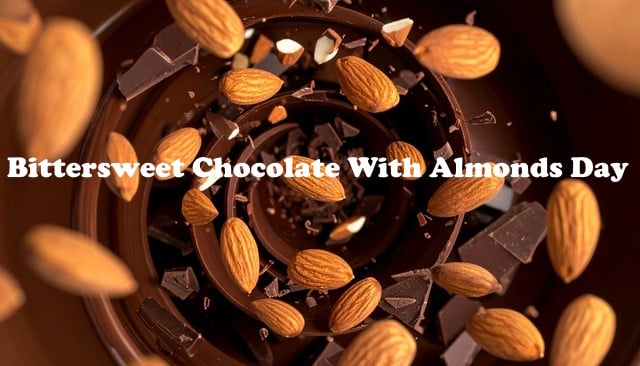
National Bittersweet Chocolate with Almonds Day celebrates the sumptuous combination of chocolate and almonds. Nearly 40% of all the world’s almonds end up in some form of chocolate, most often a candy bar. The pairing is one of the oldest known chocolate recipes.
- 1742 – Eliza Smith included the only chocolate recipe in her cookbook, The Compleat Housewife, printed by William Parks. The simple recipe combined grated chocolate, orange flower water, and sugar. But, no almonds.
- 1830 – J.S. Fry and Sons, a British chocolate maker, devised a way to turn cocoa into a solid bar.
- 1853 – The cocoa tariff is lifted, making chocolate accessible to more than just the upper class.
- 1920 – Hershey’s Mounds bar, made with almonds, coconut, and dark chocolate, hits the shelves.
- 1925 – The U.S. Cocoa Exchange opened in New York City to facilitate cocoa transactions.
- 1938 – The federal government, recognizing chocolate’s nutritional value, added it to the meal rations for U.S. troops.
- Bittersweet chocolate is chocolate liquor with sugar, cocoa butter, and vanilla added. It has less sugar and more liquor than semisweet chocolate.
- Chocolate manufacturers use 40% of the world’s almonds.
- It takes 1000 pounds of almonds to make 1 pint of almond oil.
- The world’s largest almond factory is in Sacramento, California. It processes 2 million pounds of almonds a day.
- Ancient Mesoamericans used roasted, crushed cacao beans to treat sicknesses and even kidney stones. Because of dark chocolate’s health benefits, they used it to treat a wide variety of illnesses. Even before scientists understood the specific health benefits, the wealthy in ancient times did.
- Historians agree that almonds were one of the earliest cultivated foods.
- Almonds are mentioned as far back in history as the Bible. They were a prized ingredient in bread served to Egypt’s pharaohs.
- The almond is botanically a stone fruit related to the cherry, plum, peach, and apricot.
- In America, bittersweet chocolate starts around 70% or more of cacao. Higher cacao percentages lower the sugar in your chocolate but usually raise the amount of cocoa butter used. This cacao-to-sugar ratio determines whether it is bittersweet, semi-sweet, or sweetened.
- Almonds help slow carb and sugar absorption.
- In the U.S., almonds were the first food to be awarded a qualified health claim.
- Chocolate syrup was used for blood in the famous 45-second shower scene in Alfred Hitchcock’s movie, “Psycho” which actually took 7 days to shoot.
- There are about 5 to 10 milligrams of caffeine in one ounce of bittersweet chocolate, 5 milligrams in milk chocolate, and 10 milligrams in a six-ounce cup of cocoa; by contrast, an eight-ounce cup of brewed coffee has 100 to 150 milligrams of caffeine. For example, you would have to eat more than a dozen chocolate bars to get the amount of caffeine in one cup of coffee.
- The antioxidants in dark chocolate, combined with the vitamins and proteins in almonds, offer a snack that can help reduce cardiovascular disease.
- A single chocolate chip provides enough energy for an adult to walk 150 feet; therefore, it would take about 35 chocolate chips to go a mile, or 875,000 for an around-the-world hike.
- One click of a mouse burns 0.0000024 kcals of energy, so to burn off a chocolate bar, you’d need to click your mouse 765,551,000 times.
- It takes 400 cocoa beans to make one pound of chocolate.
- Each cacao tree produces approximately 2,500 beans.
- Chocolate comes from a fruit tree; it’s made from a seed.
- Almonds are members of the rose family and are sometimes called “the queen of the rose family.”
- Benjamin Franklin sold chocolate in his print shop in Philadelphia.
- Almonds offer extensive health benefits and are often used to relieve constipation, respiratory disorders, coughs, heart disorders, anemia, impotence, and diabetes. They also help maintain healthy hair, skin, and dental health.
- Almond growers rent 1.2 to 2 million bees for pollination.
- One chocolate chip can provide an average-sized adult enough energy to walk over 100 feet.
Sources:

Mobile-Cuisine
Disclaimer
Artificial Intelligence Disclosure & Legal Disclaimer
AI Content Policy.
To provide our readers with timely and comprehensive coverage, South Florida Reporter uses artificial intelligence (AI) to assist in producing certain articles and visual content.
Articles: AI may be used to assist in research, structural drafting, or data analysis. All AI-assisted text is reviewed and edited by our team to ensure accuracy and adherence to our editorial standards.
Images: Any imagery generated or significantly altered by AI is clearly marked with a disclaimer or watermark to distinguish it from traditional photography or editorial illustrations.
General Disclaimer
The information contained in South Florida Reporter is for general information purposes only.
South Florida Reporter assumes no responsibility for errors or omissions in the contents of the Service. In no event shall South Florida Reporter be liable for any special, direct, indirect, consequential, or incidental damages or any damages whatsoever, whether in an action of contract, negligence or other tort, arising out of or in connection with the use of the Service or the contents of the Service.
The Company reserves the right to make additions, deletions, or modifications to the contents of the Service at any time without prior notice. The Company does not warrant that the Service is free of viruses or other harmful components.