Written by Amy McLean — Fact checked by Jill Seladi-Schulman, Ph.D.
- A recent review has explored whether pistachios could help support sleep, but the evidence remains uncertain.
- Pistachios contain tryptophan and phytomelatonin, though it is unclear whether the amounts in a typical serving would be enough to enhance sleep.
- Randomized controlled trials are necessary to determine whether pistachios can improve sleep quality or duration.
Researchers regularly examine the effect of diet on sleep, as certain foods can directly impact sleep quality and help regulate the sleep-wake cycle.
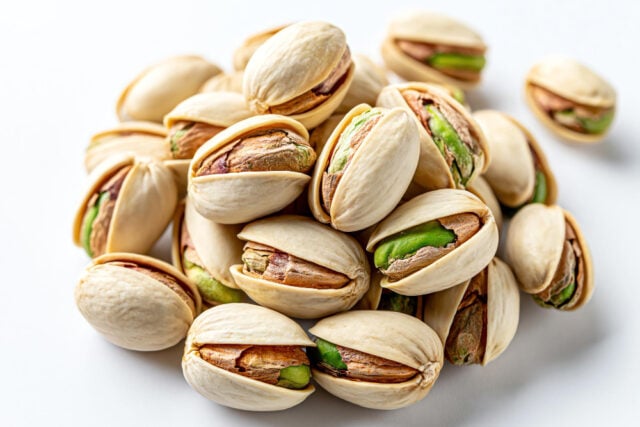
Pistachios are a source of tryptophan, an essential amino acid that plays a role in the production of the neurotransmitter serotonin as well as melatonin, a hormone that helps regulate sleep.
A recent review, published in September in Nutrition Research Reviews and funded by the American Pistachio Growers and the National Institutes of Health (NIH), explored whether tryptophan, phytomelatonin, and other components of pistachios could be beneficial for people looking to support sleep.

“Pistachios are compelling for sleep research because they bring together several nutrients and plant compounds connected to sleep physiology within one whole food,” said Marie-Pierre St-Onge, PhD, senior review author and director of the Center of Excellence for Sleep and Circadian Research at Columbia University Irving Medical Center, in the press release.
“Rather than focusing on a single ‘sleep nutrient,’ this review provides a rationale for studying how the complete pistachio food matrix may affect sleep-related pathways,” St-Onge added.
The researchers found that pistachios may influence several biological processes relevant to sleep, though they also highlight that randomized controlled trials are necessary to better determine the potential relationship between pistachio consumption and sleep outcomes.
Can the tryptophan in pistachios help with sleep?
The researchers describe pistachios as a “good-to-excellent source” of tryptophan, depending on the weight. They say that a 28.3-gram (g) serving contains 71 milligrams (mg) of tryptophan.
However, it is unclear whether this amount would be conducive to improved sleep.
Other components in pistachios, such as magnesium and vitamin B6, help convert tryptophan into serotonin and melatonin. However, again, it is not clear whether the amounts present in a serving will make any discernible difference in sleep quality.
Sebnem Unluisler, MSc, genetic engineer at the London Regenerative Institute, spoke with Medical News Today about pistachios as a source of tryptophan.
“A 28 g serving [of pistachios] provides about 71 mg of tryptophan, a precursor to serotonin and melatonin, along with vitamin B6 and magnesium, which support neurotransmitter synthesis and neurological function,” Unluisler, who was not involved in the review, explained.
“However, compared with foods such as turkey, eggs, or pumpkin seeds, pistachios are not an exceptionally concentrated source of tryptophan. More importantly, dietary intake does not directly translate into increased melatonin production, as absorption, metabolism, and transport across the blood-brain barrier all influence its biological effects,” she added.
Can the melatonin in pistachios help with sleep?
The reviewers examined whether phytomelatonin, a plant-derived source of melatonin, in pistachios could serve as a natural sleep aid.
According to the review, pistachios can contain anywhere from 0.074 micrograms (mcg) to 18.7 mcg of phytomelatonin per serving.
Many people take melatonin supplements to help with sleep, with one review suggesting that up to 5 to 6 mg of melatonin in supplements may be a safe daily dose.
In general, however, the optimal melatonin dosage for sleep support is unclear and not standardized. Furthermore, as the phytomelatonin content in pistachios is uncertain or variable, it is unclear whether they can help support sleep.
Unluisler suggested that the “potential benefits [of pistachios] may therefore come from the combined effects of nutrients, polyphenols, and gut microbiome interactions rather than melatonin alone.”
Does the timing or amount of pistachios matter for improved sleep?
The review does not establish the amount of pistachios a person would need to eat in order to experience potential sleep benefits, nor does it determine whether it would be necessary to eat them regularly.
While people typically take melatonin supplements a few hours before bed, there is currently no evidence to suggest that eating pistachios in the same timeframe would have the same effect.
What are the next steps?
While some of the findings in the review about the properties of pistachios are promising, further research is necessary to determine their potential benefits for people with sleep problems.
According to the press release, American Pistachio Growers is already supporting multiple university-led human clinical studies that will further explore the possible link between pistachios and sleep quality.
“Well-designed human trials can help us determine whether the unique combination of nutrients and bioactive compounds in the pistachio food matrix produces measurable changes in melatonin, sleep quality, sleep duration, or other sleep outcomes,” said St-Onge.
Unluisler explained that “[p]istachios may be a valuable component of a sleep-supportive dietary pattern, but the evidence does not yet justify recommending them as a specific intervention for insomnia or poor sleep quality.”
If a person has concerns about their sleep quality, a medical professional can provide information about ways to improve sleep hygiene or manage conditions such as insomnia.
A registered dietitian can help create a suitable eating plan based on individual needs that may best support sleep.
Disclaimer
Artificial Intelligence Disclosure & Legal Disclaimer
AI Content Policy.
To provide our readers with timely and comprehensive coverage, South Florida Reporter uses artificial intelligence (AI) to assist in producing certain articles and visual content.
Articles: AI may be used to assist in research, structural drafting, or data analysis. All AI-assisted text is reviewed and edited by our team to ensure accuracy and adherence to our editorial standards.
Images: Any imagery generated or significantly altered by AI is clearly marked with a disclaimer or watermark to distinguish it from traditional photography or editorial illustrations.
General Disclaimer
The information contained in South Florida Reporter is for general information purposes only.
South Florida Reporter assumes no responsibility for errors or omissions in the contents of the Service. In no event shall South Florida Reporter be liable for any special, direct, indirect, consequential, or incidental damages or any damages whatsoever, whether in an action of contract, negligence or other tort, arising out of or in connection with the use of the Service or the contents of the Service.
The Company reserves the right to make additions, deletions, or modifications to the contents of the Service at any time without prior notice. The Company does not warrant that the Service is free of viruses or other harmful components.