It almost always starts on an ordinary day. A grandfather at the dinner table, a mom folding laundry, a husband watching the game. Then, without warning, they collapse. In the next two minutes, before anyone has even finished dialing, the outcome is largely decided. Not by a doctor, not by a paramedic, but by whoever is standing in that room. That’s the uncomfortable truth behind why CPR certification matters so much more than most families realize.
Here’s the question worth sitting with. If someone you love dropped right now, would you know what to do with your hands? For most Americans, the honest answer is no. And that’s a problem we can actually fix.
Why Do the First Two Minutes Matter So Much?
When someone’s heart stops, it stops pumping blood to the brain. Brain cells begin to die within minutes. This is why cardiac arrest is a race against the clock unlike almost any other emergency.
The average ambulance takes several minutes to arrive, and in rural areas or heavy traffic, longer. During that wait, a person in cardiac arrest has no heartbeat and no oxygen reaching their brain. Every minute without help sends their chances falling.

That gap, between the moment of collapse and the moment professionals arrive, is where survival is won or lost. And the only person who can fill it is the bystander. You don’t have to be a hero or a medic. You just have to be willing to put your hands on someone’s chest and push.
How Often Does This Really Happen?
More often than most people want to believe. In the United States, more than 350,000 cardiac arrests happen outside of a hospital every year. That’s not a distant statistic. It’s hundreds of thousands of families, every year, facing the worst day of their lives.
And here’s the detail that should change how we all think about this: about 73 percent of these arrests happen at home. Not at a stadium, not at the office, but in the kitchen, the bedroom, the living room. Which means the life you’re most likely to save with CPR is someone you love.
Yet survival remains low, at roughly 9 percent nationwide. The single biggest reason isn’t a lack of hospitals or technology. It’s that too often, nobody nearby knew what to do, or froze when it counted.
What Is the Chain of Survival?
Experts describe surviving cardiac arrest as a chain of linked actions. Break any link, and the chances fall. Hold them together, and people live.
- Recognize and call. Spot the collapse, check for normal breathing, and call 911 right away.
- Start CPR. Begin chest compressions immediately to keep blood flowing to the brain.
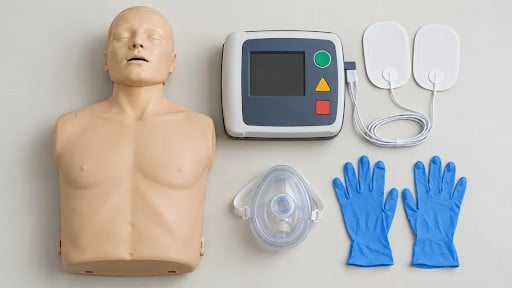
- Use an AED. Grab the nearest automated defibrillator and follow its voice prompts.
- Advanced care. Hand off to paramedics and the hospital team.
The first three links don’t require a medical degree. They require ordinary people who’ve had a few hours of training. When a bystander starts CPR immediately, it can double or even triple a person’s chance of survival. Few things in medicine give a regular person that much power.
What Does CPR Actually Involve?
A lot of people avoid learning because they picture something complicated or fear doing it wrong. The reality is far simpler than the movies suggest.
For an untrained bystander, the guidance is beautifully blunt: hands-only CPR. If you see a teen or adult suddenly collapse and they’re not breathing normally, call 911 and push hard and fast in the center of the chest. Aim for about 100 to 120 pushes a minute, each at least two inches deep, and let the chest rise fully between compressions. That’s it. No mouth-to-mouth needed.
Trained rescuers learn more, including the 30:2 rhythm of compressions and breaths, and how to adjust their technique for children and infants, whose small bodies need a gentler touch. A proper course lets you practice all of this on a manikin until the movements feel natural, so your hands know what to do even if your mind goes blank in the moment.
The common fear of “pushing too hard” or “breaking a rib” stops many people from acting. Instructors address this head-on. A cracked rib heals. A person without CPR often doesn’t. Doing something, even imperfectly, beats doing nothing every time.
Should I Really Learn to Use an AED?
Yes, and it’s easier than you think. Automated external defibrillators are now mounted in schools, malls, gyms, airports, and offices across the country. They look intimidating, but they’re engineered for panic.
When you open one, it talks you through every step in a calm voice. It reads the person’s heart rhythm automatically and only permits a shock if the heart actually needs one. You truly cannot hurt someone by trying. Pairing fast CPR with an AED is one of the most effective things any bystander can do, and knowing where to find one and how to switch it on takes the fear out of the moment.
Here’s a habit worth building: the next time you walk into a gym, a school, an office, or a shopping center, take two seconds to notice where the AED is mounted. That small act of awareness could save precious seconds someday. In an emergency, the person who already knows where the device lives is the one who gets it onto the patient’s chest fastest.
What About the Rest of the Family?
CPR tends to get the spotlight, but a full course covers the everyday scares that are far more common in a household. A toddler who swallows a grape and starts choking. A teenager with a deep kitchen cut. A grandparent showing the early signs of a stroke. An allergic reaction at a cookout.
Each of these has a clear, teachable response, and learning them together as a family turns an ordinary afternoon into real protection. Choking relief, bleeding control, and recognizing when something is a true emergency are skills that pay off far more often than people expect. When everyone in the home knows the basics, no single person has to carry the whole weight of a crisis alone.
There’s also a quiet confidence that comes with this knowledge. Parents who’ve trained describe feeling less anxious day to day, because the worst-case scenario no longer feels like a total unknown. You’ve practiced. You have a plan. That calm is a gift to your whole family.
Why Do Families Put This Off?
Life is busy. Classes feel like a hassle. And deep down, many of us assume cardiac arrest is something that happens to other people. But the numbers tell a different story, and the setting is usually our own home.
The good news is that getting trained no longer demands a full day in a stuffy classroom. Blended learning has changed that. You complete the theory portion online, at your own pace, maybe over a couple of evenings. Then you come in for one short in-person session to practice the physical skills on equipment with an instructor at your side.
Courses are built for real families and workplaces, covering Standard First Aid, CPR/AED Level C for adults, children, and infants, and BLS for those in higher-responsibility roles. They follow American Heart Association and American Red Cross guidelines, so the certification you earn is recognized and respected nationwide. If you’ve been meaning to sign up, you can explore schedules and options through Coast2Coast First Aid courses and finally check it off your list.
What’s the One Thing to Take Away?
If you remember nothing else, remember this. The person most likely to save a life with CPR is a regular, untrained family member standing in their own home. Not a professional. You.
A few hours of training is a small investment against the day you’d give anything to be ready. Picture that dinner-table moment again, but this time with you in it, calm and capable, hands already moving while help is on the way. That’s not luck. That’s preparation. And it’s available to any family willing to spend an afternoon learning.
Don’t wait for a wake-up call that comes too late. The two minutes that decide everything are coming for someone, somewhere, today. Make sure the people you love are standing next to someone who knows what to do.
If you are looking for first aid and CPR training near Pacific Coast Highway, Normandie Avenue, the Harbor City neighbourhood near the Port of Los Angeles, or surrounding areas, and you’re in the Long Beach, California area, you may reach out to Coast2Coast First Aid & Safety in that area.
Frequently Asked Questions
Q: Why does bystander CPR matter if an ambulance is already on the way?
A: Because cardiac arrest kills within minutes, and ambulances take time to arrive. During that wait, the person has no blood flowing to their brain. Bystander CPR keeps blood and oxygen moving, and starting it immediately can double or even triple the chance of survival before professionals get there.
Q: I’m scared I’ll do CPR wrong. Is that a reason not to try?
A: No. The biggest mistake is doing nothing. For an untrained person, hands-only CPR, pushing hard and fast in the center of the chest, is exactly the right response. Even imperfect compressions are far better than standing by, and instructors help you build the confidence to act.
Q: Is it true that most cardiac arrests happen at home?
A: Yes. In the United States, about 73 percent of out-of-hospital cardiac arrests happen in the home. That means the person you’re most likely to help with CPR is a family member, which is the strongest reason for ordinary households to learn the skill.
Q: How long does it take to get certified?
A: Not long at all. With blended learning, you finish the theory online on your own schedule, then attend one short in-person session for the hands-on practice. Many people complete the practical portion in a single afternoon, so a busy family can still fit it in.
Q: What will a CPR course actually teach me?
A: You’ll learn to recognize cardiac arrest, call for help, perform chest compressions for adults, children, and infants, use an AED, and respond to common emergencies like choking. Courses follow American Heart Association and American Red Cross guidelines, so your certification is recognized across the country.
Disclaimer
Artificial Intelligence Disclosure & Legal Disclaimer
AI Content Policy.
To provide our readers with timely and comprehensive coverage, South Florida Reporter uses artificial intelligence (AI) to assist in producing certain articles and visual content.
Articles: AI may be used to assist in research, structural drafting, or data analysis. All AI-assisted text is reviewed and edited by our team to ensure accuracy and adherence to our editorial standards.
Images: Any imagery generated or significantly altered by AI is clearly marked with a disclaimer or watermark to distinguish it from traditional photography or editorial illustrations.
General Disclaimer
The information contained in South Florida Reporter is for general information purposes only.
South Florida Reporter assumes no responsibility for errors or omissions in the contents of the Service. In no event shall South Florida Reporter be liable for any special, direct, indirect, consequential, or incidental damages or any damages whatsoever, whether in an action of contract, negligence or other tort, arising out of or in connection with the use of the Service or the contents of the Service.
The Company reserves the right to make additions, deletions, or modifications to the contents of the Service at any time without prior notice. The Company does not warrant that the Service is free of viruses or other harmful components.