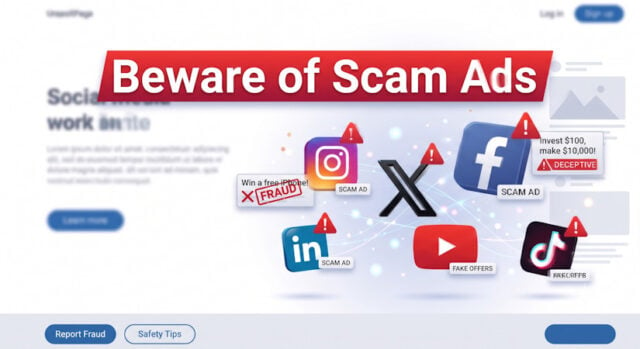
Have you ever scrolled through your feed and spotted a shady advertisement? You are definitely not alone. A vast majority of Americans are worried about online financial fraud. Now, voters are demanding immediate action. A new national survey shows that people want tech companies held legally responsible. The poll was conducted by Fabrizio Ward for the American Bankers Association. Its findings reveal widespread frustration with predatory online promotions.
The study focuses on the Safeguarding Consumers from Advertising Misconduct Act. Lawmakers call this proposal the SCAM Act. This bipartisan legislation targets deceptive promotions across digital networks. It would force platforms to verify advertisers before running their commercials. Companies would also have to swiftly remove confirmed fake promotions. According to the survey, nine in ten voters strongly back this measure. People believe digital platforms enable bad actors by failing to screen them.
Public concern regarding digital theft has reached an all-time high. The poll found that 87% of voters believe online fraud is rising. Nearly three in four voters also fear becoming victims themselves. They also worry about vulnerable family members losing hard-earned savings. “Americans are sending a powerful and unmistakable message,” stated the American Bankers Association. ABA president and CEO Rob Nichols emphasized the urgency. He explained that “social media companies must do more to stop scammers.”
Right now, criminal networks easily buy commercial space on major apps. They create fake storefronts and promote bogus investment schemes. Unsuspecting users click these links and lose substantial amounts of money. The American Bankers Association warned that “consumers, families and businesses are paying the price.” Banks often spot the damage after funds have already vanished. Consequently, financial leaders insist that prevention must start at the source. Social platforms profit from ad revenue and must safeguard their users.

The survey numbers show remarkably unified bipartisan consensus on key safeguards. About 96% of respondents favor requiring platforms to quickly remove scam ads. Another 95% want proactive systems that detect fraud before it reaches consumers. In addition, 94% demand that platforms verify the legitimate identity of advertisers. Finally, 93% support holding tech giants financially liable when they profit from fraud. Voters believe tech firms should face real penalties for negligence.
Rob Nichols reiterated that the public wants common-sense federal legislation enacted now. The American Bankers Association noted that voters favor rules that “verify advertisers.” The group added that platforms must “remove scam ads quickly.” Tech companies must also “take meaningful steps to prevent fraud before it occurs.” Banks spend billions annually fighting fraud and educating everyday account holders. However, financial institutions cannot monitor private digital ad feeds alone.
Closing these loopholes requires shared responsibility across the entire digital ecosystem. When platforms verify who pays for ads, criminals lose their easiest playground. The SCAM Act provides a clear framework to achieve that critical goal. As congressional debate continues, public demand for protection remains undeniable. Stopping fraud requires real teamwork and decisive legislative action. Everyone deserves a safer online experience. Americans want safer feeds and genuine digital accountability today.
Sources Used
- American Bankers Association: https://www.aba.com/about-us/press-room/press-releases/national-survey-voters-overwhelmingly-support-scam-act
Disclaimer
Artificial Intelligence Disclosure & Legal Disclaimer
AI Content Policy.
To provide our readers with timely and comprehensive coverage, South Florida Reporter uses artificial intelligence (AI) to assist in producing certain articles and visual content.
Articles: AI may be used to assist in research, structural drafting, or data analysis. All AI-assisted text is reviewed and edited by our team to ensure accuracy and adherence to our editorial standards.
Images: Any imagery generated or significantly altered by AI is clearly marked with a disclaimer or watermark to distinguish it from traditional photography or editorial illustrations.
General Disclaimer
The information contained in South Florida Reporter is for general information purposes only.
South Florida Reporter assumes no responsibility for errors or omissions in the contents of the Service. In no event shall South Florida Reporter be liable for any special, direct, indirect, consequential, or incidental damages or any damages whatsoever, whether in an action of contract, negligence or other tort, arising out of or in connection with the use of the Service or the contents of the Service.
The Company reserves the right to make additions, deletions, or modifications to the contents of the Service at any time without prior notice. The Company does not warrant that the Service is free of viruses or other harmful components.