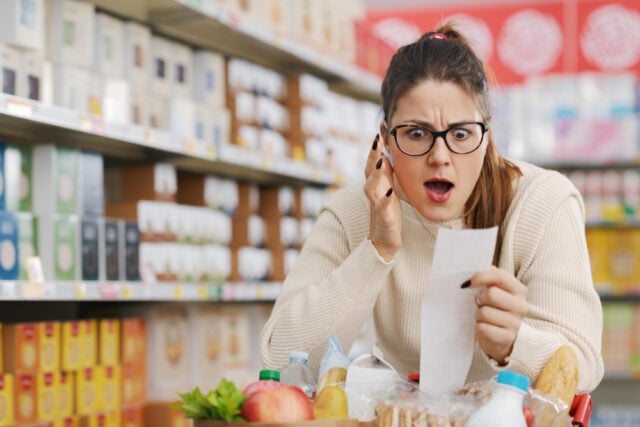
The local grocery store looks completely normal from the outside. Bright lights shine on fully stocked shelves. But underneath the surface, a major economic shift is happening. Shoppers are putting far fewer items into their plastic carts. They are tired of fighting years of steep price hikes.
This budget crunch is changing how everyday families buy food. Now, food suppliers are starting to feel the painful results. For a long time, high grocery inflation hid the true crisis. Overall sales dollars looked healthy because everything cost more. But companies can no longer hide behind inflated price tags.
A recent report by Bain and Company reveals a new phase. Grocery unit sales are dropping fast across the country. Industry data from NielsenIQ confirms this steady decline. In fact, actual grocery volume fell by nearly two percent. This means people are buying fewer boxes and cans. They are leaving the store with lighter bags.
A survey found eighty percent of Americans want to spend less. About half of those consumers are buying fewer items. They are directly buying less food to save their money. According to Circana data, weekly unit sales keep falling.

Why are grocery baskets getting so light these days? Think about the pressure on your own wallet. Grocery prices have jumped over thirty percent since 2019. That is a massive shock for any household budget. Families are also facing much higher gas and utility bills. Recent cuts to federal food assistance programs added more stress. Millions of people lost extra monthly support quite suddenly. Even new weight loss medications are shifting food demand. Patients using these popular drugs buy far fewer groceries. They often significantly cut their total food purchases. All these pressures stack up against the average shopper.
This sharp volume contraction hurts food suppliers very deeply. For many decades, packaged food brands expected steady growth. They assumed people would always buy the same amount. Now, they face an intense battle for market share. Retail giants like Walmart and Target see the strain. They are aggressively slashing prices on thousands of staples. Whole Foods is also expanding its cheaper store brands. These deep retail discounts create a massive profit squeeze. Grocers demand lower wholesale costs from their manufacturing partners. Suppliers must absorb these discounts to keep shelf space.
Meanwhile, production costs for suppliers remain stubbornly high. Labor, raw ingredients, and packaging materials still cost a lot. Distribution fees and fuel charges add extra heavy burdens. Food distributors are also consolidating to gain more market power. This leaves independent food suppliers with much less leverage. At the same time, private label sales are booming. Store brands set brand new revenue records this year. Consumers now view store brands as high quality options. They no longer automatically pay extra for national brands. This shift directly harms name brand processed food companies.
The modern grocery market has officially become a share game. Total volume is shrinking, so companies must fight harder. Food suppliers cannot just rely on price hikes anymore. That old strategy will drive customers away for good. Instead, brands must find ways to offer real value. They need transparent pricing and simpler product options. Investing in smart supply chain technology can also help. Better data tracks inventory and stops costly shipping errors. The suppliers who adapt quickly will survive this squeeze. They will win the few remaining trips to the store.
Ultimately, the grocery slowdown will not disappear overnight. Macroeconomic pressures keep budgets incredibly tight for millions. Food companies must accept this new normal today. True survival requires deep efficiency and extreme adaptability. Brands that put value first will protect their future. They will keep a place on the dinner table.
Sources and Links:
- Bain & Company / NielsenIQ: The US Grocery Slowdown Is Real
- PR Newswire / Bain & Company Analysis: US grocery slowdown enters a new phase as stretched consumers buy less
- McKinsey & Company: The State of Grocery North America 2026
- Grocery Dive / Circana / 210 Analytics: 4 key numbers that highlight the stress grocery consumers are facing
- SPS Commerce: Grocery Supply Chain Issues: 3 Pressures Reshaping 2026
- USDA Economic Research Service: Food Price Outlook – Summary Findings
- Grocery Trade News / U.S. Bureau of Labor Statistics: US Food Inflation Stays Flat in March 2026 CPI Data
- CHOSUNBIZ / The New York Times: US grocers slash prices as food inflation keeps straining shoppers
- Center for American Progress: Stopping Sticker Shock at the Grocery Store: A Plan To Make Food More Affordable
Disclaimer
Artificial Intelligence Disclosure & Legal Disclaimer
AI Content Policy.
To provide our readers with timely and comprehensive coverage, South Florida Reporter uses artificial intelligence (AI) to assist in producing certain articles and visual content.
Articles: AI may be used to assist in research, structural drafting, or data analysis. All AI-assisted text is reviewed and edited by our team to ensure accuracy and adherence to our editorial standards.
Images: Any imagery generated or significantly altered by AI is clearly marked with a disclaimer or watermark to distinguish it from traditional photography or editorial illustrations.
General Disclaimer
The information contained in South Florida Reporter is for general information purposes only.
South Florida Reporter assumes no responsibility for errors or omissions in the contents of the Service. In no event shall South Florida Reporter be liable for any special, direct, indirect, consequential, or incidental damages or any damages whatsoever, whether in an action of contract, negligence or other tort, arising out of or in connection with the use of the Service or the contents of the Service.
The Company reserves the right to make additions, deletions, or modifications to the contents of the Service at any time without prior notice. The Company does not warrant that the Service is free of viruses or other harmful components.