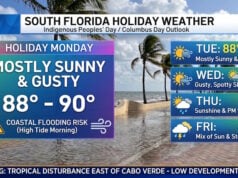
South Florida is deep into the kind of stretch where the forecast barely changes from one day to the next. Highs sit in the mid-90s highs pushing past 100 on the heat index, and meteorologists keep repeating the same advice: stay hydrated, stay in the shade, avoid the worst of the afternoon sun. That advice is aimed at the body. Less often mentioned is what the same stretch of heat does to mood, patience, and sleep, and the research on that connection has gotten harder to ignore.
The Heat and Mood Connection Is Measurable, Not Just Anecdotal
Researchers have spent the past several years trying to pin down exactly how rising temperatures affect mental health, and the findings are consistent enough to matter. Harvard’s T.H. Chan School of Public Health has tracked a body of research showing that psychiatric emergency risk during sustained heat exposure climbs the longer a heat wave drags on, with cumulative hourly temperature increases tied to a higher likelihood of psychiatric emergencies over a 24-hour window. The same research notes that extreme heat events, meaning stretches of 90-degree-plus temperatures lasting several days, have gone from roughly two per year in the 1960s to about ten per year over the past decade, according to EPA tracking cited in that research. South Florida residents do not need a study to tell them summers here have gotten longer and more oppressive, but the data explains why the toll feels different than it used to.
The federal government’s own climate and health researchers have reached similar conclusions. The Centers for Disease Control and Prevention has documented suicide rates that fluctuate with temperature, rising during periods of extreme heat, and points to increased anxiety, irritability, and post-traumatic stress as common reactions when heat waves stretch on for weeks rather than days. People with an existing mental illness face a particular risk, since some psychiatric medications interfere with the body’s ability to regulate its own temperature, which means the physical and psychological effects of heat can compound each other.

Why Heat Feels So Much Like Anxiety
Part of the confusion comes from how similar the physical symptoms are. A racing heart, sweating, dizziness, and trouble concentrating show up in both heat stress and anxiety, and the body does not always distinguish between the two triggers cleanly. Someone who has spent the afternoon outside without enough water might feel irritable, foggy, and on edge, and assume it is stress from work or a bad night’s sleep, when the underlying cause is simpler and more physical.
Recognizing the early symptoms of heat dehydration before they escalate matters here, because catching mild dehydration early and replacing fluids often resolves the mood symptoms along with the physical ones. The overlap is a good reason to rule out the simple explanation first: a glass of water and a few minutes somewhere cool before assuming the irritability is something deeper.
That said, the simple explanation does not always hold. Heat-driven irritability from a single hot afternoon tends to lift once someone cools down and rehydrates. Something that lingers for days, that shows up as trouble sleeping even in an air-conditioned bedroom, or that comes with a flattened mood rather than just short-temperedness, is a different pattern. South Florida’s summer runs roughly six months, from late spring through the end of hurricane season in November, which is a long time for a low-grade stressor to sit on top of everything else going on in someone’s life.
When It Stops Being Seasonal Crankiness
Certain groups carry more of this risk than others. Older adults, people managing chronic health conditions, and anyone already living with depression, anxiety, or a substance use disorder are more vulnerable to both the physical and psychological effects of prolonged heat. For someone already in recovery from addiction, heat-related sleep disruption and the general wear of a long, hot season can chip away at coping strategies that normally hold steady. The CDC’s research specifically flags people managing co-occurring mental health and substance use conditions as facing compounded risk during extended heat, since both the illness and some of the medications used to treat it can interfere with the body’s cooling mechanisms.
Say someone in Fort Lauderdale has been managing anxiety and a drinking habit that started as a way to unwind after work, and July’s heat has made sleep harder, patience shorter, and the drinking a little heavier than it used to be. That combination, a mental health condition and a substance use pattern reinforcing each other, is exactly what dual diagnosis care is built to address, and it does not resolve on its own just because the temperature eventually drops.
The Sylvia Brafman Mental Health Center in Fort Lauderdale runs outpatient programs for co-occurring conditions for adults in exactly that position, treating the mental health piece and the substance use piece together, rather than sending someone to two separate providers who never talk to each other. For Broward County residents whose summer has stopped feeling like ordinary heat fatigue and started looking like something that needs actual treatment, that kind of integrated, outpatient structure is often the more realistic starting point than an inpatient stay, since it does not require putting the rest of life on hold.
What Actually Helps
Most of the standard heat advice doubles as mood advice, which is worth remembering on the days when motivation is low. Staying hydrated, limiting outdoor exposure during peak afternoon hours, and prioritizing sleep in a cool room all reduce the physical stress that feeds irritability and anxiety. Building in actual breaks from the heat, not just tolerating it, matters more in a six-month South Florida summer than it might somewhere with a shorter hot season. Checking in on older neighbors or family members during the worst stretches is not just a physical safety measure; cognitive changes and mood shifts from heat show up in older adults before the more obvious physical symptoms do.
The harder part is telling the difference between a bad week and a pattern that needs more than hydration and a fan. If the irritability, sleeplessness, or low mood is still there after a cooler stretch, if it is affecting work or relationships, or if it is showing up alongside heavier drinking or other substance use, that is worth talking to a doctor or a mental health professional about directly rather than waiting for November. South Florida’s heat is not going anywhere for a while yet, and neither should the willingness to take its effect on mental health seriously.
Disclaimer
Artificial Intelligence Disclosure & Legal Disclaimer
AI Content Policy.
To provide our readers with timely and comprehensive coverage, South Florida Reporter uses artificial intelligence (AI) to assist in producing certain articles and visual content.
Articles: AI may be used to assist in research, structural drafting, or data analysis. All AI-assisted text is reviewed and edited by our team to ensure accuracy and adherence to our editorial standards.
Images: Any imagery generated or significantly altered by AI is clearly marked with a disclaimer or watermark to distinguish it from traditional photography or editorial illustrations.
General Disclaimer
The information contained in South Florida Reporter is for general information purposes only.
South Florida Reporter assumes no responsibility for errors or omissions in the contents of the Service. In no event shall South Florida Reporter be liable for any special, direct, indirect, consequential, or incidental damages or any damages whatsoever, whether in an action of contract, negligence or other tort, arising out of or in connection with the use of the Service or the contents of the Service.
The Company reserves the right to make additions, deletions, or modifications to the contents of the Service at any time without prior notice. The Company does not warrant that the Service is free of viruses or other harmful components.