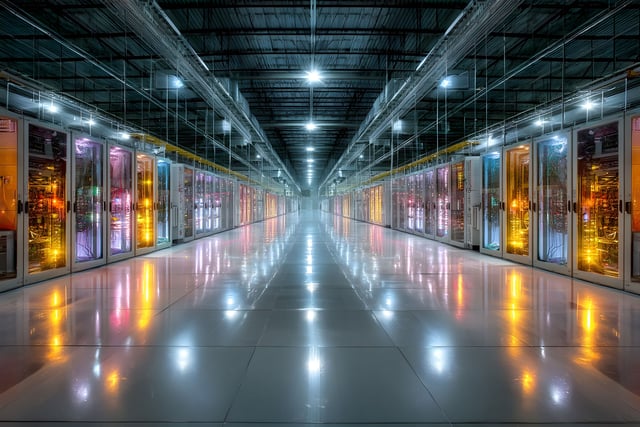
Artificial intelligence has become one of the largest drivers of infrastructure investment in modern history. Across North America, Europe, Asia, and the Middle East, billions of dollars are being invested in hyperscale data centers capable of supporting increasingly sophisticated cloud computing, machine learning, and AI workloads. While the discussion often focuses on computing power, semiconductor technology, and digital transformation, another challenge is emerging just as rapidly: electricity.
Data centers have always required significant amounts of energy, but the scale of today’s projects is fundamentally different. Individual campuses are now being designed with electrical requirements measured in hundreds of megawatts, with some planned developments expected to rival the consumption of medium-sized cities. Utilities, transmission operators, governments, and private industry are all confronting the same question. How can electricity infrastructure expand quickly enough to support unprecedented demand without compromising reliability or affordability for existing customers?
The answer extends far beyond the technology sector.
Every large electricity consumer is beginning to feel the effects of this transformation. Manufacturers, logistics providers, mining operations, commercial real estate portfolios, healthcare systems, universities, airports, and industrial processing facilities all depend on reliable access to electricity. As competition for electrical capacity increases, organizations are recognizing that energy strategy has become an executive-level business issue rather than simply a facilities management responsibility.
Historically, electricity procurement focused primarily on securing competitive pricing and maintaining reliable service. Today, those objectives remain important, but they represent only part of a much broader strategic conversation. Organizations must now consider transmission availability, long-term capacity planning, sustainability commitments, operational flexibility, electrification initiatives, and exposure to increasingly dynamic wholesale market conditions.

This shift is changing the role of organizations that provide strategic energy expertise. Rather than simply responding to market conditions after they occur, leading organizations increasingly work with an energy services company that can interpret market intelligence, evaluate operational risks, and help align energy decisions with broader business objectives.
The emergence of hyperscale computing has accelerated this transition.
Artificial intelligence platforms require enormous computational resources. Training advanced AI models, operating cloud infrastructure, processing real-time analytics, and supporting enterprise digital transformation initiatives all require continuous access to highly reliable electrical power. Unlike many traditional industrial loads, data centers frequently operate around the clock with minimal interruption, creating sustained demand that places additional pressure on existing electrical infrastructure.
Meeting these requirements cannot rely solely on the construction of additional generation facilities. Transmission expansion, substation development, interconnection capacity, battery storage, renewable integration, and demand-side flexibility must all progress simultaneously. In many jurisdictions, the pace of infrastructure development is now struggling to keep up with projected electricity demand.
This imbalance is encouraging organizations to rethink how electricity is consumed rather than focusing exclusively on how to produce additional electricity.
Operational flexibility has become increasingly valuable. Facilities capable of adjusting non-critical processes, optimizing equipment scheduling, or responding to changing market conditions contribute to a more resilient electrical system while often improving their own operational efficiency. Sophisticated energy demand management strategies are allowing large organizations to participate more actively in balancing electricity systems without compromising productivity or long-term growth objectives.
Rather than viewing electricity solely as an unavoidable operating expense, forward-looking organizations are integrating energy performance into broader corporate planning. Financial leaders, sustainability executives, operations teams, and facilities managers are collaborating more closely than ever before as energy considerations begin influencing investment decisions, expansion planning, and enterprise risk management.
The implications extend beyond electricity availability. As utilities invest in transmission infrastructure, generation resources, grid modernization, and digital control systems, organizations are also facing increasing complexity in understanding how energy markets evolve. Long-term business planning now requires greater visibility into consumption trends, infrastructure constraints, regulatory developments, and emerging technologies that could influence future operating costs.
This evolution has significantly increased the value of data. Electricity systems generate vast quantities of operational information every hour, including demand patterns, weather impacts, generation performance, transmission utilization, and system conditions. When analyzed effectively, these datasets allow organizations to move from reactive energy management toward predictive operational planning.
Large enterprises are increasingly investing in analytical capabilities that combine internal operational information with external market intelligence. Rather than making decisions based solely on monthly utility invoices, organizations are evaluating how changing electricity conditions may affect production schedules, facility expansion, capital investment, sustainability targets, and long-term procurement strategies.
The same technologies driving demand growth are also improving decision making. Artificial intelligence, machine learning, and advanced analytics are enabling organizations to identify consumption patterns that were previously difficult to detect. Forecasting models can now anticipate changes in electrical demand with greater precision by incorporating weather forecasts, production schedules, occupancy patterns, historical operating performance, and equipment-level data into a single analytical framework.
This level of intelligence becomes particularly valuable as organizations pursue decarbonization objectives. Electrification remains one of the primary pathways for reducing greenhouse gas emissions across transportation, manufacturing, and commercial operations. However, increased electrification also raises total electricity consumption, requiring careful planning to ensure that sustainability initiatives do not unintentionally create operational constraints or increase exposure to energy market volatility.
For multinational organizations, this challenge is rarely confined to a single country. Manufacturing facilities, distribution centers, office campuses, and digital infrastructure often operate across multiple jurisdictions, each with its own regulatory environment and electricity market structure. While individual market rules differ, the underlying strategic questions remain remarkably consistent. How quickly is electricity demand growing? Where are infrastructure constraints developing? What technologies are improving operational flexibility? How can organizations anticipate future risks rather than simply react to them?
Answering those questions requires access to reliable, high-quality information. Publicly available datasets, including IESO market data, contribute to a broader ecosystem of market intelligence that analysts use to understand demand trends, benchmark system performance, and identify evolving conditions. The specific geography is often less important than the analytical discipline itself. Organizations increasingly benefit from observing how electricity systems worldwide respond to common challenges such as rapid load growth, renewable integration, and infrastructure investment.
One of the most significant changes occurring today is the elevation of energy strategy from an operational function to a competitive differentiator. Decisions regarding facility location, production scheduling, capital investment, and digital transformation increasingly intersect with electricity availability and long-term system resilience. Corporate leadership teams that once viewed energy primarily through the lens of procurement are now considering it within broader discussions of business continuity, operational resilience, financial performance, and sustainable growth.
The organizations that adapt most successfully will likely be those that treat energy intelligence as an ongoing strategic capability rather than an occasional analytical exercise. Investments in forecasting, operational flexibility, data analytics, and informed decision making can provide resilience in an environment where electricity demand is expected to continue rising for years to come.
The global expansion of artificial intelligence and hyperscale computing represents far more than a technology story. It is accelerating a structural shift in how electricity is generated, delivered, and consumed across virtually every major economy. As competition for reliable electrical capacity intensifies, organizations that understand the changing relationship between energy, infrastructure, and business strategy will be better positioned to grow confidently in an increasingly electrified world.
Disclaimer
Artificial Intelligence Disclosure & Legal Disclaimer
AI Content Policy.
To provide our readers with timely and comprehensive coverage, South Florida Reporter uses artificial intelligence (AI) to assist in producing certain articles and visual content.
Articles: AI may be used to assist in research, structural drafting, or data analysis. All AI-assisted text is reviewed and edited by our team to ensure accuracy and adherence to our editorial standards.
Images: Any imagery generated or significantly altered by AI is clearly marked with a disclaimer or watermark to distinguish it from traditional photography or editorial illustrations.
General Disclaimer
The information contained in South Florida Reporter is for general information purposes only.
South Florida Reporter assumes no responsibility for errors or omissions in the contents of the Service. In no event shall South Florida Reporter be liable for any special, direct, indirect, consequential, or incidental damages or any damages whatsoever, whether in an action of contract, negligence or other tort, arising out of or in connection with the use of the Service or the contents of the Service.
The Company reserves the right to make additions, deletions, or modifications to the contents of the Service at any time without prior notice. The Company does not warrant that the Service is free of viruses or other harmful components.