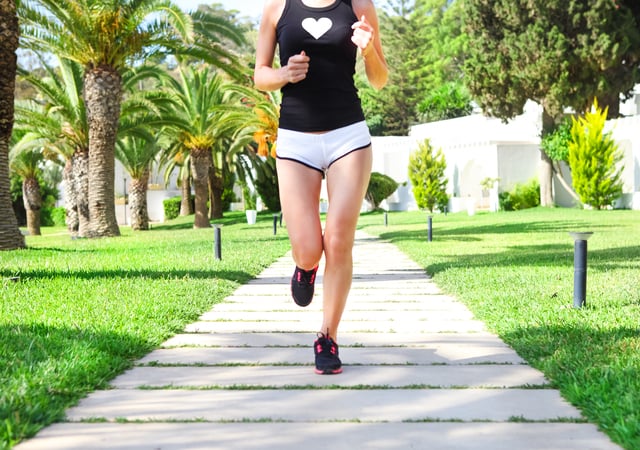
We have all been there. You lace up your sneakers, step out the front door full of optimism, and instantly feel like you have walked straight into a wall of warm, thick soup. Within five minutes, your legs feel like lead, your heart is hammering against your ribs, and you are questioning every life choice that brought you to this moment. When the summer sun sets out to “broil,” the temptation to retreat to an air-conditioned gym treadmill is all too real.
But what if fleeing indoors isn’t your only option? It turns out your body is remarkably adaptable, and facing the climate head-on can unlock some serious physical advantages.
The Biology Behind the Brutality
To survive the summer, it helps to understand why running or cycling in hot weather feels so fundamentally miserable. It isn’t just in your head—it is a complex physiological chess match. When you exercise, your muscles generate a massive amount of internal heat. To keep your core temperature stable, your body has to work overtime to cool itself down.
Your heart suddenly finds itself pulling double duty. It has to pump oxygen-rich blood to your working muscles, but it also has to divert a huge chunk of that blood supply outward to the surface of your skin so heat can radiate away. Because your cardiovascular system is splitting its resources, your muscles receive less fuel, leaving you feeling exhausted far faster than you would on a crisp autumn morning.

To make matters worse, your brain acts as a strict, proactive safety switch. As highlighted by Lifehacker, sports science research shows that our brains actually slow our bodies down from the very start of a hot workout to prevent us from overheating later. Your body is hardwired to put on the brakes before your core temperature reaches a dangerous 104 degrees Fahrenheit, the threshold at which severe heat illness can take hold.
Then, there is the humidity factor. Our most effective cooling mechanism is sweating, but sweat only cools you down if it evaporates off your skin, pulling heat away with it. When the air is already saturated with water vapor, that sweat just sits there.
Why Suffer? The Hidden Superpowers of Heat Adaptation
If hot workouts are such a drag, why bother? Because if you approach it systematically, your body undergoes a beautiful transformation called heat acclimatization.
As the fitness experts at Lifehacker point out: “The human body can acclimate to exercising in the heat, so it may be worth heading outdoors anyway. After a few weeks, these temperatures will be your new normal—and research suggests you may enjoy a small performance boost when the weather cools down again.”
One of the coolest physiological shifts that happens during this process is an increase in your total blood volume—specifically your plasma volume (the liquid part of your blood). Because your body realizes it needs extra fluid to pump to the skin for cooling and to the muscles for fuel, it builds a bigger reservoir. This adaptation expands your cardiovascular capacity so thoroughly that scientists often compare it to a natural, completely legal version of blood doping. When fall arrives and the ambient temperature drops, you will suddenly find yourself running faster and feeling lighter than ever before.
How to Teach Your Body to Tolerate the Heat
You can’t just jump into a midday summer sprint session and expect your body to adapt; you have to coax it along safely. Here are three practical strategies to build your hot-weather tolerance over a two-week period.
Method 1: The Gradual Outdoor Shift
Instead of avoiding the heat, do your normal training outside but dramatically lower your expectations for the first several days. When workers start jobs in high-heat environments, safety organizations like OSHA recommend giving them just 20% of their usual workload on day one, slowly ramping up to 100% over a week. Apply that same kindness to your fitness. Drop your pace, cut your mileage in half, and allow your body 7 to 10 consecutive days of shorter, easier exposures to trigger those biological shifts.
Method 2: Daily Ambient Immersion
If you can’t log all your workouts outside, you can train your thermostat simply by living in the climate. Aim to spend at least two hours out in the heat each day, ensuring that a portion of that time includes light cardiovascular activity, such as walking or casual cycling. This constant, low-stakes exposure teaches your sweat glands to start firing earlier and more efficiently.
Method 3: The Post-Workout Sauna Protocol
What if you live in a place with unpredictable weather, or you truly prefer working out in a chilled gym? You can mimic heat training by stepping into a dry sauna or a hot bath for 15 to 30 minutes immediately after an indoor workout. Because your core temperature is already elevated from your exercise session, the immediate blast of heat forces your body to adapt rapidly, giving you the perks of heat training without requiring you to run under a blazing sun.
A Crucial Note on Maintenance:
Heat adaptations are a “use it or lose it” superpower. If you step away from the heat and hide out in the air conditioning for a week, those hard-earned biological upgrades will begin to fade. Within three weeks, you will lose roughly 75% of your tolerance, meaning you will have to start the acclimation process almost entirely from scratch.
Be smart, listen to your brain when it tells you to ease up, keep a cold water bottle handy, and embrace the sweat. Your future, faster autumn self will thank you.
Sources and Links:
- Lifehacker: How to Get Used to Exercising in the Heat
- National Weather Service / NOAA: Heat Index Chart and Science
Disclaimer
Artificial Intelligence Disclosure & Legal Disclaimer
AI Content Policy.
To provide our readers with timely and comprehensive coverage, South Florida Reporter uses artificial intelligence (AI) to assist in producing certain articles and visual content.
Articles: AI may be used to assist in research, structural drafting, or data analysis. All AI-assisted text is reviewed and edited by our team to ensure accuracy and adherence to our editorial standards.
Images: Any imagery generated or significantly altered by AI is clearly marked with a disclaimer or watermark to distinguish it from traditional photography or editorial illustrations.
General Disclaimer
The information contained in South Florida Reporter is for general information purposes only.
South Florida Reporter assumes no responsibility for errors or omissions in the contents of the Service. In no event shall South Florida Reporter be liable for any special, direct, indirect, consequential, or incidental damages or any damages whatsoever, whether in an action of contract, negligence or other tort, arising out of or in connection with the use of the Service or the contents of the Service.
The Company reserves the right to make additions, deletions, or modifications to the contents of the Service at any time without prior notice. The Company does not warrant that the Service is free of viruses or other harmful components.