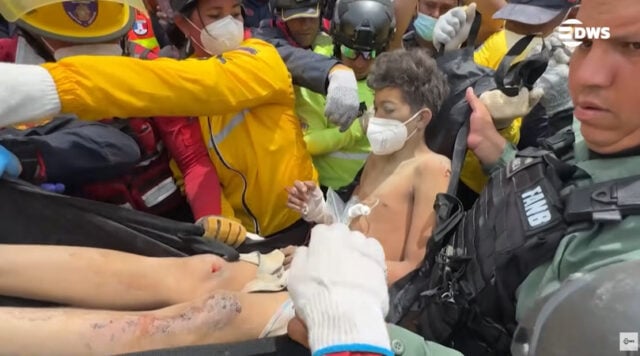
LA GUAIRA, Venezuela — The search for survivors in Venezuela has reached an agonizing tipping point. Four days after back-to-back earthquakes tore through the north-central region of the country, local families and international rescue crews are racing against a closing survival window to pull victims from the remnants of pancaked apartment buildings, shattered storefronts, and collapsed public housing complexes.
On Wednesday, June 24, 2026, the country was hit by a violent seismic sequence: a magnitude 7.2 foreshock followed just 39 seconds later by a catastrophic magnitude 7.5 mainshock. Both tremors were shallow, striking at depths between 10 and 22 kilometers, amplifying the energy sent ripping through the surface. While the epicenters were technically located near Yumare in Yaracuy state, the ripples of destruction spread widely across north-central Venezuela, leaving towns in La Guaira, Carabobo, Aragua, Miranda, and the Capital District of Caracas severely damaged.

As Sunday evening marks the passing of the critical 72-hour mark—the timeline emergency experts designate as the maximum threshold for finding trapped victims alive without water—hope is battling severe structural and logistical chaos.
A Landscape of Ruin and Resilience
The scale of physical devastation left by the twin disasters is staggering. According to a preliminary satellite assessment published by the United Nations Development Programme (UNDP), the earthquakes caused an estimated $6.7 billion in direct physical damage, a figure representing roughly six percent of Venezuela’s gross domestic product. More than 1.7 million structures were located within the severe shaking zones, with approximately 2.1 million people experiencing the strongest, most volatile tremors.
In coastal urban hubs like Catia La Mar and Caraballeda in La Guaira state, whole neighborhoods have been transformed into mountains of pulverized concrete and twisted rebar. Multistory apartment blocks collapsed into dense layers, trapping entire families within pockets of space beneath thousands of tons of debris. Nighttime satellite photography analyzed by the UNDP confirmed widespread power outages across Caracas, Carabobo, and La Guaira, complicating rescue efforts that must now rely on portable spotlights and heavy machinery to operate through the night.
For many local residents, the formal response felt tragically slow in the immediate aftermath of the tragedy. Citing a scarcity of government rescue personnel during the first 48 hours, thousands of everyday citizens took the rescue into their own hands. Armed with nothing more than hammers, crowbars, and power tools, neighbors formed human chains to clear chunks of masonry, listening intently for hollow echoes or faint cries for help beneath the rubble.
In La Guaira, residents like Nazareth Jimenez described the pure horror of watching neighbors attempt to cut through massive concrete slabs to reach her missing siblings, nieces, and nephews. “My God, how are we going to get them out of there?” she said, pleading for heavy industrial machinery to assist. Others, like Yuleidy Cadenas, stood vigil across from a pancaked 12-floor public housing building where her son, mother, and brother were inside. Cadenas had fled barefoot from a neighboring building as it shook, only to find her family’s home entirely flattened. “I got on top of the rubble and told them to yell back, and nobody did,” she recalled.
International Aid Converges on Caracas
Faced with a humanitarian crisis of unprecedented magnitude, acting President Delcy Rodríguez declared a state of emergency and welcomed an influx of foreign assistance. The political backdrop in Venezuela remains complex; Rodríguez took office in January 2026 following the capture and removal of former President Nicolás Maduro by the United States, leaving a country already strained by a decade of economic hardship and infrastructure decay. The earthquake has amplified these deep-seated vulnerabilities, putting immense pressure on the transitional government.
In response to a formal request from Venezuelan authorities, the United Nations Office for the Coordination of Humanitarian Affairs (OCHA) activated its international emergency response mechanisms. By Sunday, more than 2,245 search and rescue specialists alongside 140 trained search dogs from 27 countries had arrived on the ground. Organized into 44 distinct Urban Search and Rescue (USAR) teams, these international experts have brought highly specialized listening devices, thermal imaging cameras, and heavy-lifting gear to systematically comb through the most hazardous collapse sites.
The international deployment represents a massive global coalition, drawing specialists from across the Americas, including Argentina, Brazil, Canada, Chile, Colombia, Ecuador, El Salvador, Guatemala, Mexico, Panama, Peru, and the Dominican Republic. European and Middle Eastern nations have also sent teams, with personnel arriving from Germany, Czechia, Spain, France, Italy, Lithuania, the Netherlands, Qatar, the United Kingdom, Serbia, Switzerland, Jordan, and Syria.
The United States has mounted a substantial component of the response, deploying nearly 250 specialized civilian rescuers. This includes two renowned 80-person USAR teams from Fairfax County, Virginia, and Los Angeles, California, alongside additional tactical teams from Miami, Florida. The U.S. State Department announced an initial $150 million aid package, with a senior administration official indicating that a nine-figure supplementary funding package is expected to be approved shortly. American military cargo flights carrying vital relief supplies have begun landing at Simón Bolívar International Airport, while a U.S. naval vessel remains stationed offshore to provide logistical and medical support.
Navigating Bureaucracy and Aftershocks
Despite the arrival of world-class rescue personnel, the operation faces intense logistical bottlenecks. Volunteer groups and independent rescuers have expressed deep frustration over strict access controls imposed on La Guaira state. Authorities require all volunteer workers to secure formal “safe-entry passes” before joining the search zones, leading to lengthy queues and delays. “You need a permit to save lives. Just imagine,” said Carlos Itriago, a 27-year-old resident waiting for entry clearance. “How many lives have we already lost by now?”
Compounding the human and bureaucratic challenges is the volatile geology of the region. The area continues to be rocked by a series of significant aftershocks that threaten to collapse already unstable structures. On Saturday, June 27, a powerful magnitude 4.8 aftershock struck 70 kilometers west of Caracas near Aragua state, followed closely by a magnitude 4.5 tremor in Falcón state. These recurrent shakes have sent waves of panic through survivors, many of whom are too terrified to re-enter any standing buildings and are instead sleeping in makeshift open-air camps, parking lots, and plazas.
A Strained Healthcare System
The physical toll of the earthquake sequence has completely overwhelmed Venezuela’s medical infrastructure. Jorge Rodriguez, the president of the National Assembly, confirmed that the verified death toll has climbed to 1,430, while 3,238 people are documented as injured. However, the true human cost is expected to be much higher. Independent digital databases managed by civilians estimate that over 51,000 people remain missing. Authorities note that this staggering number includes many individuals who are simply cut off from communication due to the collapse of regional cell towers and power grids, rather than definitively trapped.
The Pan American Health Organization (PAHO) and the World Health Organization (WHO) have deployed dedicated engineering and health assessment teams across the affected states. Early evaluations paint a chaotic picture inside the country’s medical facilities. At least 91 emergency hospitals are located within the high-intensity shaking zones, with 20 exposed to severe structural stress. Overcrowding, massive surgical backlogs in orthopedics and neurosurgery, and a breakdown of basic biosafety protocols have severely compromised care. Crucially, forensic and morgue services have entirely collapsed in the hardest-hit municipalities, complicating casualty registration and the tracking of missing persons.
As the formal 72-hour rescue phase transitions into a grim recovery operation, miraculous stories of survival still emerge to fuel the efforts of those digging through the rubble. On Friday, a newborn baby was pulled alive from a collapsed building in La Guaira after 32 hours under the debris. On Saturday, residents cheered as emergency workers successfully extracted 11-year-old Moises Calzadilla from a ruin. Yet, as the hours press onward, the window for such miracles is rapidly slamming shut.
Sources and Links
- Pan American Health Organization / World Health Organization (PAHO/WHO): Situation Report No.2: Earthquakes in Venezuela (M7.2 and M7.5)
- CBS News: Venezuela death toll rises as search for earthquake survivors enters 3rd day
- UN News: Venezuela earthquakes: International rescue teams join the search for survivors as death toll surpasses 1,400
- Associated Press (AP): Venezuelans take search for the missing into their own hands as earthquake death toll climbs
- Al Jazeera: In pictures: Race against time to rescue Venezuela earthquake survivors
- Earthquake Track: Today’s Earthquakes in Venezuela
- Al Jazeera English: Another powerful magnitude 4.8 earthquake hits near Venezuela
- ABC News Australia: New 4.9 earthquake rocks Venezuela, days after two major quakes
Disclaimer
Artificial Intelligence Disclosure & Legal Disclaimer
AI Content Policy.
To provide our readers with timely and comprehensive coverage, South Florida Reporter uses artificial intelligence (AI) to assist in producing certain articles and visual content.
Articles: AI may be used to assist in research, structural drafting, or data analysis. All AI-assisted text is reviewed and edited by our team to ensure accuracy and adherence to our editorial standards.
Images: Any imagery generated or significantly altered by AI is clearly marked with a disclaimer or watermark to distinguish it from traditional photography or editorial illustrations.
General Disclaimer
The information contained in South Florida Reporter is for general information purposes only.
South Florida Reporter assumes no responsibility for errors or omissions in the contents of the Service. In no event shall South Florida Reporter be liable for any special, direct, indirect, consequential, or incidental damages or any damages whatsoever, whether in an action of contract, negligence or other tort, arising out of or in connection with the use of the Service or the contents of the Service.
The Company reserves the right to make additions, deletions, or modifications to the contents of the Service at any time without prior notice. The Company does not warrant that the Service is free of viruses or other harmful components.