A rapid realignment of American geopolitical, scientific, and industrial power occurred today, June 22, 2026, as the White House advanced multi-layered strategies spanning international diplomacy, advanced physics, and military-industrial reform. In Switzerland, high-stakes negotiations produced a breakthrough 60-day stabilization roadmap with Iran, aimed at unwinding months of intense conflict. Simultaneously, from the Oval Office, the administration turned its focus to long-term national competitiveness by signing sweeping executive actions on quantum computing and post-quantum cryptography.
These developments are closely linked to an impending showdown with America’s largest defense contractors. As the administration leverages emergency powers to rebuild depleted munitions reserves, it is directly challenging corporate profit structures. Together, today’s actions highlight a governing approach that connects immediate battlefield diplomacy with deep investments in future technological dominance.
The Bürgenstock Breakthrough: A 60-Day Path Toward De-escalation
High-level diplomatic talks wrapped up today at the Bürgenstock Resort overlooking Lake Lucerne, Switzerland. The intense, 36-hour session involving the United States, Iran, and key regional mediators Qatar and Pakistan concluded with a formalized 60-day roadmap toward a broader peace agreement.

The primary achievement of the summit is Tehran’s agreement to allow United Nations nuclear inspectors back into the country. This marks the first major inspection agreement since regional military strikes severely damaged Iranian facilities last year. Speaking before departing Emmen Military Air Base on Air Force Two, Vice President JD Vance described the development as a significant milestone for the American people and the first step toward permanently ending Iran’s nuclear weapons program. However, Vance tempered expectations by noting that extensive work remains to be done.
“The final deal is the house,” Vice President Vance told reporters in Switzerland. “We set the foundation. We haven’t built the house, but we’ve laid a successful foundation to get to a good place.”
To maintain diplomatic momentum and offer immediate economic incentives, Treasury Secretary Scott Bessent announced that the U.S. Treasury is issuing a temporary 60-day waiver lifting sanctions on Iranian crude oil, petrochemicals, and petroleum derivatives. Effective through August 21, 2026, this general license allows Iran’s central bank to clear transactions and sell oil directly to international buyers, primarily China, without fear of secondary U.S. sanctions.
In a parallel arrangement brokered by Qatar, a memorandum was signed to release frozen Iranian assets held in Qatari bank accounts. However, the Trump administration has placed strict conditions on these funds. According to Vance, the agreement requires Iran to spend its unfrozen assets exclusively on humanitarian goods, specifically agricultural products like soybeans produced by American farmers. This mechanism aims to relieve runaway domestic inflation within Iran while supporting the U.S. agricultural sector.
“Trash Talk” and Truth: Behind the Diplomatic Scenes
The breakthrough follows severe friction that nearly ended the summit prematurely over the weekend. On Sunday, a series of direct warnings from President Trump on social media angered the Iranian delegation, led by Foreign Minister Abbas Araghchi, prompting threats of a walkout. Today, President Trump continued to push a hardline stance online, declaring that the international community is fully aware of what is required.
“Everybody is fully aware that Iran will agree to have Major Weapons Inspections in order to ensure ‘Nuclear Honesty’ long into the future,” Trump wrote on social media on Monday.
When questioned about the tense weekend exchange, Vice President Vance explained that the administration’s blunt communication style is a deliberate negotiating tool. He noted that when foreign delegations engage in what he described as “trash talk,” they cannot expect the president to remain silent or leave the record uncorrected. Despite the rhetorical sparring, Vance emphasized that negotiations ultimately moved forward effectively.
The upcoming implementation phase will test the strength of these preliminary agreements. In Tehran, Iranian Foreign Ministry spokesperson Esmaeil Baghaei sought to minimize the political cost of the concessions. He stated to the official IRNA news agency that Iran did not negotiate away its core nuclear program nor accept new long-term commitments on Sunday. Baghaei asserted that cooperation with the International Atomic Energy Agency (IAEA) would proceed strictly under existing domestic legal frameworks, subject to final approval by the Iranian parliament and the Supreme National Security Council.
Meanwhile, top Iranian negotiator Mohammad Baqer Qalibaf traveled to Oman today to consolidate bilateral arrangements for managing commercial shipping lanes. Concurrently, the Trump administration is moving to reassure its regional allies. State Department spokesperson Tommy Pigott confirmed that Secretary of State Marco Rubio will begin a diplomatic tour tomorrow, June 23, visiting the United Arab Emirates, Kuwait, and Bahrain. Rubio’s objective is to brief Gulf partners on the details of the Swiss memorandum of understanding, coordinate efforts to guarantee free and safe transit through the Strait of Hormuz, and ensure that regional defense frameworks remain aligned during the 60-day de-escalation window.
Quantum Physics as a Strategic Battlefield
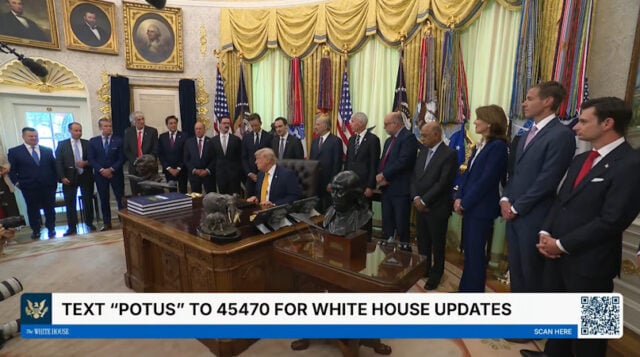
While negotiators managed volatile regional dynamics in Europe, President Trump held a press conference at the White House today to sign two executive orders aimed at accelerating U.S. capabilities in quantum information science and post-quantum cryptography. The administration frames quantum computing not merely as a matter of academic interest, but as a critical domain for national security and economic competition.
The first executive order establishes an intensive national initiative to build the first ever quantum computer capable of performing highly complex scientific calculations. It also commands federal labs to develop quantum-enabled sensors and specialized networks within the next five years. This policy updates the strategy originally outlined in the 2018 National Quantum Initiative Act, filling funding and research gaps that emerged after several pilot programs expired.
The order instructs the Assistant to the President for Science and Technology to collaborate with private tech enterprises and academic institutions. The goal is to build secure supply chains for quantum components, preventing foreign intelligence agencies from infiltrating or disrupting American research pipelines.
The second executive order addresses the security risks of the quantum era: the vulnerability of current encryption models to future quantum decryption tools. This directive orders a swift, nationwide migration to post-quantum cryptography (PQC) across all federal agencies, overseen by the Office of Management and Budget (OMB) and the National Cyber Director. Under the mandate, all departments managing critical infrastructure, national security systems, or sensitive public data must fully transition to quantum-resistant cryptographic standards by 2031.
The Department of Commerce, the National Security Agency (NSA), and the Department of Homeland Security (DHS) are tasked with delivering practical guidance to state and federal agencies to accelerate this transition. Security analysts argue that this aggressive timeline is necessary because foreign adversaries are actively collecting encrypted data today, planning to decrypt it once powerful quantum computers become available.
Reining In Big Defense: The Defense Production Act and Contractor Profits
The immediate driver behind both the diplomatic push in Switzerland and the technological mandates in Washington is the strain placed on America’s defense infrastructure by recent conflicts. The war against Iran has consumed considerable stockpiles of precision munitions, exposing supply chain vulnerabilities and low production capacities within the domestic defense industrial base.
To address these vulnerabilities, President Trump recently issued a decisive memo to Defense Secretary Pete Hegseth, invoking the Defense Production Act (DPA). This emergency invocation allows the federal government to bypass typical procurement delays and directly jumpstart the manufacturing of critical missiles, munitions, and tactical equipment. Assistant Secretary of Defense for Industrial Base Policy Michael Cadenazzi noted that the DPA mechanism is being used to build voluntary agreements and coordinated action plans with private firms. This approach allows the Department of War to bring industry leaders together to resolve persistent supply chain bottlenecks, such as component shortages and long-lead material dependencies.
However, this push for rapid manufacturing has created friction between the White House and major defense contractors. The Trump administration has intensified pressure on defense firms to reinvest their profits into domestic manufacturing facilities and factory floor expansions, rather than focusing on shareholder payouts. This follows a January executive order aimed at limiting stock buybacks and dividend distributions among major defense suppliers.
| Defense Contractor | 2026 Shareholder Actions & Financial Adjustments | Production Status under Administration Directives |
| Lockheed Martin | Fully halted stock buyback programs under White House pressure. | Maximizing output of precision-guided munitions and tactical missiles. |
| RTX (Raytheon) | Increased shareholder dividends by roughly 7% in May; halted stock buybacks. | Addressing critical shortages in air-defense missile components. |
| Northrop Grumman | Increased dividends by 7% in May; executed a minor stock buyback. | Under close scrutiny by the White House ahead of Wednesday’s summit. |
| Boeing | Maintained a complete halt on stock buybacks and dividends since 2020. | Facing directives to streamline assembly and clear aerospace backlogs. |
This corporate behavior has set up a high-stakes meeting scheduled for Wednesday at the White House. President Trump is slated to meet face-to-face with the chief executives of Lockheed Martin, RTX, BAE Systems, Boeing, Honeywell Aerospace, L3Harris, and Northrop Grumman. According to sources familiar with the administration’s plans, the president intends to demand direct explanations from executives—particularly those from Northrop Grumman and RTX—regarding their recent dividend increases.
The administration’s stance is clear: during an active defense buildup and a sensitive diplomatic transition, corporate resources must be directed toward expanding production lines, securing raw materials, and fulfilling government contracts, rather than enriching Wall Street investors. Combined with today’s diplomatic progress in Switzerland and the new directives in quantum physics, this industrial crackdown reflects a broader effort to reposition American power for the challenges of the coming decade.
Sources and Links:
- Fox News: US-Iran talks in Switzerland yield 60-day roadmap as next phase begins
- The Guardian: Iran agrees to UN nuclear inspectors’ return as part of agreement with US
- The Guardian Live Updates: US-Iran talks laid ‘very good foundation for a successful final deal’, says Vance
- MeriTalk: Trump Signs 2 Executive Orders to Bolster Quantum Computing
- The White House Fact Sheets:
- CBS News Defense Coverage:
- Time Magazine Analysis: Trump, Iran and the Denial of Defeat
Disclaimer
Artificial Intelligence Disclosure & Legal Disclaimer
AI Content Policy.
To provide our readers with timely and comprehensive coverage, South Florida Reporter uses artificial intelligence (AI) to assist in producing certain articles and visual content.
Articles: AI may be used to assist in research, structural drafting, or data analysis. All AI-assisted text is reviewed and edited by our team to ensure accuracy and adherence to our editorial standards.
Images: Any imagery generated or significantly altered by AI is clearly marked with a disclaimer or watermark to distinguish it from traditional photography or editorial illustrations.
General Disclaimer
The information contained in South Florida Reporter is for general information purposes only.
South Florida Reporter assumes no responsibility for errors or omissions in the contents of the Service. In no event shall South Florida Reporter be liable for any special, direct, indirect, consequential, or incidental damages or any damages whatsoever, whether in an action of contract, negligence or other tort, arising out of or in connection with the use of the Service or the contents of the Service.
The Company reserves the right to make additions, deletions, or modifications to the contents of the Service at any time without prior notice. The Company does not warrant that the Service is free of viruses or other harmful components.