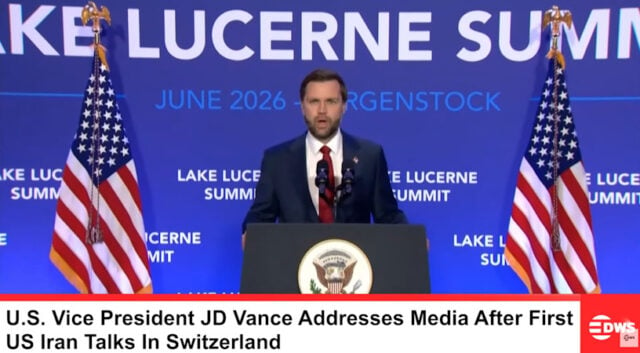
BÜRGENSTOCK, Switzerland — Speaking from a serene mountainside resort overlooking Lake Lucerne, Vice President JD Vance announced Monday morning that intensive, high-stakes negotiations between the United States and Iran have successfully established a “good foundation for a successful final deal.” The diplomatic breakthrough marks the most significant progress toward peace since a devastating regional military conflict erupted in late February 2026, opening an unexpected window for long-term stabilization in the Middle East.
“The final deal is the house,” Vance told reporters gathered at the Bürgenstock Resort following a marathon session of talks that stretched from Sunday afternoon into the early hours of Monday morning. “We set the foundation. We haven’t built the house, but we’ve laid a successful foundation to get to a good place for the American people.”
The remarks capped the initial session of what has been officially dubbed the Lake Lucerne Summit, a high-stakes diplomatic gathering mediated by Qatar and Pakistan. Despite acute geopolitical friction and aggressive rhetoric radiating from Washington over the weekend, the initial talks concluded with a concrete 60-day roadmap toward a comprehensive bilateral treaty, a formal resumption of international nuclear inspections, and an unconventional framework to unfreeze billions in Iranian assets to benefit American agricultural sectors.
Building the Architecture: The 60-Day Roadmap
The core procedural achievement of Monday morning’s session is a formalized framework designed to transition the conflict from an active military theater into a strictly managed diplomatic process. In a joint statement released simultaneously by Pakistani and Qatari mediators, both Washington and Tehran agreed to establish a High-Level Committee for political oversight. This newly formed body will serve as the primary supervisor for chief negotiators, who are now bound to a strict 60-day sprint to hammer out the complex technical details of a permanent peace accord.

Inside the 60-Day Roadmap: The Technical Benchmarks and Timelines from the Lake Lucerne Summit
Furthermore, the delegations agreed to create a dedicated, real-time “deconfliction cell.” The primary objective of this cell is to guarantee the durability of the fragile ceasefire in southern Lebanon between Israel and Iran-backed Hezbollah militants. While neither Israel nor Hezbollah are formal signatories to this immediate U.S.-Iran bilateral framework, the deconfliction cell represents a critical international mechanism to ensure that localized border skirmishes do not accidentally unravel the broader peace process.
Iranian Foreign Minister Abbas Araghchi echoed a cautious optimism on social media, writing on X that the international mediators had successfully delivered “major progress to end the Lebanon War.” However, Araghchi added a sobering caveat, stating that the first “real test” of the newly minted negotiations would be whether this bilateral mechanism succeeds in completely halting active fighting on the ground between Israeli defense forces and Hezbollah.
Breakthrough on Nuclear Inspections
A major victory claimed by the U.S. delegation involves a sudden breakthrough regarding Iran’s highly controversial nuclear program. According to Vice President Vance, senior Iranian officials—including parliamentary speaker Mohammad Bagher Qalibaf—formally agreed to invite inspectors from the International Atomic Energy Agency (IAEA) back into their primary nuclear facilities.
The issue has long been a fatal sticking point for Western diplomats, given that many of Iran’s enrichment facilities had been targeted by tactical U.S. and allied military strikes over the past year. The Trump administration has remained steadfast that any long-term lifting of economic sanctions is contingent upon Tehran verifying the dilution of its highly enriched uranium stockpiles and proving its program has no military applications.
“Nuclear inspections will start possibly this week,” Vance affirmed to reporters before boarding Air Force Two at the Emmen Military Air Base, noting that work could begin “as soon as today.” This sudden announcement follows a private briefing delivered days prior by U.S. envoy Steve Witkoff, who indicated that technical teams were already preparing the logistical groundwork to identify and inspect heavily enriched material sites that Iran had previously shielded from international oversight.
A ‘Classic Trump Deal’ for American Farmers
Beyond security and nuclear non-proliferation, the summit produced a highly novel approach to the contentious issue of frozen Iranian assets. Under the interim agreement signed last week, Tehran is poised to regain access to billions of dollars in overseas funds currently locked by international sanctions. The prospect of unfreezing these assets had drawn sharp criticism from domestic hawks in Washington, who warned that the capital would inevitably be funneled to regional proxies and militant networks.
Vance aggressively pushed back against those characterizations Monday morning, framing the asset release as a strategic victory for the domestic economy. He detailed a strict, dual-approval mechanism developed in tandem with Qatari officials, ensuring that neither the Iranian government nor its military apparatus can directly touch or reallocate the unfrozen funds.
“If there are any frozen Iranian assets that are unfrozen, then we have approval over that process, the Qataris have approval over that process,” Vance explained to the press corps. “The money would actually go to buy American soy, American corn, and American wheat for the benefit of the Iranian people.”
The Vice President explicitly credited the broader negotiating team, including presidential envoy Jared Kushner, with engineering an arrangement that simultaneously feeds a civilian population and boosts domestic markets. “Fundamentally, what Jared and the Qataris and the entire team here in Bürgenstock accomplished is, to me, a classic Trump deal,” Vance said. “If Iranian assets are ever unfrozen, they’re going to go to make American farmers richer and to feed the Iranian people. That’s a very, very good and very classic Trump deal. It’s great for our people, great for the people of Iran.”
Diplomatic Frictions: The View from Washington
While Vance struck a cooperative, forward-looking tone in Switzerland, the summit was nearly derailed by erratic signals emanating from Washington. From thousands of miles away, President Donald Trump delivered a blistering, 20-minute telephone interview with Fox News that sent shockwaves through the Swiss mountainside resort.
Reacting to domestic political critiques, Trump threatened to execute extreme military options if the agreement faltered, directly warning that the U.S. could forcefully seize the Strait of Hormuz—a vital maritime chokepoint responsible for a significant portion of global energy shipments. Iran had claimed to close the strait over the weekend in response to ongoing border clashes, though U.S. Central Command disputed that commercial shipping traffic had actually stopped.
Trump’s rhetoric turned intensely personal, warning the Iranian negotiating team that if they closed the waterway, “you won’t have a country. You won’t even make it back to your f***ing country.” The comments sparked immediate fury within the Iranian delegation, leading to frantic midnight reports that the entire diplomatic team was planning an immediate walkout.
Senior U.S. diplomats, speaking on the condition of anonymity, acknowledged that Trump’s statements jolted the venue and forced Vance into a delicate “good cop” role. Vance worked behind the scenes to smooth over the insults, emphasizing that the President explicitly instructed the delegation to “turn over a new leaf” and extend an “outstretched hand” if Tehran genuinely desired to abandon its role as a driver of regional instability. Ultimately, the mediators successfully pacified the Iranian team, allowing the historic session to conclude constructively before the Iranian representatives departed for Zurich to fly back to Tehran.
The Long Road Ahead
With the initial summit adjourned, Vice President Vance noted that while the geopolitical breakthrough is real, the hardest work remains ahead for technical teams. “We wanted to set up a structure for that so that you could have proper political oversight,” Vance concluded. “But obviously, as much as this place is very beautiful, I can’t stay here for the next 60 days.”
As Vance returns to Washington, technical experts, diplomats, and nuclear watchdogs are left with the daunting task of turning a fragile mountainside foundation into a permanent architecture of peace.
Sources and Links:
- BNN Bloomberg: Vance says talks in Switzerland with Iranian officials set ‘good foundation’ for a deal to end war — bnnbloomberg.ca
- The Jerusalem Post: JD Vance: Good progress was made during US-Iran talks in Switzerland — jpost.com
- Fox News: US-Iran talks in Switzerland yield 60-day roadmap as next phase begins — foxnews.com
- PBS NewsHour: As Vance meets top Iranian officials in Switzerland, Trump threatens Tehran from afar — pbs.org
- The Guardian: US-Iran talks strained as Trump threats spark Iranian walkout — theguardian.com
Disclaimer
Artificial Intelligence Disclosure & Legal Disclaimer
AI Content Policy.
To provide our readers with timely and comprehensive coverage, South Florida Reporter uses artificial intelligence (AI) to assist in producing certain articles and visual content.
Articles: AI may be used to assist in research, structural drafting, or data analysis. All AI-assisted text is reviewed and edited by our team to ensure accuracy and adherence to our editorial standards.
Images: Any imagery generated or significantly altered by AI is clearly marked with a disclaimer or watermark to distinguish it from traditional photography or editorial illustrations.
General Disclaimer
The information contained in South Florida Reporter is for general information purposes only.
South Florida Reporter assumes no responsibility for errors or omissions in the contents of the Service. In no event shall South Florida Reporter be liable for any special, direct, indirect, consequential, or incidental damages or any damages whatsoever, whether in an action of contract, negligence or other tort, arising out of or in connection with the use of the Service or the contents of the Service.
The Company reserves the right to make additions, deletions, or modifications to the contents of the Service at any time without prior notice. The Company does not warrant that the Service is free of viruses or other harmful components.