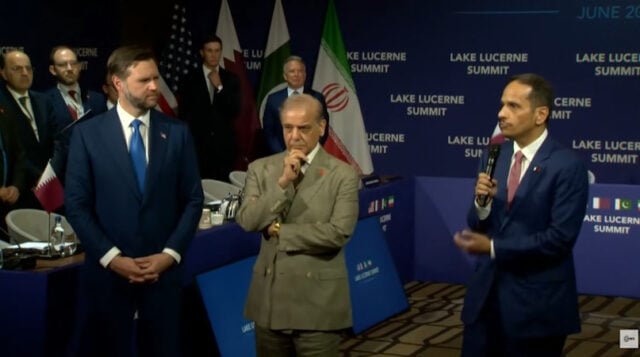
The diplomatic landscape in Bürgenstock, Switzerland, transformed overnight from an arena of cautious optimism into a high-stakes theater of geopolitical brinkmanship. Just a week after the United States and Iran signed a landmark, highly fragile 60-day interim peace deal—which initially sent shockwaves of relief through depressed global equities and overheated energy markets—a single social media post from U.S. President Donald Trump has fundamentally altered the calculus.
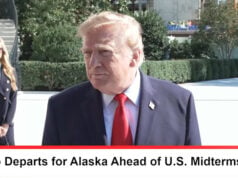
On the evening of Sunday, June 21, 2026, President Trump issued a severe, unvarnished warning directly targeting Tehran and its regional network of proxy forces. The message, broadcast across his primary communication channels, introduced an immediate geopolitical risk premium back into the global financial architecture. The ripples were felt instantaneously across Asian trading floors on Monday morning, June 22, severely clouding the opening of direct, high-level bilateral talks in Switzerland.
The juxtaposition of hard-nosed military threats with delicate, mediated peace talks captures the signature style of the administration’s approach to Middle Eastern foreign policy. However, for international investors, central bankers, and corporate supply chain managers, the immediate consequence is a sudden resurgence of volatility. This deep-dive analysis evaluates the status of the ongoing Swiss negotiations, the structural mechanics behind the sudden drops in stock futures, the upward trajectory of crude oil and domestic gas markets, and the macroeconomic anomalies driving the precious metals sector.
Inside the Swiss Standoff: Status of the US-Iran Bilateral Talks
The diplomatic gathering at the Bürgenstock resort was meant to solidify the operational guidelines of the 60-day memorandum of understanding (MoU) signed just a week prior. The stakes could not be higher. The United States delegation, led directly by Vice President J.D. Vance, alongside senior advisors Jared Kushner and Steve Witkoff, arrived in Switzerland with a mandate to negotiate long-term maritime safety, structured sanctions relief, and an enforceable framework regarding Iran’s uranium enrichment programs. Across the table, the Iranian delegation was anchored by two of the country’s most prominent political figures: Parliament Speaker Mohammad Bagher Qalibaf and Foreign Minister Abbas Araghchi.

The discussions, mediated actively by Pakistan and Qatar, hit an immediate roadblock on Sunday night following President Trump’s digital broadside:
The Catalyst: “Iran must immediately stop their highly paid PROXIES in Lebanon from causing trouble. If they don’t, we’ll hit Iran very hard again, just like we did last week, only harder!!!” — President Donald Trump, June 21, 2026.
The Midnight Scare
Following the post, state-aligned media outlets in Tehran abruptly reported that the Islamic Republic had suspended all diplomatic tracks and ordered its negotiators to halt proceedings, citing a breach of diplomatic etiquette and continuing Israeli operations in southern Lebanon. For several hours, global markets braced for an absolute collapse of the peace initiative.
However, senior diplomats close to the talks later confirmed that behind closed doors, the delegations never actually left the table. Instead, American and Iranian officials engaged in grueling, all-night sessions stretching into the early hours of Monday, June 22. The core of these midnight arguments focused on the definitive boundaries of the Strait of Hormuz and establishing precise verification mechanisms to ensure a lasting cessation of hostilities between Israeli forces and Hezbollah militants in Lebanon.
While Tehran insists that regional ceasefires must precede any permanent maritime agreements, Washington maintains that the unconditional freedom of international navigation is non-negotiable. Trump amplified this stance in a weekend media appearance, bluntly threatening that if Iranian forces attempted to reseal the critical waterway, “you won’t even make it back to Iran.”
Equity Futures Retrench: Wall Street Braces for Impact
The immediate casualties of this digital escalation were U.S. and Asian stock index futures. Coming off a holiday weekend when cash markets were closed on Friday, the sudden surge in geopolitical tensions caught overextended bulls by surprise.
- S&P 500 Futures: Slipped by 0.5% to 0.6% in early trading, snapping a consecutive series of record highs.
- Nasdaq 100 Futures: Dropped by roughly 0.7%, reflecting a pronounced pull-back in high-beta technology and growth segments.
- MSCI Asia Pacific Index: Fell 0.3%, led primarily by losses in export-heavy sectors across Japan and South Korea.
This downward adjustment serves as an important reality check for a market that had recently grown complacent. Throughout the second quarter of 2026, a massive tech-led rally pushed global equities up by an astonishing 15%—marking one of the strongest quarterly expansions in six years. This optimism was heavily predicated on the assumption that the devastating regional war, which originally erupted in late February 2026, was finally entering an irreversible phase of de-escalation. Analysts note that the fragility of the U.S.-Iran MoU represents an immediate threat to corporate earnings projections, particularly if a breakdown in talks forces a return to a full-scale maritime blockade.
Energy Markets Rebound: Crude Oil Prices Surge on Strait Violations
The response from the energy complex was swift and sharp, reversing a massive downward trend seen last week when crude prices cratered by nearly 10% on the initial news of the interim deal.
On Monday morning, international benchmark Brent crude futures jumped between 1.1% and 1.4%, trading back up into the $81.50 to $82.30 per barrel range. Concurrently, domestic benchmark West Texas Intermediate (WTI) crude futures surged by 2% to 3%, hovering near $77.44 to $78.93 per barrel.
[Mid-Conflict Peak: $126] ──> [Post-MoU Drop: $77-$81] ──> [Trump Post Bounce: $79-$82]
The underlying catalyst for this price spike is the Strait of Hormuz’s highly contested status. On Saturday, Tehran claimed it had officially closed the vital shipping channel once again, pointing to alleged U.S. failures to lift banking restrictions swiftly. While U.S. naval tracking data confirmed that millions of barrels of crude continued to physically pass through the strait over the weekend without kinetic interruption, the mere threat of a renewed blockade forced algorithms and energy traders to aggressively price the geopolitical risk premium back into front-month contracts.
The Supply Reality
Even if the Swiss negotiations yield a breakthrough, energy sector experts caution against expecting an immediate flood of cheap oil. According to Kevin Book, managing director at the independent research firm Clearview Energy Partners, the physical scars of the 2026 conflict will take months to heal. Multiple drilling sites, offshore processing platforms, and regional refining hubs were either structurally damaged or completely shuttered during the spring hostilities.
Reactivating these sophisticated systems requires extensive engineering oversight, safety audits, and deep-water mine clearing operations. Furthermore, because global industrial economies have spent the last four months aggressively depleting their strategic and commercial oil stockpiles to compensate for missing Middle Eastern flows, any initial increase in production will likely be diverted to refilling empty inventories rather than dampening spot prices.
The Retail and Industrial Fallout: Gas Prices and Fertilizer Crises
The volatility in crude markets has directly trickled down to derivative energy products. On Monday, benchmark European natural gas futures spiked by up to 3.9%, while U.S. gasoline futures recorded matching gains. For the everyday consumer, this guarantees that retail gas prices will remain elevated at the pump, extending the inflationary pain that has characterized much of the 2026 fiscal year.
The damage, however, extends far beyond the consumer fuel pump. The protracted disruption of the Strait of Hormuz has severely impacted the global agricultural supply chain. The waterway is the primary transit vector for three of the planet’s top ten producers of urea and anhydrous ammonia—critical components for industrial fertilizers:
- Saudi Arabia
- Qatar
- Iran
According to Josh Linville, vice president of financial services at StoneX, the prolonged closure of the strait earlier this year inflicted deep, systemic wounds on global agribusiness. U.S. agricultural communities, particularly soybean and corn growers who were already navigating aggressive tariff structures, are projected to face their fourth consecutive year of negative net margins in 2026. The sudden spikes in fertilizer costs occurred because the administration failed to adequately stockpile chemical inputs before participating in joint military actions alongside Israel in February. Experts warn that even if shipping lanes normalize tomorrow, fertilizer prices will likely remain stuck at historic highs well into next spring.
The Safe-Haven Anomaly: Why Gold Holds Its Decline
In a standard geopolitical crisis, precious metals typically surge as investors flock to defensive assets. Yet, spot gold exhibited a remarkably subdued response to Trump’s latest warnings, edging up a mere 0.2% to sit between $4,155 and $4,162 an ounce on Monday. Crucially, gold remains locked in a three-week downward trajectory, having shed more than 20% of its total valuation since its historic peaks when the conflict first broke out in February.
This counter-intuitive behavior is driven by aggressive macroeconomic forces:
| Asset & Commodity Market Snapshot (June 22, 2026) | ||
| Market / Asset Class | Current Value / Level | Immediate Directional Shift |
| S&P 500 Index Futures | 0.5% – 0.6% Decline | Risk-off retrenchment |
| Nasdaq 100 Index Futures | 0.7% Drop | Tech-heavy profit taking |
| Brent Crude Oil | $81.50 – $82.30 / barrel | Up 1.1% to 1.4% |
| West Texas Intermediate (WTI) | $77.44 – $78.93 / barrel | Up 2.0% to 3.0% |
| Spot Gold Bullion | $4,155 – $4,162 / ounce | Flat / Negligible 0.2% gains |
| European Natural Gas Futures | 3.9% Escalation | Sharp upward tracking |
The primary headwind for bullion is the Federal Reserve’s monetary policy stance. The energy supply shocks stemming from the Middle Eastern conflict have kept headline global inflation numbers unsustainably high. In response, the newly appointed Federal Reserve Chairman, Kevin Warsh, adopted an intensely hawkish policy tone during his inaugural monetary committee meeting last week.
Warsh signaled that the central bank is prepared to implement further interest rate hikes and maintain an elevated cost of borrowing for an extended duration to break the back of sticky inflation. Because gold is a non-yielding asset that pays zero interest, the prospect of prolonged high real yields makes holding physical bullion significantly less attractive to institutional asset managers, completely neutralizing its traditional role as a safe-haven asset during this diplomatic crisis.
Looking Ahead: The Fragile 60-Day Horizon
The immediate future of global commodity prices rests entirely on whether Vice President Vance and Foreign Minister Araghchi can decouple the Swiss negotiations from the escalating public rhetoric. The 60-day window created by last week’s memorandum is highly volatile. If negotiators manage to establish a credible, third-party-verified system to police the southern Lebanon ceasefire and guarantee unhindered commercial shipping transit, market analysts anticipate that oil could quickly slide back into the mid-$70s, paving the way for a broader equity market recovery.
Conversely, if President Trump’s social media warnings manifest into actual kinetic strikes against Iranian military infrastructure, or if Tehran attempts a hard enforcement of a shipping blockade, the financial fallout will be immediate. Under a worst-case escalation scenario, energy economists warn that Brent crude could easily breach its previous peak of $126 a barrel, sparking a profound stagflationary shock that would severely test the resilience of global markets.
Sources and Links
- Bloomberg L.P. — Oil Climbs, US Futures Dip on Tense US-Iran Talks: Markets Wrap
- The Business Times — Gold holds decline after Trump warns Iran during peace talks
- The Hindu — Trump threats shake up U.S.-Iran talks in Switzerland; negotiators expect to work through night
- Investing.com — Oil rises as Trump threatens new attacks on Iran; Hormuz closed again
- Futu News — Crude oil futures rose as Trump issued renewed threats amid the launch of U.S.-Iran peace talks
- NPR / WUFT — Crude oil futures drop after Trump promises an Iran deal will be signed Friday
- The Washington Post — For cash-strapped farmers, deal to end Iran fighting comes too late
Disclaimer
Artificial Intelligence Disclosure & Legal Disclaimer
AI Content Policy.
To provide our readers with timely and comprehensive coverage, South Florida Reporter uses artificial intelligence (AI) to assist in producing certain articles and visual content.
Articles: AI may be used to assist in research, structural drafting, or data analysis. All AI-assisted text is reviewed and edited by our team to ensure accuracy and adherence to our editorial standards.
Images: Any imagery generated or significantly altered by AI is clearly marked with a disclaimer or watermark to distinguish it from traditional photography or editorial illustrations.
General Disclaimer
The information contained in South Florida Reporter is for general information purposes only.
South Florida Reporter assumes no responsibility for errors or omissions in the contents of the Service. In no event shall South Florida Reporter be liable for any special, direct, indirect, consequential, or incidental damages or any damages whatsoever, whether in an action of contract, negligence or other tort, arising out of or in connection with the use of the Service or the contents of the Service.
The Company reserves the right to make additions, deletions, or modifications to the contents of the Service at any time without prior notice. The Company does not warrant that the Service is free of viruses or other harmful components.