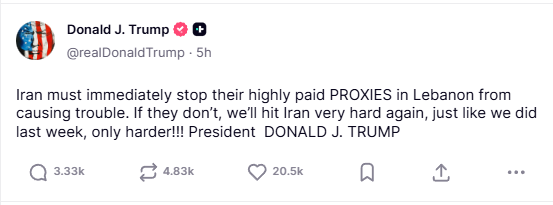
“Iran must immediately stop their highly paid PROXIES in Lebanon from causing trouble. If they don’t, we’ll hit Iran very hard again, just like we did last week, only harder!!!” — U.S. President Donald Trump, Truth Social, June 21, 2026
BÜRGENSTOCK, Switzerland — The highly anticipated diplomatic summit aimed at reshaping the Middle East collapsed into chaos on Sunday afternoon. The sudden rupture came in immediate protest of the aggressive warning issued above by U.S. President Donald Trump on Truth Social. Iranian negotiators abruptly walked out of direct, quadrilateral talks with the United States at the Bürgenstock mountain resort, with Tehran’s chief representative labeling the remarks an “unacceptable threat” to their sovereignty and personal safety.
The high-stakes summit, mediated by Pakistan and Qatar, was designed to finalize the technical procedures of the newly signed Islamabad Memorandum of Understanding (MoU). Instead, the meetings ground to a screeching halt after just 80 minutes of formal discussion. The sudden diplomatic breakdown leaves a fragile regional non-aggression framework on the brink of collapse. It highlights the stark operational contrast between a disciplined, professional U.S. diplomatic team and the highly volatile rhetoric of the American commander-in-chief.
IRNA reports on Iran-US talks progress from Swiss venue pic.twitter.com/WHYUgjzdXZ
— IRNA News Agency ☫ (@IrnaEnglish) June 21, 2026

NEW: Iranian negotiators in Switzerland have refused a planned handshake and joint photo-op with the U.S. delegation—walking past without acknowledgment as cameras waited.
The Iranian team rejected repeated U.S. and organizer requests for the ceremonial gesture, informing them… pic.twitter.com/gyF9NTfqU9
— Hormuz Report (@HormuzReport) June 21, 2026
The Iranian delegation, led by Parliamentary Speaker Mohammad-Bagher Ghalibaf, refuse a photo with U.S. Vice President JD Vance and the American side, walking out of the negotiation venue in Switzerland, following threats made against Iran’s diplomatic delegation by President… pic.twitter.com/6LgBHHqheu
— OSINTdefender (@sentdefender) June 21, 2026
The Incendiary Rhetoric That Broke the Summit
The fragile technical momentum evaporated when President Trump’s digital commentary filtered across the Atlantic directly into the Bürgenstock negotiation rooms. Reacting to intense, ongoing border violence between Israel and Hezbollah in central and southern Lebanon, as well as a disputed maritime blockade of the Strait of Hormuz announced by the Islamic Revolutionary Guard Corps (IRGC), Trump’s online ultimatum was quickly backed by further hardline rhetoric in the American media.
In a subsequent call with Fox News correspondent Trey Yingst, the president’s warnings escalated rapidly. He warned that if Iran maintained its maritime blockade, the U.S. would implement aggressive unilateral tolls on all shipping in the vital corridor, even suggesting the U.S. could take over the channel entirely. In a particularly incendiary comment directed at the Iranian officials working in Switzerland, Trump stated: “You close it [the Strait] and you won’t have a country. You won’t even make it back to your f***ing country.”
The explicit reference to preventing the negotiators from returning home caused immediate anger and alarm within the Iranian camp. Arguing that the American president had flagrantly violated the non-aggression clauses embedded in the Islamabad MoU, Chief Negotiator Mohammad Bagher Ghalibaf and Foreign Minister Abbas Araghchi ordered their team to halt all discussions. They exited the venue to hold emergency internal consultations.
“Don’t they think to themselves that if their threats had any effect, they wouldn’t have reached the desperation they face today?” Ghalibaf later remarked to Iranian state media. “We don’t take the Americans’ threats into account at all.”
Despite the public dismissal, the delegation formally lodged a severe protest with Qatari and Pakistani mediators, demanding that Washington bring Trump’s “bullying” under immediate control.
Drama and Chilly Optics at Bürgenstock
The diplomatic atmosphere was strained long before the actual walkout occurred. Seeking to signal their deep distrust of the American administration amid domestic political pressure, the Iranian delegation instantly set a rigid tone. They explicitly refused to participate in a planned handshake or join a group photo opportunity with the American delegation, which was led by U.S. Vice President JD Vance, Special Envoy for Peace Jared Kushner, and Envoy Steve Witkoff.
Organizers had hoped a unified photo-op would demonstrate momentum. However, Iranian officials sharply dismissed the proposal, calling it an artificial American “media show.” While video footage caught a brief, chilly moment where Foreign Minister Araghchi entered a communal room to embrace Pakistani Prime Minister Shehbaz Sharif just meters away from a glancing Vice President Vance, the two sides maintained strict distance.
Despite the cold optics, technical teams managed to sit down for a quadrilateral session alongside Qatari and Pakistani mediators. Early indications even suggested subtle progress. Behind closed doors, negotiators finalized a crucial draft agreement regarding U.S. oil sanctions waivers—a primary Iranian precondition before expanding talks to permanent nuclear inspections. Concurrently, Qatari officials facilitated the initial executive procedures required to release billions of dollars in frozen Iranian assets held abroad. All of this progress, however, was undone the moment the digital notifications from Washington reached the resort.
Mixed Signals and Fragmented Diplomacy
The walkout underscores a profound disconnect between the U.S. State Department’s official diplomatic strategy and the messaging from the White House. Just hours before the session collapsed, Vice President Vance had been actively projecting an emollient, optimistic tone to international reporters. Vance emphasized that Trump had personally empowered the delegation to “turn over a new leaf” and extend an “outstretched hand” to transform a historically destructive relationship.
Even as the conflict in Lebanon threatened to disrupt the Swiss summit, Vance minimized the turbulence. He noted that regional transformations are “always a little bit messy” but insisted the administration was actively managing the escalation to ensure long-term stability, highlighting that “great progress” had been made over the preceding few days to ensure the ceasefire holds.
However, Tehran viewed the combination of Vance’s diplomatic overtures and Trump’s military threats as a calculated good-cop, bad-cop routine. State broadcaster Press TV reported that Iran’s leadership felt compelled to walk out to defend national dignity. They also needed to satisfy hardline domestic factions who view any concessions to Washington with extreme skepticism.
Compounding the diplomatic breakdown is a highly volatile situation in the Persian Gulf. While the U.S. military actively disputed Iranian claims regarding a total shutdown of the Strait of Hormuz—stating that dozens of commercial merchant vessels safely completed transits over the weekend—maritime tracking data tells a more complicated story. Tanker-tracking feeds indicated a near-total cessation of commercial transits through the narrow chokepoint immediately following the IRGC’s naval directive. Iranian officials have since tied the reopening of the chokepoint explicitly to a permanent, respected ceasefire in Lebanon.
The Precarious Path Ahead
It remains highly ambiguous whether Iran’s walkout constitutes a permanent termination of the 2026 peace process or a calculated, symbolic show of diplomatic leverage. The fact that critical drafts on oil waivers and asset releases were finalized just before the suspension suggests that both economies remain highly incentivized to keep the deal’s core infrastructure alive.
For now, the Bürgenstock resort remains quiet as international mediators from Qatar and Pakistan scramble to conduct proximity diplomacy, shuffling between the isolated delegations. The United Nations nuclear watchdog, led by IAEA chief Rafael Grossi, also remains on standby in Switzerland, awaiting word on whether technical nuclear verification talks can be salvaged.
However, the events of Sunday have made one reality undeniable: in modern geopolitics, a single social media post can dismantle months of meticulous, multi-nation diplomacy in less than two hours. Until Washington can align its top-level executive rhetoric with its formal diplomatic missions, the path to a durable Middle Eastern peace will remain exceptionally fragile.
Sources and Links:
- The Guardian: Trump threatens Iran after JD Vance hails ‘great progress’ made in Switzerland talks – as it happened
- The Indian Express: Trump threatens, Vance strikes positive note as Iran sees 2 Americas
- WDRB (Associated Press): As Vance meets top Iranian officials in Switzerland, Trump threatens Tehran from afar
- Washington Examiner: Trump vows to strike Iran if it doesn’t rein in Hezbollah attacks in Lebanon
- Business Today: ‘We’ll hit harder’: Trump warns Iran over its Lebanon ‘proxies’ as peace talks resume
- Al Jazeera: Iran war day 114: US, Iranian delegations in Switzerland for key talks
Disclaimer
Artificial Intelligence Disclosure & Legal Disclaimer
AI Content Policy.
To provide our readers with timely and comprehensive coverage, South Florida Reporter uses artificial intelligence (AI) to assist in producing certain articles and visual content.
Articles: AI may be used to assist in research, structural drafting, or data analysis. All AI-assisted text is reviewed and edited by our team to ensure accuracy and adherence to our editorial standards.
Images: Any imagery generated or significantly altered by AI is clearly marked with a disclaimer or watermark to distinguish it from traditional photography or editorial illustrations.
General Disclaimer
The information contained in South Florida Reporter is for general information purposes only.
South Florida Reporter assumes no responsibility for errors or omissions in the contents of the Service. In no event shall South Florida Reporter be liable for any special, direct, indirect, consequential, or incidental damages or any damages whatsoever, whether in an action of contract, negligence or other tort, arising out of or in connection with the use of the Service or the contents of the Service.
The Company reserves the right to make additions, deletions, or modifications to the contents of the Service at any time without prior notice. The Company does not warrant that the Service is free of viruses or other harmful components.