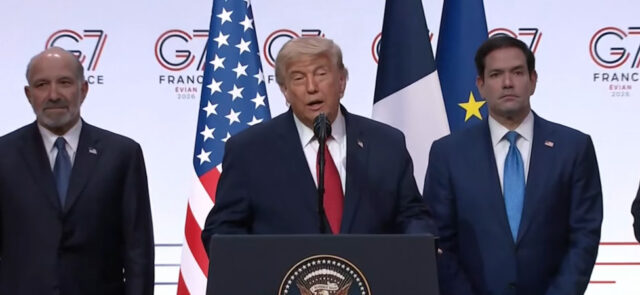
The Group of Seven (G-7) summit in Évian-les-Bains, France, concluded with a dramatic press conference from U.S. President Donald Trump, who declared that a monumental peace agreement with Iran is “all signed.” The announcement marks a pivotal shift in global geopolitics and energy markets following a intense three-and-a-half-month conflict in the Persian Gulf. Trump asserted that the breakthrough would put the Iran war “in the rearview mirror,” allowing the administration and its international allies to refocus their strategic priorities.
Central to the closing address was the status of Iran, a sudden drop in global oil costs, the future architecture of international sanctions, and rigid parameters regarding Iran’s nuclear power capabilities. While the announcement was met with a mix of optimism and skepticism among G-7 leaders, the immediate impact was felt across global financial and energy markets.
The U.S.-Iran Status and the Strait of Hormuz
The cornerstone of President Trump’s closing address was the unveiling of a memorandum of understanding (MOU) aimed at ending the maritime and military standoff in the Gulf. Trump announced that the strategically vital Strait of Hormuz—the world’s most critical oil transit chokepoint—will be “completely open” following the formalization of the deal.
The agreement was orchestrated through fast-moving technical discussions led by U.S. Vice President JD Vance and chief Iranian negotiator Mohammad-Bagher. According to U.S. officials, the core framework of the MOU trades the complete reopening of the Strait of Hormuz for the lifting of a restrictive U.S. naval blockade on Iran. The formal signing ceremony is scheduled to take place in Geneva, Switzerland.

Despite the announcement, Trump maintained a cautious tone, emphasizing that the deal is “not final” in its implementation and issuing a direct warning that the U.S. remains prepared to resume military actions “if they don’t behave.” Furthermore, White House officials clarified that there would be no immediate drawdown of U.S. forces deployed near Iran. The current military posture will remain in place during the upcoming phases of negotiations to ensure compliance.
+-------------------------------------------------------------+
|               U.S.-IRAN MEMORANDUM OF UNDERSTANDING          |
+----------------------------+--------------------------------+
|      Iran Commitment       |         U.S. Commitment        |
+----------------------------+--------------------------------+
| Fully reopen the Strait    | Lift the U.S. naval blockade   |
| of Hormuz to maritime traffic| on Iranian waters            |
+----------------------------+--------------------------------+
| Accept strict policing of  | Consider phased relief of      |
| its nuclear energy program | economic sanctions             |
+----------------------------+--------------------------------+
Oil Prices Drop and Global Economic Impacts
The economic ramifications of the diplomatic breakthrough dominated a significant portion of the press conference. The blockades and military actions in the Gulf over the preceding months had severely disrupted global energy supplies. Gas prices doubled between the onset of the conflict and May, prompting the World Bank to forecast a 2.5 percent decline in global economic growth.
Trump touted an immediate reversal in energy markets following news of the agreement, stating that “the oil is plummeting down and the stock market is shooting up like a rocket.” The reopening of the Strait of Hormuz ensures that millions of barrels of crude oil can once again flow unhindered to global markets, easing supply crunches that had driven inflation upward.
However, international economic experts and G-7 leaders cautioned that the recovery will not happen overnight. Even with peace holding and maritime transit resuming, analysts warn that it could take several months for retail fuel prices to return to pre-war baselines. G-7 hosts, including French President Emmanuel Macron, noted that Western partners are prepared to take swift action to help restore maritime security and stabilize energy corridors as quickly as possible.
The Future of Sanctions: A Shift to Russia
The resolution of the Gulf conflict has cleared the path for a major recalibration of the international sanctions regime. During his address, President Trump signaled that the U.S. is preparing to reimpose or increase strict sanctions on Russian oil shipments—vessels and networks that had received temporary relief during the heights of the Iran war.
In March, the U.S. temporarily eased certain sanctions on Russian oil to inject supply into the market and mitigate surging global crude prices. With Iranian diplomatic progress restoring regular oil flows through the Strait of Hormuz, Trump indicated those waivers would expire. “Soon we’ll be able to do that because the oil is now flowing,” Trump told reporters. “We’re in a position to do that soon.”
Concurrently, the shifting energy landscape allowed G-7 leaders to return the war in Ukraine to the top of their joint agenda. Ukrainian President Volodymyr Zelenskyy joined the summit for a 75-minute session, securing unanimous support from the G-7. While the U.S. has scaled back direct aid, European allies pledged continued military and financial backing. Reinforcing this shift, the United Kingdom announced its own set of new sanctions targeting Russia’s “shadow fleet”—vessels used to transport oil and liquefied natural gas from sanctioned Arctic projects.
Regarding Iranian sanctions, the White House clarified that the release of frozen assets and broad economic relief will be strictly conditional. U.S. officials emphasized that “$0 of unfrozen assets have been released” thus far, and any future relief will be tied directly to Iran meeting its verified commitments.
Nuclear Power and Policing Mechanisms
The most critical and scrutinized element of the G-7 discussions centered on the future of Iran’s nuclear power program. Trump struck a firm line, declaring that the overriding objective of the entire diplomatic and military campaign was ensuring that Tehran can never develop a nuclear weapon.
“The main thing is that Iran will not have a nuclear weapon. They fully agreed to that with strong policing powers, and they won’t have a nuclear weapon, which is what it was all about.” — President Donald Trump
The deal permits Iran to maintain a civilian nuclear power architecture but subjects it to rigorous, invasive international oversight. Trump referenced previous military actions, claiming that bunker-buster strikes had successfully collapsed key Iranian underground sites, significantly diminishing their enrichment capabilities. The new agreement seeks to cement these limitations by granting international inspectors comprehensive “policing powers” to monitor uranium stockpiles and enrichment levels.
The domestic fate of the agreement remains fluid. In a notable departure from standard executive agreements, Trump voiced openness to sending the U.S.-Iran deal to Capitol Hill for formal congressional review, stating, “I like the idea, send it to Congress please… I mean who wouldn’t approve it?” This review will likely face intense debate, as several congressional Republicans have already expressed deep skepticism regarding whether the proposed inspection mechanisms are sufficient to permanently deter Iran’s nuclear ambitions.
Geopolitical Friction and Allied Responses
The summit’s conclusion also highlighted underlying rifts between the United States and its closest allies. Leaders such as German Chancellor Friedrich Merz, British Prime Minister Keir Starmer, Italian Prime Minister Giorgia Meloni, and President Macron had previously expressed frustration at the lack of consultation before the U.S. initiated military action in the Gulf. Trump had even threatened to draw down U.S. troop presence in those NATO countries due to their initial lack of support.
While Chancellor Merz acknowledged that the peace deal could significantly stabilize the volatile global economy, European leaders raised immediate alarms over secondary conflicts threatening the region. Specifically, last-minute tensions flared after an Israeli drone strike in southern Lebanon violated parameters of a parallel ceasefire, drawing sharp criticism from European Commission President Ursula von der Leyen, who warned that lasting peace is impossible while Lebanon remains unstable.
Trump mirrored some of this frustration during his media availability, stating he was “not happy with the way Israel has handled itself with Lebanon and with Hezbollah,” noting that prolonged hostilities throw a “negative light” on the overarching agreement with Iran. Despite these diplomatic frictions, the G-7 nations closed the summit unified in their desire to quickly implement the maritime security frameworks, lower global energy pressures, and test the durability of the newly signed accord.
Sources and Links:
- The Guardian: Trump declares US-Iran peace deal ‘all signed’ as G7 leaders battle to tie up loose ends
- PBS NewsHour: Trump signals he may reimpose sanctions on Russian oil as G7 refocuses on Ukraine
- CBS News: Live Updates: Trump says U.S.-Iran deal “not final,” threatens to resume bombing “if they don’t behave”
- TribLIVE: Trump signals swift return of sanctions on Russian oil as G7 refocuses on Ukraine
Disclaimer
Artificial Intelligence Disclosure & Legal Disclaimer
AI Content Policy.
To provide our readers with timely and comprehensive coverage, South Florida Reporter uses artificial intelligence (AI) to assist in producing certain articles and visual content.
Articles: AI may be used to assist in research, structural drafting, or data analysis. All AI-assisted text is reviewed and edited by our team to ensure accuracy and adherence to our editorial standards.
Images: Any imagery generated or significantly altered by AI is clearly marked with a disclaimer or watermark to distinguish it from traditional photography or editorial illustrations.
General Disclaimer
The information contained in South Florida Reporter is for general information purposes only.
South Florida Reporter assumes no responsibility for errors or omissions in the contents of the Service. In no event shall South Florida Reporter be liable for any special, direct, indirect, consequential, or incidental damages or any damages whatsoever, whether in an action of contract, negligence or other tort, arising out of or in connection with the use of the Service or the contents of the Service.
The Company reserves the right to make additions, deletions, or modifications to the contents of the Service at any time without prior notice. The Company does not warrant that the Service is free of viruses or other harmful components.