A high-stakes political standoff has brought the United States’ foreign surveillance apparatus to the brink of a historic operational lapse. President Donald Trump has upended carefully negotiated bipartisan legislation by holding off on permanently replacing acting Director of National Intelligence (DNI) Bill Pulte. By stalling the confirmation process for his permanent nominee, Jay Clayton, President Trump has effectively frozen Capitol Hill. He is leveraging the critical renewal of Section 702 of the Foreign Intelligence Surveillance Act (FISA) to demand that lawmakers pass the SAVE America Act, a controversial voter ID mandate that currently lacks the necessary votes to clear either chamber of Congress.
The Flashpoint: Bill Pulte and the Intel Vacancy
The crisis began after Tulsi Gabbard’s resignation, prompting President Trump to appoint Bill Pulte—the current head of the Federal Housing Finance Agency (FHFA)—as acting DNI. Pulte’s sudden insertion into the upper echelon of the U.S. intelligence community immediately triggered intense backlash on Capitol Hill. Lawmakers from both sides of the aisle raised sharp objections, citing Pulte’s complete lack of national security or intelligence experience in overseeing the nation’s 18 intelligence agencies.
Furthermore, critics highlighted Pulte’s controversial tenure at the FHFA, where he was tied to criminal referrals targeting prominent critics of the administration, including New York Attorney General Letitia James and California Senator Adam Schiff. House Intelligence Committee Democrats, led by Representative Jim Himes, fiercely condemned the choice, writing that Pulte was “uniquely poor” and lacked the baseline independence required for the post.

Even usually staunch allies among congressional Republicans expressed deep reservations. Senate Majority Leader John Thune publicly warned against the potential “weaponization” of the top intelligence position, emphasizing that the role requires seasoned professionals. In response to the intensifying pressure, President Trump clarified that Pulte’s tenure would be short-lived, characterizing it as a temporary “renovation role” designed to downsize the Office of the Director of National Intelligence (ODNI). Speaker of the House Mike Johnson confirmed that the administration views Pulte as a transitional figure rather than a permanent fixture, and Trump noted that he is actively interviewing a handful of other candidates, including former House Intelligence Committee Chairman Pete Hoekstra.
The FISA Collapse: Section 702 in Jeopardy
The domestic political fight over Pulte has directly imperiled Section 702 of FISA, a vital intelligence tool that allows the National Security Agency (NSA), the CIA, and the FBI to conduct warrantless electronic surveillance on foreign targets overseas. While privacy advocates on both the political left and right have long sought reforms to protect the incidental collection of Americans’ communications, leaders of both parties had recently forged a hard-won compromise bill to secure a long-term extension of the surveillance powers.
That bipartisan agreement disintegrated the moment Pulte was positioned at the helm of the intelligence network. Virginia Senator Mark Warner, the lead Democrat on the Senate Intelligence Committee who had been working closely with Republicans on the compromise, described Pulte’s appointment as a “live hand grenade” thrown directly into the legislative process.
Democrats, joined by a faction of independent-minded Republicans, flatly refused to renew the sweeping surveillance powers while Pulte remained in the acting role. A series of critical votes collapsed in dramatic fashion. The House failed to pass a temporary patch in a 198-218 vote, with roughly 20 Republicans breaking ranks to vote against the measure alongside Democrats. In the Senate, a group of seven Republicans joined Democrats to block a long-term extension.
With the expiration deadline fast approaching, prominent lawmakers, including Senate Intelligence Committee Chairman Tom Cotton and Senate Judiciary Committee Chairman Chuck Grassley, issued stark warnings to the administration. In a formal letter, they urged executive branch agencies to brace for a “potential significant gap in foreign intelligence collection,” cautioning that a lapse could fundamentally blind American security services during a period of acute global tension, marked by active military friction between the United States and Iran.
The Pivot: Holding Clayton Hostage for the SAVE America Act
Seeking to break the congressional logjam, President Trump initially prepared to advance Jay Clayton’s nomination to serve as DNI permanently. The Senate Intelligence Committee had fast-tracked Clayton’s confirmation process, scheduling an immediate hearing and a committee vote. Because Clayton was widely viewed as a stabilizing, confirmable choice, lawmakers expected his quick approval would pave the way for a smooth, bipartisan passage of the stalled FISA renewal.
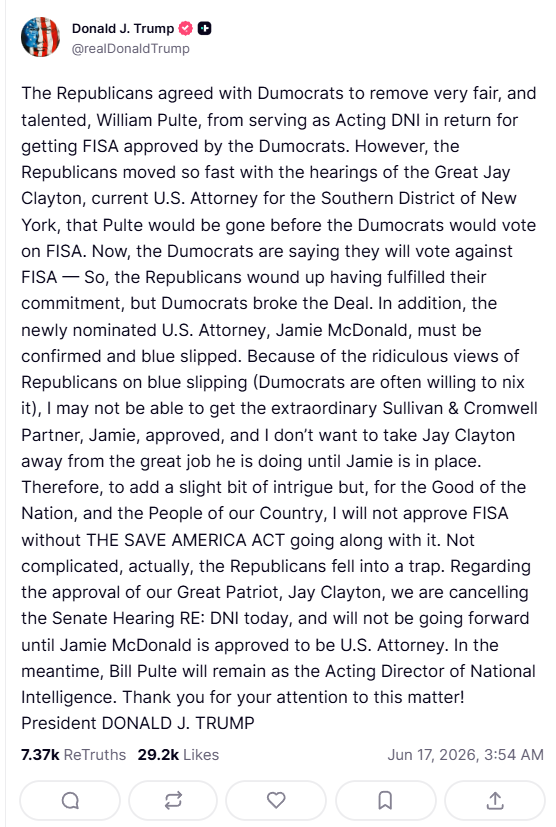
However, in a sudden tactical pivot, President Trump used his social media platform to announce that he was freezing Clayton’s nomination and deliberately keeping Pulte in place as the acting chief. The President accused Democrats of breaking faith on broader agreements and laid out explicit new conditions for allowing the national security bill to move forward. He declared that he would not sign any FISA reauthorization unless Congress concurrently passed the SAVE (Safeguarding American Voter Eligibility) America Act—a Republican-backed piece of legislation that mandates strict proof of citizenship and physical voter ID for federal elections.
“Therefore, to add a slight bit of intrigue but, for the Good of the Nation, and the People of our Country, I will not approve FISA without THE SAVE AMERICA ACT going along with it,” Trump stated.
This maneuver effectively linked an essential foreign policy and counter-terrorism tool to a domestic election-law dispute. The strategy was immediately met with skepticism by congressional leadership. Senate Majority Leader John Thune labeled the plan to attach the voter ID bill to the surveillance package “unrealistic,” noting that the SAVE America Act lacks even the 60 votes needed to overcome a filibuster in the Senate, primarily due to unified Democratic opposition.
+-----------------------------------------------------------------------------------+
|                           THE SURVEILLANCE & VOTING STALEMATE                     |
+------------------------------------+----------------------------------------------+
| Administration Stance              | Congressional Obstacles                      |
+------------------------------------+----------------------------------------------+
| • Keeps Bill Pulte as Acting DNI   | • Bipartisan pushback over Pulte's lack of   |
|   to oversee "renovation."         |   intelligence experience.                   |
|                                    |                                              |
| • Delays Jay Clayton's permanent   | • Democrats refuse to pass FISA extension    |
|   nomination hearings.             |   while Pulte runs the ODNI.                 |
|                                    |                                              |
| • Demands the SAVE America Act be  | • Majority Leader Thune calls the attachment |
|   attached to the FISA bill.       |   of the voter ID bill "unrealistic."        |
+------------------------------------+----------------------------------------------+
National Security Implications and Next Steps
The political game of chicken has raised alarm bells across the intelligence community. While a technical lapse of Section 702 does not completely strip federal agencies of their current operational capabilities overnight, it introduces severe legal and structural vulnerabilities. Legal experts and lawmakers warn that a prolonged lapse will expose ongoing surveillance programs to aggressive constitutional and court challenges. This legal uncertainty could cause private telecommunications companies to hesitate or refuse to cooperate with federal data requests, leading to what intelligence officials describe as “stale intelligence.”
The timing of the lapse is particularly sensitive. Security officials have noted that a disruption in high-level intelligence reporting occurs just as major domestic security operations are ramping up for global events hosted across American cities, alongside preparations for the nation’s 250th anniversary.
As Congress remains deadlocked, some lawmakers have urged the White House to consider alternative administrative pathways, such as a targeted executive order, to keep data streams flowing and prevent a total drop-off in foreign monitoring. However, such stopgap measures face murky legal prospects. For the moment, the path forward remains entirely dependent on whether the White House will relent on its demands regarding the SAVE America Act, or if congressional leaders can assemble an alternate bipartisan coalition strong enough to force a resolution over the President’s objections.
Sources and Links:
- PBS NewsHour: WATCH: House rejects short-term FISA extension
- Fox Business: Congress fails to pass FISA extension, Trump demands Save America Act attachment
- CBS News: Trump puts Jay Clayton’s nomination for intel chief on hold
- Associated Press via PBS NewsHour: WATCH LIVE: Senate meets after deal to renew expiring surveillance program falters
- Associated Press via AP News: Trump sticks with Pulte for intel job as risk grows of lapse in spy powers
Disclaimer
Artificial Intelligence Disclosure & Legal Disclaimer
AI Content Policy.
To provide our readers with timely and comprehensive coverage, South Florida Reporter uses artificial intelligence (AI) to assist in producing certain articles and visual content.
Articles: AI may be used to assist in research, structural drafting, or data analysis. All AI-assisted text is reviewed and edited by our team to ensure accuracy and adherence to our editorial standards.
Images: Any imagery generated or significantly altered by AI is clearly marked with a disclaimer or watermark to distinguish it from traditional photography or editorial illustrations.
General Disclaimer
The information contained in South Florida Reporter is for general information purposes only.
South Florida Reporter assumes no responsibility for errors or omissions in the contents of the Service. In no event shall South Florida Reporter be liable for any special, direct, indirect, consequential, or incidental damages or any damages whatsoever, whether in an action of contract, negligence or other tort, arising out of or in connection with the use of the Service or the contents of the Service.
The Company reserves the right to make additions, deletions, or modifications to the contents of the Service at any time without prior notice. The Company does not warrant that the Service is free of viruses or other harmful components.