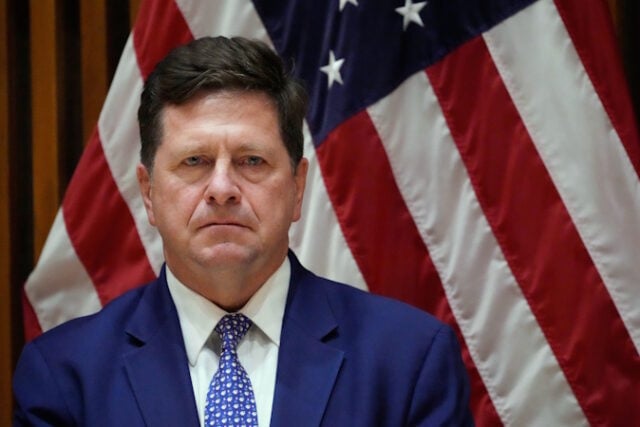
WASHINGTON — In a major personnel shift intended to break a high-stakes legislative deadlock over national security powers, President Donald Trump announced on Thursday that he will nominate Jay Clayton to serve as the permanent Director of National Intelligence (DNI).
Clayton, who currently serves as the U.S. Attorney for the Southern District of New York (SDNY) and previously led the Securities and Exchange Commission (SEC) during Trump’s first term, is being tapped to helm the Office of the Director of National Intelligence (ODNI). The cabinet-level position coordinates the sprawling, multi-billion-dollar apparatus of the United States’ 18 intelligence agencies.
The surprise announcement, shared via a post on Trump’s Truth Social platform, comes as the administration faces intense bipartisan criticism over its stopgap plan to install Bill Pulte as the acting spy chief. It also coincides with a fast-approaching deadline on a powerful, post-9/11 foreign electronic surveillance tool, which is now on track to lapse following a legislative stalemate tied directly to the intelligence leadership dispute.
From Wall Street and Main Justice to Global Intelligence
Jay Clayton, a veteran corporate attorney, has spent much of his career at the pinnacle of the American legal and financial sectors. A graduate of the University of Pennsylvania’s Carey Law School and the Wharton School, he spent decades at the elite international law firm Sullivan & Cromwell, eventually serving as its leader. In his Truth Social announcement, Trump leaned heavily on Clayton’s legal credentials, praising Sullivan & Cromwell as “one of the most prominent and successful Law Firms anywhere in the World.”

“Few people anywhere in the Legal Community are respected at the level of Jay,” President Trump wrote, urging the United States Senate to proceed to a confirmation vote “as soon as possible.”
During Trump’s first term in office, Clayton chaired the SEC from 2017 to 2020. His tenure at the markets watchdog was defined by a steady, regulatory approach focused on protecting retail investors, navigating the market shocks of the COVID-19 pandemic, managing the financial fallout of Brexit, and creating early regulatory frameworks for digital assets and cryptocurrencies. After a brief return to the private sector as the independent chair of Apollo Global Management, Clayton re-entered public service in April 2025 when he was sworn in as the U.S. Attorney for the Southern District of New York.
As the top federal prosecutor in Manhattan, Clayton inherited an office with a massive, prestigious portfolio. The SDNY is renowned for handling high-profile cases involving financial fraud, public corruption, international terrorism, and foreign espionage. During his tenure, Clayton oversaw complex international files, including the high-stakes drug trafficking prosecutions of former Venezuelan President Nicolás Maduro and his wife, Cilia Flores, as well as the unsealing of extensive court records related to the Jeffrey Epstein sex-trafficking investigation.
Despite taking the reins during a turbulent period marked by the high-profile exit of veteran prosecutors, Clayton maintained stability in the district, earning a reputation among lawmakers as an institutionalist capable of managing delicate legal and political realities.
The Pushback and the Pulte Contretemps
The decision to name Clayton as a permanent nominee came less than two weeks after the White House caused a firestorm by announcing that Bill Pulte, the 38-year-old current head of the Federal Housing Finance Agency, would step into the DNI role on an acting basis. The vacancy arose following the sudden resignation of former DNI Tulsi Gabbard, who stepped down to care for her husband during cancer treatment.
Trump had planned for Pulte to take over the acting role on June 19, explicitly tasking him with downsizing the ODNI—an agency that Trump’s administration has worked to scale back. However, Pulte’s nomination immediately drew furious blowback from Democrats and deep skepticism from institutional Republicans. Critics pointed out that Pulte, a close political ally of the president, possessed zero background in national security, military operations, or foreign intelligence gathering.
On Capitol Hill, House Minority Leader Hakeem Jeffries publicly characterized Pulte as “deeply unqualified” to lead the nation’s intelligence apparatus. Concerns mounted among opposition lawmakers that a political loyalist without intelligence background could potentially weaponize sensitive, classified material against the president’s domestic political rivals.
The backlash soon crystallized into a severe legislative standoff that derailed one of the government’s primary counterterrorism tools.
A Surveillance Crisis in Congress
The primary casualty of the political battle over Pulte has been Section 702 of the Foreign Intelligence Surveillance Act (FISA). Originally enacted after the September 11 attacks, Section 702 permits U.S. spy agencies to intercept the digital communications of non-U.S. citizens located abroad without a warrant, even when those communications pass through American telecom networks. U.S. intelligence officials view the program as absolutely vital for stopping cyberattacks, disrupting espionage, and tracking foreign adversaries.
FISA Section 702 was scheduled to lapse at midnight on Friday. In an attempt to buy time, congressional leadership attempted to pass a short-term, three-week extension of the program. However, congressional Democrats leveraged the vote as a point of maximum political pressure, declaring they would uniformly block any renewal of the spy powers unless Trump backed away from Pulte and named a qualified, permanent nominee.
On Thursday morning, the gambit played out on the House floor. The short-term FISA extension failed in a 198–218 vote, guaranteeing that Section 702 would lapse at midnight. Following the failed vote, the House adjourned and left Washington for a scheduled recess, meaning lawmakers will not return to the Capitol until the week of June 22.
While intelligence agencies can legally keep existing surveillance streams running for a limited period under current court orders, the formal expiration of the law represents a significant disruption and a sharp rebuke of the administration’s initial intelligence management plans.
Early Senate Reactions and the Path to Confirmation
While Clayton’s nomination was explicitly intended to calm the waters and break the congressional deadlock, it arrived too late to prevent the immediate expiration of FISA. Nevertheless, the selection of the veteran prosecutor has noticeably shifted the political dynamic in Washington, drawing early signs of bipartisan relief.
Representative Jim Himes of Connecticut, the ranking Democrat on the House Intelligence Committee, spoke warmly of the nominee, noting that he has known and respected Clayton for decades. “His intelligence, temperament, and deep commitment to public service will make him a terrific DNI,” Himes stated, while observing wistfully that if Clayton had been selected a week earlier, “lots of pain might have been avoided.”
In the upper chamber, Senate Majority Leader John Thune expressed optimism about a swift confirmation path. Thune stated that the Senate could move “fairly quickly” to vet and confirm Clayton once the White House transmits the formal nomination paperwork, praising Clayton’s “great reputation” within the Senate.
However, the nomination has not entirely erased the underlying conflict. Senate Democratic Leader Chuck Schumer reacted to the news by reiterating that the administration must completely abandon its interim plans. “Pulte has to go,” Schumer remarked plainly to reporters. “He cannot be in the DNI role. It’s too important.”
Because Clayton must undergo a formal Senate confirmation process—including hearings before the Senate Intelligence Committee—it remains mathematically impossible for him to be confirmed before the planned June 19 transition date. The White House must now decide whether to proceed with installing Pulte as a short-term caretaker, which would prolong the fight with Capitol Hill, or name an alternative acting official from within the professional intelligence ranks to manage the agency until Clayton is formally confirmed.
Sources and Links
- CBS News: Trump nominating prosecutor Jay Clayton to be next director of national intelligence
- Associated Press (AP News): Trump plans to nominate US Attorney Jay Clayton to be national intelligence director
- The Guardian: Trump nominates former SEC chair Jay Clayton as national intelligence director – US politics live
- PBS NewsHour: Trump plans to nominate U.S. Attorney Jay Clayton to be national intelligence director
- The Washington Post: Trump picks Jay Clayton, Manhattan U.S. attorney, to be director of national intelligence
- Axios: Trump picks Jay Clayton for Director of National Intelligence
- The Daily Pennsylvanian: Trump taps Penn professor Jay Clayton as next director of national intelligence
- Iowa Public Radio (NPR): Trump names Jay Clayton to serve as director of national intelligence
Disclaimer
Artificial Intelligence Disclosure & Legal Disclaimer
AI Content Policy.
To provide our readers with timely and comprehensive coverage, South Florida Reporter uses artificial intelligence (AI) to assist in producing certain articles and visual content.
Articles: AI may be used to assist in research, structural drafting, or data analysis. All AI-assisted text is reviewed and edited by our team to ensure accuracy and adherence to our editorial standards.
Images: Any imagery generated or significantly altered by AI is clearly marked with a disclaimer or watermark to distinguish it from traditional photography or editorial illustrations.
General Disclaimer
The information contained in South Florida Reporter is for general information purposes only.
South Florida Reporter assumes no responsibility for errors or omissions in the contents of the Service. In no event shall South Florida Reporter be liable for any special, direct, indirect, consequential, or incidental damages or any damages whatsoever, whether in an action of contract, negligence or other tort, arising out of or in connection with the use of the Service or the contents of the Service.
The Company reserves the right to make additions, deletions, or modifications to the contents of the Service at any time without prior notice. The Company does not warrant that the Service is free of viruses or other harmful components.