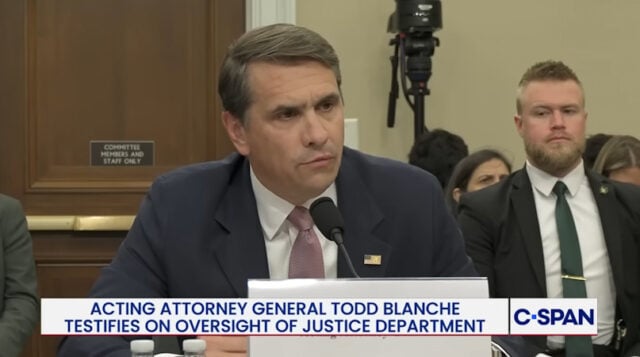
WASHINGTON — In a dramatic Capitol Hill reversal that reshapes the federal budget landscape, Acting Attorney General Todd Blanche announced Tuesday that the Trump administration is permanently abandoning its highly controversial $1.8 billion “Anti-Weaponization Fund.”
Video courtesy of C-Span
Appearing before a House Appropriations subcommittee, Blanche attempted to put a definitive end to weeks of intense political warfare, stating unequivocally that the administration would not revive the initiative under any circumstances.
“We are not moving forward with the fund. Period,” Blanche told lawmakers during an oversight hearing for the Department of Justice (DOJ) budget.

When pressed by Representative Grace Meng, a New York Democrat, on whether “not moving forward” meant the program was finished forever, Blanche responded with a single word: “Correct.”
The sudden surrender marks a significant retreat for the White House. The fund, which was formally structured at $1.776 billion in a nod to patriotic imagery, was intended to compensate individuals who claimed they were unfairly targeted or “weaponized” against by federal agencies. However, the program faced an immediate avalanche of bipartisan criticism, legal challenges, and deep skepticism from fiscal conservatives and civil rights advocates alike.
+-----------------------------------------------------------------+
|                   THE ANTI-WEAPONIZATION FUND                   |
+-----------------------------------------------------------------+
| Proposed Budget:   $1.776 Billion                               |
| Origin:            Trump v. IRS Legal Settlement                |
| Stated Purpose:    Compensate victims of federal "weaponization"|
| Primary Critics:   House/Senate Democrats, Senate Republicans   |
| Current Status:    Permanently Defunct                          |
+-----------------------------------------------------------------+
The Legal Roots and Rapid Collapse
The collapse of the multi-billion-dollar fund was accelerated by a swift sequence of events in both the judiciary and the halls of Congress. The fund’s origins trace back to a legal settlement reached between President Donald Trump, his family, his business entities, and his own Justice Department. The settlement was designed to resolve a $10 billion lawsuit Trump had filed against the Internal Revenue Service (IRS) concerning the unauthorized leaking of his tax records during his previous term.
As part of the resolution to drop the private lawsuit, the DOJ agreed to establish the massive compensation fund. However, the mechanism immediately drew fierce resistance from outside watchdog groups. Last week, a federal judge in the U.S. District Court for the Eastern District of Virginia issued a temporary injunction blocking the creation of the fund, responding to a lawsuit brought by the advocacy group Democracy Forward and other plaintiffs.
On Monday, the Justice Department issued a cautious public statement indicating that it would abide by the court order while the litigation played out. That statement, however, left a cloud of ambiguity over Washington, leading critics to worry that the administration might simply resurrect the program after the temporary judicial block expired on June 12.
Blanche’s testimony on Tuesday was designed to erase that ambiguity for restive lawmakers, though he maintained that the philosophical intent behind the program was justified.
“The reasons for the fund, I think, remain as important as they were before, but we are not moving forward with the fund,” Blanche testified, defending the underlying premise that many citizens have had the machinery of government weaponized against them.
Bipartisan Backlash Grips the Capitol
The political pressure on the Justice Department had reached a boiling point, threatening to derail the broader legislative goals of congressional leadership. In the House, Democrats fiercely denounced the program as a non-transparent partisan piggy bank. Representative Rosa DeLauro, the ranking Democrat on the House Appropriations Committee, used her opening remarks to lambast the initiative, characterizing it as an unconscionable “slush fund” that could theoretically be used to distribute taxpayer dollars to political allies or individuals convicted of violent crimes during the January 6, 2021, Capitol riot.
DeLauro also pointedly highlighted Blanche’s past professional relationship as Trump’s personal criminal defense attorney, arguing that the creation of the fund represented an institutional conflict of interest.
“It is unconscionable that taxpayer dollars could be used to pay off just about anyone for just about anything,” DeLauro remarked during the sharp exchange.
Equally damaging to the fund’s survival was an unexpected mutiny among Senate Republicans. Bipartisan resistance to the program had successfully paralyzed a critical $70-plus billion budget reconciliation package intended to fund vital immigration enforcement agencies, including Immigration and Customs Enforcement (ICE) and the U.S. Border Patrol.
Republican leadership had hoped to pass the security funding bill before the Memorial Day recess, but a faction of Senate Republicans refused to advance the legislation while the anti-weaponization fund remained on the table. Lawmakers like Senator Thom Tillis of North Carolina openly pledged to vote to strike down the fund if it arrived on the Senate floor, while others expressed deep discomfort with the lack of legislative oversight regarding how the $1.8 billion would be managed and distributed.
Timeline of the Fund's Demise (2026)
├─ Mid-May: Trump settles IRS lawsuit; DOJ announces $1.776B fund.
├─ Late May: Senate GOP halts $70B immigration bill over fund dispute.
├─ May 28: Federal judge issues temporary injunction blocking the fund.
├─ June 1: DOJ agrees to abide by court order; fiscal uncertainty remains.
└─ June 2: Acting AG Blanche tells Congress the fund is permanently dead.
The Remaining Audit Immunity Dispute
While Blanche’s declaration that the fund is “dead” provided a sigh of relief to legislative schedulers, it did not entirely defuse the political tension surrounding the original IRS settlement. During the hearing, Democratic lawmakers highlighted that while the $1.8 billion payout mechanism has been destroyed, other core components of the President’s settlement with the IRS remain fully intact.
Specifically, the settlement agreement bars the IRS “forever” from pursuing any past tax filings or claims against President Trump, his children, or his corporate entities. According to an independent analysis by The New York Times, this permanent immunity from historical audits could save the Trump family upwards of $100 million in potential liabilities and ongoing legal expenses.
Representative DeLauro pressed Blanche on this aspect of the agreement, accusing the Justice Department of granting a blanket, unprecedented immunity to the Chief Executive and his immediate family from future tax investigations.
Blanche aggressively pushed back against that characterization, arguing that the audit limitations were standard legal concessions made in the course of resolving a major civil dispute.
“It’s standard. It’s typical,” Blanche insisted, explaining that mutual releases of claims are a routine feature of standard federal lawsuit settlements and do not equate to a specialized shield against accountability.
However, the permanent audit ban continues to draw fire from both sides of the aisle. Some Republican senators indicated Tuesday that wiping out the fund was only the first step. Senator John Curtis, a Republican from Utah, publicly expressed dismay over the ongoing IRS restrictions, labeling that portion of the deal “part of the problem” and stating that he wanted it entirely dismantled.
“I need it dead, dead,” Curtis reportedly said to journalists, signaling that congressional scrutiny over the settlement is unlikely to fade quickly.
The Path Forward for Budget Legislation
The immediate consequence of Blanche’s absolute renunciation of the fund is the liberation of the stalled immigration enforcement bill. Senate Majority Leader John Thune told reporters on Tuesday morning that he had spoken directly with Blanche ahead of the afternoon testimony. Thune expressed optimism that an absolute, public declaration from the nation’s top law enforcement official would “create the certainty” required to unite the fractured Republican conference and advance the reconciliation package.
“We are not guaranteeing that happens yet,” Thune cautioned, noting that some lawmakers were still digesting the fast-moving developments, but leadership figures on the Hill indicated they hoped to begin rolling procedural votes as early as Wednesday morning.
The political fallout, however, will likely linger. Outside legal groups that initiated the lawsuits against the Department of Justice expressed skepticism about Blanche’s verbal assurances. Skye Perryman, the president and CEO of Democracy Forward, issued a statement challenging the administration to formalize its policy shift within the judicial system rather than relying solely on congressional testimony.
“If you can say it on TV, you should say it in court,” Perryman said, noting that her organization would closely monitor upcoming court filings to ensure the administration formally rescinds the operational framework of the fund in writing.
During the hearing, Representative Meng repeatedly requested that Blanche commit to submitting a formal, written cancellation of the fund to the committee. Blanche declined to provide a separate written document, arguing that his statements before Congress, preserved forever in the official legislative record, were binding enough.
“Why do I need to put something in writing if I’m telling you what we’re doing?” Blanche asked.
“You established it in writing, so it just makes sense to rescind it in writing,” Meng countered, reflecting the deep-seated distrust that remains between the administration and congressional overseers. “I’m just concerned because you’re not under oath… and putting it in writing would settle that issue.”
With the $1.8 billion program officially neutralized, the focus shifts back to the broader federal budget battle. While the Trump administration suffered a high-profile defeat on its signature compensation fund, the survival of the IRS audit immunity ensures that the true legal and financial boundaries of the President’s settlement will remain a battleground for weeks to come.
Sources and Links:
- PBS News: WATCH: Trump administration ‘not moving forward’ with anti-weaponization fund, Blanche testifies
- The Guardian: Trump’s $1.8bn ‘anti-weaponization’ fund scrapped, acting attorney general Todd Blanche confirms – as it happened
- Courthouse News Service: Blanche says Trump’s $1.8 billion ‘anti-weaponization’ fund is dead
- The Fiscal Times: $1.8 Billion ‘Anti-Weaponization’ Fund Is Dead, Blanche Says, but Trump’s IRS Immunity Remains
- CBS News: Blanche says DOJ “not moving forward” with $1.8 billion “anti-weaponization” fund
- WYSO Public Radio (NPR): Blanche says DOJ has nixed the ‘anti-weaponization’ fund
- Punchbowl News: Blanche: ‘Weaponization’ fund out
- Washington Examiner: Todd Blanche says DOJ will not move forward with anti-weaponization fund
Disclaimer
Artificial Intelligence Disclosure & Legal Disclaimer
AI Content Policy.
To provide our readers with timely and comprehensive coverage, South Florida Reporter uses artificial intelligence (AI) to assist in producing certain articles and visual content.
Articles: AI may be used to assist in research, structural drafting, or data analysis. All AI-assisted text is reviewed and edited by our team to ensure accuracy and adherence to our editorial standards.
Images: Any imagery generated or significantly altered by AI is clearly marked with a disclaimer or watermark to distinguish it from traditional photography or editorial illustrations.
General Disclaimer
The information contained in South Florida Reporter is for general information purposes only.
South Florida Reporter assumes no responsibility for errors or omissions in the contents of the Service. In no event shall South Florida Reporter be liable for any special, direct, indirect, consequential, or incidental damages or any damages whatsoever, whether in an action of contract, negligence or other tort, arising out of or in connection with the use of the Service or the contents of the Service.
The Company reserves the right to make additions, deletions, or modifications to the contents of the Service at any time without prior notice. The Company does not warrant that the Service is free of viruses or other harmful components.