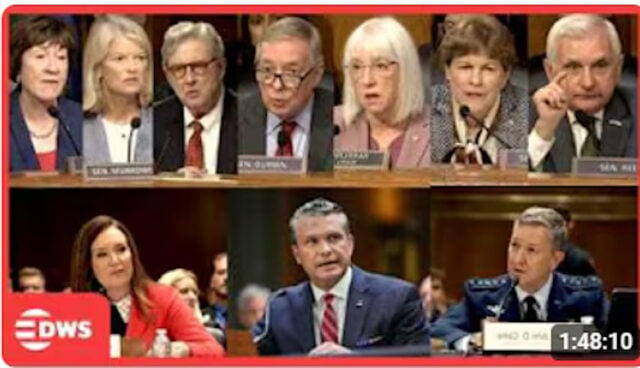
Capitol Hill saw plenty of sparks flying on Tuesday as Defense Secretary Pete Hegseth and Chairman of the Joint Chiefs of Staff Gen. Dan Caine stepped into the hot seat before the Senate Appropriations Committee. The duo arrived with a massive ask from the White House: an $87.6 billion emergency supplemental funding request, with $67.1 billion earmarked directly for defense to sustain ongoing military operations in the Middle East and replenish critical equipment stocks.

Hegseth kicked off his testimony by framing the request as an “urgent, necessary injection of resources” vital for maintaining military readiness and rebuilding depleted stockpiles. According to the Defense Secretary, the military requires a generational investment to deliver true “peace through strength” and build a force so capable that no foreign adversary would dare challenge it. Gen. Caine joined Hegseth to outline specific operational needs, including $20 billion for military pay and for forward-deployed forces, alongside $40 billion to accelerate production lines for high-demand munitions such as solid rocket motors.
However, the mood inside the hearing room quickly turned tense as lawmakers grilled the Pentagon leaders over the strategy, duration, and skyrocketing price tag of the military campaign. Under intense questioning from Sen. Dick Durbin, Hegseth disclosed that the conflict with Iran has already racked up an estimated $37.5 billion in costs to date.
That eye-popping number didn’t sit well with Senate Democrats. Committee member Sen. Patty Murray delivered a stern warning, declaring that Congress would not simply “rubber-stamp a request to bankroll this war”. Murray argued that the conflict risks spiraling into “another forever war” with unclear end goals. Meanwhile, Sen. Kirsten Gillibrand slammed the optics of the request, telling Hegseth that constituents back home are struggling with rising housing, food, and fuel prices while the administration asks for “unlimited money for bombs”.
The hearing reached its boiling point during several sharp clashes between Hegseth and his congressional critics. Unwilling to back down, Hegseth fired back at lawmakers who questioned the administration’s strategic direction. He sharply criticized those raising doubts, stating that the “biggest adversary we face at this point are the reckless naysayers and defeatist words” coming from Capitol Hill. Hegseth insisted that delaying or denying the requested emergency funds would create dangerous shortfalls for troops deployed in high-risk zones.
Protesters repeatedly interrupted Hegseth’s opening statement, highlighting the intense public scrutiny surrounding the administration’s military actions. Senate Democratic Leader Chuck Schumer also took aim at Hegseth’s public focus, questioning his leadership priorities while casualty reports from the ongoing strikes continued to mount.
Despite the fierce pushback, Hegseth and Caine maintained that every dollar in the supplemental request is essential to restore deterrence and keep American service members safe. With Congress heading toward a pivotal vote, the fiery session underscored the deep ideological divide over defense spending and America’s military posture abroad.
Sources and Links:
- U.S. Department of War – Hegseth, Caine Testify in Support of Supplemental Budget Request
- PBS News – Senators grilled Hegseth on Iran. Here are 3 big moments from the hearing
- CBS News – Iran war has cost $37.5 billion, Hegseth says, as conflict escalates
- Air Force Times – Cost of Iran war rises to $37.5 billion, Pentagon requests $67.1 billion more
- Colorado Politics – Hegseth questioned by senators over funding for the Iran war
- PBS News – 4 takeaways from Hegseth’s hearings on historic defense budget request, Iran war
Disclaimer
Artificial Intelligence Disclosure & Legal Disclaimer
AI Content Policy.
To provide our readers with timely and comprehensive coverage, South Florida Reporter uses artificial intelligence (AI) to assist in producing certain articles and visual content.
Articles: AI may be used to assist in research, structural drafting, or data analysis. All AI-assisted text is reviewed and edited by our team to ensure accuracy and adherence to our editorial standards.
Images: Any imagery generated or significantly altered by AI is clearly marked with a disclaimer or watermark to distinguish it from traditional photography or editorial illustrations.
General Disclaimer
The information contained in South Florida Reporter is for general information purposes only.
South Florida Reporter assumes no responsibility for errors or omissions in the contents of the Service. In no event shall South Florida Reporter be liable for any special, direct, indirect, consequential, or incidental damages or any damages whatsoever, whether in an action of contract, negligence or other tort, arising out of or in connection with the use of the Service or the contents of the Service.
The Company reserves the right to make additions, deletions, or modifications to the contents of the Service at any time without prior notice. The Company does not warrant that the Service is free of viruses or other harmful components.