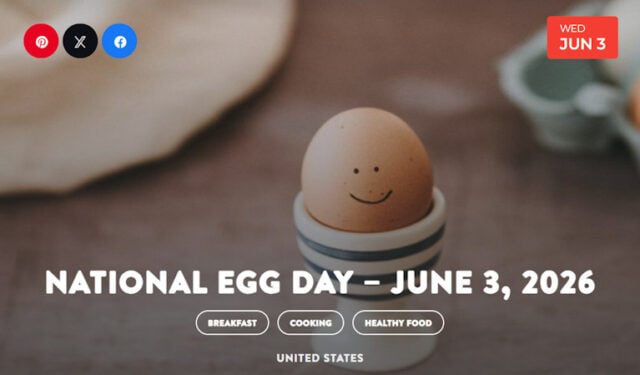
June 3rd is time to get a crack on the annual observance of National Egg Day!
- 3200 BC – Around this time, jungle birds are domesticated for egg production. Archaeological evidence for egg consumption dates back to this period.
- 1400 BC – Fowl laid eggs for human consumption as early as 1400 B.C., according to records from Egypt and China.
- 300 BC – Chicken farmers start incubating chicken eggs in warm clay ovens
- 1504 – The ostrich egg globe was made from real ostrich eggs. This is one of the oldest globes ever made. It originated in the year 1504 and was made to depict the New World. This globe is engraved with immaculate details on two conjoined halves of an ostrich egg.
- 1898 – “Eggs and How to Use Them” is published. Written by Alphonse Meyer, this book features the life story of the egg as well as cooking instructions.
- 1912 – three men from the United Kingdom wanted to examine the embryonic contents of emperor penguin eggs. During their expedition, one man broke his teeth from the violent shaking from the cold.
- 1920s – Eggs are still mostly farmed in backyards.
- 1930s – Dried eggs are manufactured. Helping with transport and preservation, especially during wartime shortages, dried eggs are mass-produced.
- 1956 – The largest recorded chicken egg in history weighs 16 ounces!
- 1976 – “The Incredible, Edible Egg” slogan premieres. This jingle for the American Egg Board was released and became a commonly known household phrase.
- 2010 – A hen named Harriet has laid the world’s largest egg. In 2010, a hen in the United Kingdom hatched an egg measuring 9.1 inches in diameter.
- The nutrient-rich food has gone back and forth with science and nutritionists over the decades as to just how many eggs are too many for a healthy diet.
- One egg provides an excellent source of protein and vitamin D. At 75 calories and 5 grams of fat, it’s an easy choice to satisfy hunger, too.
- Some historians believe humans have been eating eggs for over 6 million years!
- Some of these more unique edible eggs include duck eggs, goose eggs, emu eggs, ostrich eggs and even crocodile eggs!
- Health benefits
- Eggs provide complete protein. The combination of the egg yolk and the egg white offers 6 full grams of protein as well as all nine essential amino acids, which act as the building blocks for protein.
- Eggs support good cholesterol. Some studies show that people who eat three or more eggs per day can expect a boost to their HDL, which is the “good” cholesterol.
- Eggs contain antioxidants. Many people don’t realize that eggs contain lutein and zeaxanthin, which are important compounds that help keep the eyes healthy and protect them from cataracts and other age-related eye diseases.
- Eggs have Vitamin D. The yolk of the egg is one of the few foods that naturally contain this vitamin.
- An eggshell has thousands of pores — up to 17,000! These pores allow for gases to transfer through the shell, receiving oxygen and giving off carbon dioxide as well as other gases.
- The color of the eggshell is completely determined by the breed of the bird laying the eggs. And the earlobe color of the chicken is associated with the color of the eggshell!
- Some breeds can also lay blue, green or pink eggs.
- An average hen lays 300 to 325 eggs each year — almost one every day. And as the hen gets older, the eggs get larger.
- After a hen lays an egg, she turns it dozens of times a day to keep the yolk from sticking to the side of the shell.
- Each average-sized egg contains around 6-7 grams of protein
- Raw vs. hard-boiled spin test: Spin one raw egg and one hard-boiled egg. The hard-boiled egg spins more smoothly because the inside is solid. Stop both eggs with a finger and release. The raw egg often starts spinning again because the liquid interior keeps moving.
- Freshness float test: Place an egg in water. Fresher eggs tend to sink and lie flat; older eggs often tilt upward or float because the air cell grows over time as moisture slowly evaporates through the shell. Floating is a clue, not a full diagnosis. Smell and appearance still matter.
- Saltwater density trick: Try an egg in plain water and then in salt water. Adding salt increases the water’s density, which can help an egg float.
- “Naked egg” experiment: Soak an egg in vinegar to dissolve the shell and reveal the flexible membrane. It becomes bouncy and translucent, which feels like kitchen magic but is really chemistry at work.
- One large egg has around 72 calories.
- Eggs are good for your eyes. They contain lutein, which prevents cataracts and muscle degeneration.
- If you drop an egg on the floor, sprinkle it heavily with salt to make cleanup easier.
- The fastest omelet maker in the world made 427 two-egg omelets in 30 minutes.
- More than 105-109 billion eggs are produced in the US yearly.
- Iowa produces over 15 billion eggs yearly.
- The next state to produce the next number of eggs is Ohio at 7.9 billion eggs per year.
Sources:

Disclaimer
Artificial Intelligence Disclosure & Legal Disclaimer
AI Content Policy.
To provide our readers with timely and comprehensive coverage, South Florida Reporter uses artificial intelligence (AI) to assist in producing certain articles and visual content.
Articles: AI may be used to assist in research, structural drafting, or data analysis. All AI-assisted text is reviewed and edited by our team to ensure accuracy and adherence to our editorial standards.
Images: Any imagery generated or significantly altered by AI is clearly marked with a disclaimer or watermark to distinguish it from traditional photography or editorial illustrations.
General Disclaimer
The information contained in South Florida Reporter is for general information purposes only.
South Florida Reporter assumes no responsibility for errors or omissions in the contents of the Service. In no event shall South Florida Reporter be liable for any special, direct, indirect, consequential, or incidental damages or any damages whatsoever, whether in an action of contract, negligence or other tort, arising out of or in connection with the use of the Service or the contents of the Service.
The Company reserves the right to make additions, deletions, or modifications to the contents of the Service at any time without prior notice. The Company does not warrant that the Service is free of viruses or other harmful components.