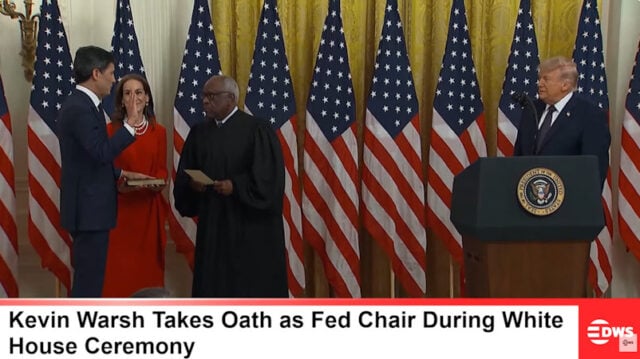
WASHINGTON, D.C. — In a ceremony inside the East Room of the White House, Kevin Warsh was officially sworn in as the 11th chair of the modern Federal Reserve. The high-profile event marks the transition in leadership of the world’s most powerful central bank from Jerome Powell to Warsh, a former Fed governor and Wall Street financier.
The transition comes at a highly fraught moment for the United States economy. The Trump administration faces intense domestic pressure over a recent spike in consumer prices, fueled by an escalating international conflict and aggressive tariff policies. Amid these complex economic crosscurrents, the swearing-in ceremony highlighted a central paradox: President Donald Trump’s public demand for central bank autonomy, juxtaposed with his year-long campaign to pressure the Federal Reserve to lower interest rates.
The Swearing-In Ceremony
The ceremony drew an influential crowd to the White House, including Supreme Court justices, members of Congress, Cabinet officials, and prominent leaders from the financial sector. Supreme Court Justice Clarence Thomas administered the oath of office. Warsh, 56, placed his hand on a Bible held by his wife, Jane Lauder, an heiress to the Estée Lauder Companies.
President Trump introduced Warsh with substantial praise, predicting a historic tenure for his nominee.

“Honestly, I really mean this, this is not said in any other way, I want Kevin to be totally independent,” Trump stated during his introductory remarks. “I want him to be independent and just do a great job. Don’t look at me, don’t look at anybody, just do your own thing and do a great job, OK?”
Trump added that he believes Warsh “will go down as one of the truly great chairmen of the Federal Reserve that we’ve ever had,” asserting that “no one in America is better prepared” to guide the central bank.
The President’s public insistence on Fed independence marked a distinct shift in rhetoric. For more than a year following his return to the Oval Office, Trump has criticized the central bank’s monetary policy. He waged a persistent public campaign against outgoing Chair Jerome Powell, frequently targeting Powell for his cautious approach to lowering interest rates.
Trump has previously applied harsh rhetoric to Powell, openly discussing the possibility of dismissing him. This pressure culminated in a federal criminal investigation into Powell, which prosecutors officially closed after a judge agreed the probe appeared to be an attempt at intimidation. The investigation was subsequently handed over to the Fed’s internal watchdog, clearing the legislative logjam that had temporarily stalled Warsh’s confirmation process.
Despite his explicit directive for Warsh to ignore outside opinions, Trump immediately qualified his statement by asserting that the central bank had “lost its way in recent years” under Powell’s stewardship.
Warsh’s Vision and Economic Theory
Upon taking the podium, Warsh pledged to lead a “reform-oriented Federal Reserve.” He outlined an optimistic economic outlook that aligns with some of the administration’s supply-side goals while maintaining a focus on core macroeconomic indicators.
“Inflation can be lower, growth stronger, real take-home pay higher, and America can be more prosperous,” Warsh declared, identifying these markers as vital to national economic stability.
Warsh steps into the role with a long history in both public policy and private finance. After earning a law degree from Harvard University in 1995, he worked in mergers and acquisitions at Morgan Stanley, eventually rising to executive director. In 2002, President George W. Bush appointed him as executive secretary of the National Economic Council. In 2006, Bush appointed him to the Federal Reserve Board of Governors, making Warsh the youngest governor in the history of the central bank at age 35.
During the 2008 financial crisis, Warsh served as the central bank’s primary liaison to Wall Street. Alongside then-Fed Chair Ben Bernanke, Timothy Geithner, and Donald Kohn—a group dubbed the “Four Musketeers”—Warsh helped orchestrate major interventions, including the rescue of AIG and JPMorgan Chase’s acquisition of Bear Stearns. However, Warsh later emerged as an internal skeptic of prolonged monetary easing, voicing concerns that aggressive bond-buying programs would eventually trigger severe inflation.
Kevin Warsh: Career Timeline
│
├── 1995: Graduates from Harvard Law School
├── 1996–2002: Investment Banker at Morgan Stanley
├── 2002–2006: Executive Secretary, National Economic Council (Bush Admin)
├── 2006–2011: Youngest-ever Governor on the Federal Reserve Board
├── 2011–2025: Distinguished Visiting Fellow at the Hoover Institution
└── 2026: Sworn in as Chairman of the Federal Reserve
In recent years, Warsh has been an outspoken critic of the Federal Reserve’s modern operational framework. Operating from the right-leaning Hoover Institution, he publicly called for a “regime change” at the central bank, arguing that its monetary policy framework had broken down.
To reconcile his historical stance as an inflation hawk with Trump’s demands for lower interest rates, Warsh has advanced a unique supply-side economic theory centered on technology. He argues that the rapid acceleration of artificial intelligence represents a profound productivity wave capable of significantly expanding economic output. Under this framework, Warsh posits that the U.S. economy can sustain lower interest rates and aggressive growth without triggering inflationary feedback loops, because technological efficiency will naturally offset rising demand.
Macroeconomic Headwinds and Market Realities
Warsh takes control of the Federal Reserve at a deeply volatile period for global and domestic markets. The incoming chairman faces immediate economic pressures that may complicate any near-term plans to reduce borrowing costs.
- Stubbornly High Inflation: The Consumer Price Index (CPI) report showed year-over-year inflation rising to 3.8%, a three-year high. Concurrently, the March Personal Consumption Expenditures (PCE) index—the Fed’s preferred inflation metric—registered at 3.5%, well above the central bank’s long-term 2% target.
- Surging Fuel Prices: Driven by the geopolitical fallout of the war on Iran, nationwide retail fuel prices surged to an average of $4.55 per gallon, representing a steep increase of $1.35 compared to the previous year.
- Rising Bond Yields: Long-term Treasury yields have climbed significantly as fixed-income markets price in prolonged inflationary risks and the fiscal implications of the administration’s tariff programs.
Key Economic Indicators (May 2026)
┌──────────────────────────────────────┬──────────┐
│ Indicator                            │ Value    │
├──────────────────────────────────────┼──────────┤
│ Consumer Price Index (YoY)           │ 3.8%     │
│ Personal Consumption Expenditures    │ 3.5%     │
│ National Average Gas Price (Gallon)  │ $4.55    │
│ Federal Reserve Inflation Target     │ 2.0%     │
└──────────────────────────────────────┴──────────┘
These structural realities have created a stark divide between White House expectations and financial market forecasts. While President Trump has frequently asserted that lower interest rates will unlock non-inflationary growth, Wall Street analysts and central bank watchers warn that the macroeconomic landscape is highly restrictive.
Furthermore, Warsh does not possess unilateral authority over monetary policy. He is just one of 12 voting members on the Federal Open Market Committee (FOMC). Ahead of Warsh’s first policy meeting, several regional Fed presidents issued public dissents, signaling a preference for neutral or potentially tighter monetary policy to combat the 3.8% inflation rate. Analysts interpret these internal divisions as a clear message to the incoming chairman that any attempt to aggressively force interest rate cuts will face stiff resistance from the central bank’s career institutionalists.
Political Backlash and Confirmation Controversy
The transition of power at the Federal Reserve has triggered sharp political polarization on Capitol Hill. Warsh’s path to the chairmanship culminated in a near-party-line vote in the Senate, reflecting deep congressional divisions over the future of the nation’s economic governance.
During his confirmation hearings before the Senate Banking Committee, Democratic lawmakers aggressively questioned Warsh regarding his independence from the executive branch. His refusal to explicitly state whether Donald Trump lost the 2020 presidential election drew sharp criticism from progressives, who argued that his hesitation signaled a willingness to prioritize political alignment over institutional norms.
Following the swearing-in ceremony, Senator Elizabeth Warren, the top Democrat on the Senate Banking Committee, issued a blistering statement condemning the appointment.
“Kevin Warsh starts his tenure with his credibility in tatters,” Warren said. “Having proven himself to be Donald Trump’s sock puppet, I worry Mr. Warsh will prioritize the President’s political interests over the economic wellbeing of American families.”
Opposition lawmakers also targeted Warsh over his personal finances. Financial disclosures filed during the confirmation process revealed that Warsh is the wealthiest individual to ever hold the position of Federal Reserve Chair, with a net worth exceeding $100 million. Senate Democrats criticized Warsh for failing to fully disclose the full extent of his private investments, which include notable stakes in high-valuation private firms such as SpaceX and the prediction market platform Polymarket.
Looking Ahead to the June Meeting
The true test of Warsh’s leadership and his commitment to institutional independence will arrive shortly. The new chairman is scheduled to lead his first official FOMC monetary policy meeting.
As the country enters the busy Memorial Day holiday weekend—a period when high fuel prices directly impact millions of traveling Americans—public dissatisfaction with the economy remains elevated. Recent polling data indicates that 68% of Americans believe the administration has prioritized non-economic policy battles at the expense of general financial well-being, while broader consumer confidence metrics have slid to a four-year low.
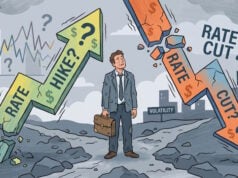
Warsh must now navigate these compounding pressures. He is caught between a president demanding lower interest rates to stimulate corporate expansion, a divided FOMC protective of its historical mandate, and an economy experiencing a clear resurgence in consumer prices. Whether Warsh can successfully implement his technology-driven, low-rate economic theory without triggering further inflation remains the defining question of his nascent chairmanship.
Sources Used and Links:
- The Guardian: Kevin Warsh sworn in as Fed chair as Trump faces backlash over economy
- The Independent: Trump claims he wants ‘independent’ Fed as his pick Kevin Warsh is sworn in as chair
- CBS News: Kevin Warsh sworn in as new Fed chair at White House, replacing Powell
- Forbes: Who Is Kevin Warsh? Trump’s Fed Chair Nominee Had Deep Billionaire Ties
- Al Jazeera: Kevin Warsh sworn in as new US Fed chair
- PBS NewsHour: Senate confirms Trump pick Warsh as chairman of the Federal Reserve, following Powell
- Wikipedia: Kevin Warsh
- Center for Economic and Policy Research / Equitable Growth: What is the relationship between inflation, interest rates, and economic growth, and what does it mean for the new Federal Reserve chair?
- iHeartRadio: Warsh Sworn In As Fed Chair
Disclaimer
Artificial Intelligence Disclosure & Legal Disclaimer
AI Content Policy.
To provide our readers with timely and comprehensive coverage, South Florida Reporter uses artificial intelligence (AI) to assist in producing certain articles and visual content.
Articles: AI may be used to assist in research, structural drafting, or data analysis. All AI-assisted text is reviewed and edited by our team to ensure accuracy and adherence to our editorial standards.
Images: Any imagery generated or significantly altered by AI is clearly marked with a disclaimer or watermark to distinguish it from traditional photography or editorial illustrations.
General Disclaimer
The information contained in South Florida Reporter is for general information purposes only.
South Florida Reporter assumes no responsibility for errors or omissions in the contents of the Service. In no event shall South Florida Reporter be liable for any special, direct, indirect, consequential, or incidental damages or any damages whatsoever, whether in an action of contract, negligence or other tort, arising out of or in connection with the use of the Service or the contents of the Service.
The Company reserves the right to make additions, deletions, or modifications to the contents of the Service at any time without prior notice. The Company does not warrant that the Service is free of viruses or other harmful components.