The delicate balance of the retail economy is facing a massive disruption. Walmart, the nation’s largest retailer and a traditional bellwether for American consumer health, delivered its fiscal 2027 first-quarter earnings report on May 21, 2026. The results revealed a stark warning: the ongoing war in Iran and the consequent disruption of global energy corridors are sending shockwaves through supply chains, driving fuel costs to punishing highs.
While Walmart managed to beat top-line revenue estimates by generating $177.8 billion—a 7.3% increase year-over-year—the corporate mood was decidedly cautionary. Executive leadership confirmed that the retail giant swallowed a massive $175 million hit to its operating income growth during the quarter just to keep prices stable for cash-strapped families. However, Chief Financial Officer John David Rainey explicitly warned analysts that if these energy headwinds persist, the company will have no choice but to let retail price inflation tick upward in the second quarter and throughout the latter half of 2026.
The announcement sent shockwaves through Wall Street, triggering a 7.3% drop in Walmart’s stock price and wiping away nearly $76 billion in market capitalization in a single trading session. For an economy already battling stubborn inflationary pressures, the warning from Bentonville serves as a flashing red light that the era of aggressive grocery discounts could face an energy-driven pause.
Inside the Numbers: A Solid Quarter Dented by Energy Shock
On paper, Walmart’s operational engine performed remarkably well during the three-month period ending April 30, 2026. Driven by an aggressive push toward digital convenience and a surge in grocery traffic, the company outpaced consensus expectations on several key metrics.

| Financial Metric | Q1 2026 Result | Wall Street Estimate | Year-Over-Year Change |
| Total Revenue | $177.8 Billion | $174.8 Billion | +7.3% |
| Adjusted Earnings Per Share | $0.66 | $0.65 | +8.2% |
| U.S. Comparable Sales (Excl. Fuel) | +4.1% | ~3.9% | Strong Transaction Volumes |
| Global E-Commerce Sales | +26.0% | N/A | Driven by Store-Fulfilled Delivery |
| Operating Income | $7.5 Billion | Missed Projections | +5.0% (Suppressed by Fuel) |
Despite these healthy top-line gains, the company missed Wall Street’s elevated targets for operating income growth. The culprit was entirely tied to global energy infrastructure. Walmart absorbed roughly 250 basis points of operating income growth due to higher-than-planned fuel costs across its global distribution, trucking, and fulfillment networks.
By prioritizing consumer trust and absorbing the full $175 million fuel shock in the first quarter, Walmart intentionally sacrificed profit margins. However, executives openly admitted that corporate absorption has its structural limits.
The Supply Chain Strain: Why Diesel Fuels Store Inflation
To understand why global fuel spikes inevitably dictate the price of a gallon of milk or a box of cereal at a local retail outlet, one must look at the sheer scale of Walmart’s logistical footprint. The company operates one of the largest private distribution fleets in the world, utilizing thousands of tractors and trailers to keep store shelves stocked daily.
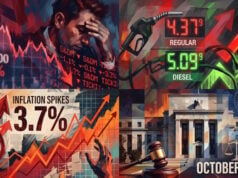
When the war in Iran escalated earlier this year, it severely bottlenecked crude oil production and heavily compromised passage through the Strait of Hormuz. Consequently, U.S. domestic diesel and regular gasoline retail prices marched upward, with national averages hovering around $4.56 to $4.60 per gallon.
[War in Iran / Strait of Hormuz Crisis]
                  │
                  ▼
    [Global Crude & Diesel Spikes]
                  │
                  ▼
[+$175 Million Logistics & Distribution Cost]
                  │
                  ▼
[Walmart Absorbs Cost (Q1 Margin Compression)]
                  │
                  ▼
[Projected Retail Price Adjustments (Q2 & H2)]
The financial friction spreads across the retail ecosystem in three distinct phases:
1. Primary Inbound and Outbound Logistics
Every item sold at Walmart must be transported multiple times before reaching a customer. Raw materials move to manufacturing hubs, finished goods travel to regional distribution centers, and fulfillment fleets dispatch items to retail locations or directly to consumer doorsteps. When fuel prices spike by 45% compared to the previous year, the baseline cost of moving a single pallet climbs instantly.
2. Secondary Agricultural Inputs
The closure of critical trade routes in the Middle East has severely disrupted the global supply of foundational agricultural inputs, including nitrogen, phosphates, and key raw materials for fertilizer production. CFO John David Rainey pointed out that these manufacturing shortages hit the agricultural sector first. As domestic farmers face dramatically higher costs to cultivate crops and feed livestock, the wholesale price of groceries climbing upstream will eventually filter directly down to Walmart’s food aisles, which account for more than 55% of the company’s total revenue.
3. The Last-Mile Dilemma
As Walmart rapidly expands its e-commerce business—which grew by 26% this quarter—it relies heavily on store-fulfilled pickup and rapid home delivery. More than 36% of all U.S. digital orders are now fulfilled and delivered in under three hours. While localizing fulfillment cuts down long-haul transit, it drastically increases the number of localized vehicular trips. Higher pump prices make running these delivery networks significantly more expensive per drop block.
Stressed Shoppers Ration at the Pump
The most alarming revelation from Walmart’s executive call was not the corporate margin squeeze, but rather the stark behavioral data emerging directly from the company’s proprietary gas stations.
For decades, economists have used fuel transaction volumes as a real-time indicator of working-class financial health. During the first quarter, Walmart recorded a significant shift: the average volume of fuel purchased per transaction at its U.S. fuel stations fell below 10 gallons for the first time since 2022—the year Russia launched its full-scale invasion of Ukraine, sending global energy markets into a tailspin.
“When customers pull up to our pumps and intentionally buy less than 10 gallons at a time, that is a clear, unvarnished indication of financial stress,” stated CFO John David Rainey. “They aren’t filling up their tanks because they are tightly managing weekly cash flow, buying only what they need to get to work that day.”
This behavioral shift highlights a stark divergence among American income brackets:
- Lower-Income Cohorts: Lower-income families are exhibiting severe budget-conscious behaviors. They are pulling back heavily on non-essential, discretionary categories like electronics, apparel, and home decor, routing almost their entire wallet share toward basic essentials, private-label brands, and fresh food.
- Higher-Income Cohorts: Conversely, higher-income households are increasingly turning to Walmart for value. Affluent families who previously used Walmart only for groceries are now crossing the aisle into general merchandise, seeking out the store’s lower prices to offset inflation elsewhere in their lives.
This influx of wealthier shoppers has allowed Walmart to gain massive overall market share, but it simultaneously masks the severe strain felt by its foundational, lower-income consumer base.
Balancing Act: 7,200 Rollbacks vs. Macro Headwinds
Despite the looming threat of fuel-driven retail inflation, Walmart’s domestic leadership team remains highly defensive of its core corporate identity. Walmart U.S. President and CEO John Furner reiterated that the corporation is doing everything within its logistical power to fight sweeping price hikes through its “Everyday Low Price” (EDLP) framework.
To counter broader macroeconomic pressures, Walmart accelerated its discount programs during the first quarter, executing more than 7,200 active “rollbacks” (temporary price reductions) across its store categories—a 20% increase in total discounts compared to the same period last year. The company also rolled out high-visibility value packages, such as a summer grilling basket designed to feed eight people for under $5 per person.
However, management openly conceded that they are not “bulletproof” against persistent geopolitical conflicts. If international logistics routes remain compromised through the summer, the cost of goods sold will outpace the savings generated by automated distribution centers and corporate restructuring.
Furthermore, Walmart is facing legislative and structural challenges closer to home. The company’s first-quarter comparable sales took a distinct 100-basis-point hit directly tied to new federal regulations stemming from the Inflation Reduction Act, which altered how pharmacies are reimbursed for specific prescription medications. Compounding this pharmacy headache is an environment of intense regulatory scrutiny, as federal and state lawmakers actively debate bills aimed at restricting how major grocery chains use consumer data to dictate electronic shelf labels.
Looking Forward: Disappointing Guidance Signals Caution
Because of the highly volatile global environment, Walmart issued a second-quarter and full-year profit outlook that fell notably short of consensus Wall Street models.
For the upcoming second quarter, the retailer projects adjusted earnings per share to land between $0.72 and $0.74, missing the $0.75 target that analysts had penciled in. For the full fiscal year, Walmart expects adjusted earnings to hover between $2.75 and $2.85 per share, coming in safely below the $2.91 consensus forecast.
While the company reaffirmed its broader net sales growth targets of 3.5% to 4.5% for the full year, the reduced profit guidance signals to investors that the retail giant expects to spend the next nine months in a structural defensive crouch, absorbing costs where possible but inevitably passing portions of the transport premium onto consumer goods if energy benchmarks fail to cool down.
The broader retail landscape is already reacting unevenly. Following Walmart’s presentation, grocery-heavy competitors like Kroger saw their stocks slide by more than 2%, while apparel- and discretionary-focused retailers like Target managed a modest 3.1% rebound. The divergence emphasizes that the current economic squeeze is hitting foundational, high-turnover consumer goods—like food and logistics-heavy consumables—the hardest.
Ultimately, Walmart’s Q1 review paints the picture of a corporate titan operating at peak logistical efficiency, yet remaining vulnerable to global geopolitical volatility. If the conflict in Iran continues to strain the global energy matrix, the price hikes currently hitting American gas tanks will inevitably trickle down to the grocery and retail aisles of the nation’s largest stores.
Sources Used and Links:
- Alpha Spread Walmart Issues Weak Outlook as High Gas Prices Weigh on Shoppers https://www.alphaspread.com/market-news/earnings/walmart-issues-weak-outlook-as-high-gas-prices-weigh-on-shoppers
- Retail Dive Walmart warns of price increases due to fuel costs https://www.retaildive.com/news/walmart-price-increases-iran-war-fuel-costs-q1/820845/
- Financial Times Walmart says customers are rationing petrol as Iran war hits wallets https://www.ft.com/content/4c1d2ee0-e9dd-410f-bdc3-e0917f3ca41f?syn-25a6b1a6=1
- Grocery Dive Walmart ramps up price cuts https://www.grocerydive.com/news/walmart-ramps-up-price-cuts-first-quarter-fiscal-2027/820853/
- HomePage News Fuel Prices, Tariff Refunds Hover in Walmart’s Future After Solid Q1 Gains https://www.homepagenews.com/retail-articles/fuel-prices-tariff-refunds-hover-in-walmarts-future-after-solid-q1-gains/
- China.org.cn (Xinhua)Walmart issues weak financial outlook as surging gas prices strain U.S. consumers http://www.china.org.cn/world/Off_the_Wire/2026-05/22/content_118507685.shtml
- WDRB News Walmart wins over broader swath of consumers, but global uncertainty clouds outlook for retailers https://www.wdrb.com/news/national/walmart-wins-over-broader-swath-of-consumers-but-global-uncertainty-clouds-outlook-for-retailers/article_0ac18494-b646-59c1-9f81-7290eed76439.html
- Morningstar (MarketWatch) People are putting less gas in their tanks as high prices crimp budgets, Walmart says https://www.morningstar.com/news/marketwatch/20260521390/people-are-putting-less-gas-in-their-tanks-as-high-prices-crimp-budgets-walmart-says
- Retail TouchPoints Walmart Q1 Results: Higher Gas Prices Strain Household Budgets https://www.retailtouchpoints.com/news/walmart-q1-results-higher-gas-prices-strain-household-budgets/619605/
- The Spokesman-Review (Bloomberg) Walmart flags higher fuel costs eroding retailer’s earnings https://www.spokesman.com/stories/2026/may/21/walmart-flags-higher-fuel-costs-eroding-retailers-/
Disclaimer
Artificial Intelligence Disclosure & Legal Disclaimer
AI Content Policy.
To provide our readers with timely and comprehensive coverage, South Florida Reporter uses artificial intelligence (AI) to assist in producing certain articles and visual content.
Articles: AI may be used to assist in research, structural drafting, or data analysis. All AI-assisted text is reviewed and edited by our team to ensure accuracy and adherence to our editorial standards.
Images: Any imagery generated or significantly altered by AI is clearly marked with a disclaimer or watermark to distinguish it from traditional photography or editorial illustrations.
General Disclaimer
The information contained in South Florida Reporter is for general information purposes only.
South Florida Reporter assumes no responsibility for errors or omissions in the contents of the Service. In no event shall South Florida Reporter be liable for any special, direct, indirect, consequential, or incidental damages or any damages whatsoever, whether in an action of contract, negligence or other tort, arising out of or in connection with the use of the Service or the contents of the Service.
The Company reserves the right to make additions, deletions, or modifications to the contents of the Service at any time without prior notice. The Company does not warrant that the Service is free of viruses or other harmful components.