In a dramatic escalation of his “maximum pressure” diplomacy, President Donald Trump announced on Sunday that he is dispatching a high-level delegation to Islamabad, Pakistan, for a final attempt at a negotiated settlement with Tehran. Even as the diplomatic machinery moves toward a Tuesday summit, the President issued a chilling warning to the Iranian leadership: accept the terms of the “Great Deal” or face the systematic destruction of the nation’s civil infrastructure.
The Islamabad Mission: A Last Chance for Peace
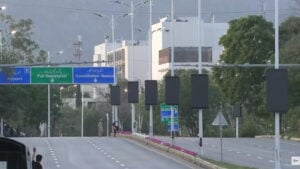
The announcement, made via Truth Social and later confirmed in a series of briefings from the White House, marks a pivotal moment in the 2026 Iran conflict. President Trump revealed that his hand-picked “deal-makers”—Special Envoy for the Middle East Steve Witkoff and his son-in-law Jared Kushner—are scheduled to arrive in the Pakistani capital on Monday evening.
The choice of Islamabad as the venue is no coincidence. Pakistan has emerged as the primary mediator in this conflict, having already hosted a marathon 21-hour negotiation session earlier this month involving Vice President J.D. Vance. While those talks ended without a definitive breakthrough, they established a 14-day ceasefire that is set to expire this Wednesday, April 22.

“My people are arriving Monday night—that’s tomorrow,” Trump told Fox News on Sunday morning. “I’m sending Steve Witkoff and Jared Kushner. They know the players, they know how to make a deal. We’re giving diplomacy one last chance, but the clock has run out.”
The “Total Violation” in the Strait of Hormuz
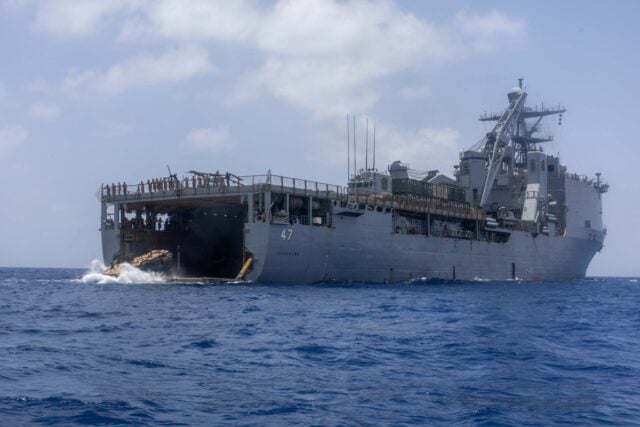
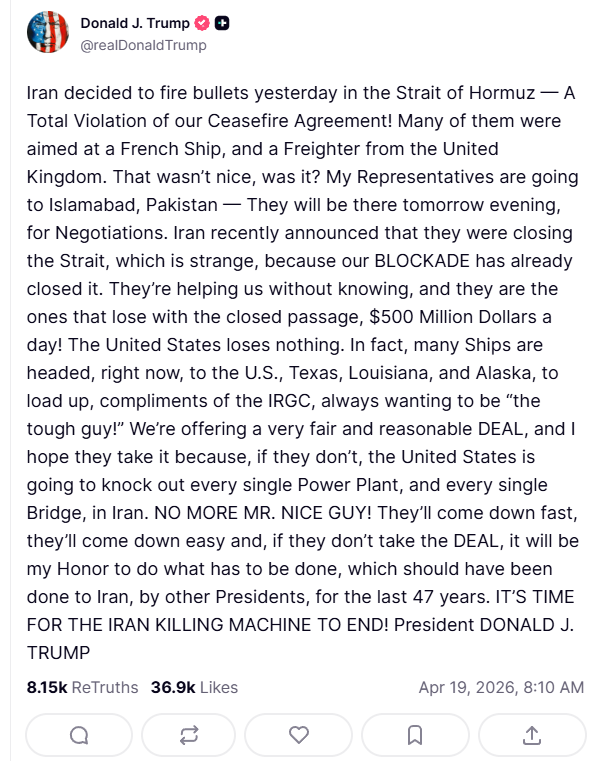
The urgency of the Islamabad mission is underscored by reports of fresh hostilities in the Persian Gulf. President Trump accused Iran of a “total violation” of the standing ceasefire, alleging that Iranian forces targeted a French vessel and a British freighter in the Strait of Hormuz on Saturday.
“Iran decided to fire bullets yesterday… that wasn’t nice, was it?” Trump wrote. These reported skirmishes have shattered the brief period of relative calm and provided the President with the narrative justification for his intensified threats. Despite the alleged violations, the U.S. has opted for one final diplomatic push rather than immediate kinetic retaliation, though the threat of the latter looms larger than ever.
“No More Mr. Nice Guy”: The Infrastructure Ultimatum

While the diplomatic envoys prepare their briefcases, the President has made the “or else” of the negotiation crystal clear. In language that has sent shockwaves through international diplomatic circles, Trump vowed that a rejection of the U.S. proposal would lead to the military “knocking out” every power plant and every bridge in Iran.
“We’re offering a very fair and reasonable DEAL,” Trump asserted. “If they don’t take the DEAL, it will be my Honor to do what has to be done… They’ll come down fast, they’ll come down easy.”
Military analysts suggest that this is not mere hyperbole. The U.S. has spent the last 40 days of conflict systematically dismantling Iranian military assets. The shift to targeting civilian “dual-use” infrastructure—power grids and transportation networks—would represent a move toward total war designed to cripple the Iranian state’s ability to function as a modern entity. Trump’s rhetoric of “ending the Iran Killing Machine” suggests a desire to permanently neutralize Iran as a regional power.
The President’s move to send representatives while simultaneously threatening total destruction is a hallmark of the 2026 Trump Doctrine. There are several strategic reasons behind this “carrot-and-stick” approach:
1. Economic Stranglehold and the Naval Blockade The U.S. currently maintains a devastating naval blockade of the Strait of Hormuz. While Iran previously used the Strait as a weapon to spike global oil prices, the U.S. has flipped the script. By interdicting all traffic entering and exiting Iranian ports, the U.S. is costing the Iranian economy an estimated $500 million per day. Trump noted on Sunday that the U.S. “loses nothing” from this arrangement because American oil production in Texas, Louisiana, and Alaska has filled the global supply gap. He is using this economic leverage to force Tehran to the table from a position of near-bankruptcy.
2. The Nuclear “Dust” Objective The primary U.S. demand remains the total abandonment of Iran’s nuclear program. Trump has frequently referred to Iran’s enriched uranium as “dust” that must be handed over. By threatening the total destruction of the country’s power and transportation, he is presenting a binary choice: give up the nuclear ambition or return to a “pre-industrial” state.
3. Exploiting Potential Regime Instability Trump’s social media posts have alluded to a “Complete and Total Regime Change” where “different, smarter, and less radicalized minds” might prevail. By providing a “fair deal” on the table, the U.S. is attempting to drive a wedge between the Iranian public (and more pragmatic elements of the government) and the hardline IRGC (Islamic Revolutionary Guard Corps). The threat to destroy bridges and power plants is a direct message to the Iranian people of what their current leadership’s recalcitrance will cost them.
4. The “Deal-Maker” Branding By sending Kushner and Witkoff—men associated with the Abraham Accords and high-stakes real estate—Trump is framing this not as a traditional diplomatic summit, but as a closing meeting for a transaction. This bypasses traditional State Department channels and emphasizes a personal, “President-to-Leader” style of negotiation that seeks to achieve in days what traditional diplomacy failed to do in decades.
Global Reaction and Iranian Defiance
The response from Tehran has been a mix of defiance and cautious silence. While President Masoud Pezeshkian has stated that Iranians are “ready to sacrifice their lives,” Iranian officials have also noted that a final agreement remains elusive due to “excessive demands” from Washington. The IRGC has countered with its own threats, suggesting that any strike on Iranian infrastructure would result in a “blackout” for the entire region, including Saudi Arabia.
Conclusion: The 48-Hour Window
As Kushner and Witkoff prepare to touch down in Islamabad, the world holds its breath. The “Islamabad Peace Talks” are no longer just about a ceasefire; they are about the survival of the Iranian state’s modern infrastructure. President Trump has set the stage for a dramatic conclusion to his 47-year grievance with the Iranian Revolutionary state.
The deadline is Wednesday. If the “deal-makers” return empty-handed, the “No More Mr. Nice Guy” era of American foreign policy may transition from a Truth Social post to a devastating military reality.
Sources Used and Links
- WANA News Agency: “Trump Sends Representatives to Islamabad; Issues Infrastructure Ultimatum to Iran” (April 19, 2026) https://wanaen.com/trump-sends-representatives-to-islamabad-issues-infrastructure-ultimatum-to-iran/
- ANI News: “Offering a very fair, reasonable deal: Trump says US negotiators Witkoff and Kushner will head to Pakistan for Iran ceasefire talks” (April 19, 2026) https://www.aninews.in/news/world/us/offering-a-very-fair-reasonable-deal-trump-says-us-negotiators-witkoff-and-kushner-will-head-to-pakistan-for-iran-ceasefire-talks20260419183652
- The Washington Post: “Trump says Iran talks will resume, threatens power plants and bridges if no deal” (April 19, 2026) https://www.washingtonpost.com/world/2026/04/19/trump-iran-war-hormuz-strait-negotiations/
- The Guardian: “Donald Trump says ‘a whole civilisation will die’ if Iran ignores demands” (April 7, 2026) https://www.theguardian.com/world/2026/apr/07/israel-warns-iran-lives-at-risk-if-they-use-trains-trump-deadline
- Al Arabiya English: “Trump warns Iran ‘whole civilization will die’ without deal” (April 7, 2026) https://english.alarabiya.net/News/middle-east/2026/04/07/trump-says-a-whole-civilization-will-die-tonight-if-iran-does-not-make-a-deal
- Wikipedia: “Islamabad Talks” (Accessed April 19, 2026) https://en.wikipedia.org/wiki/Islamabad_Talks
- Anadolu Agency: “Trump says US envoys heading to Islamabad for Iran talks amid Strait of Hormuz tensions” (April 19, 2026) https://www.aa.com.tr/en/americas/trump-says-us-envoys-heading-to-islamabad-for-iran-talks-amid-strait-of-hormuz-tensions/3911361
- The Times of Israel: “Trump: ‘A whole civilization will die tonight’ if ultimatum for Iran to open Hormuz expires” (April 7, 2026) https://www.timesofisrael.com/trump-a-whole-civilization-will-die-tonight-if-ultimatum-for-iran-to-open-hormuz-expires/
- The Washington Post Opinion: “Trump flips the script in the Strait of Hormuz” (April 13, 2026) https://www.washingtonpost.com/opinions/2026/04/13/trump-blockade-strait-hormuz-iran-war/
- Associated Press (AP): “Trump says U.S. negotiators will be in Pakistan on Monday for talks with Iran” (April 19, 2026) https://apnews.com/article/trump-iran-negotiators-islamabad-ceasefire-1c0894ef4a2c2feaabc326cc68571c33
- Associated Press (AP): “3 times Trump has given Iran deadlines and then delayed them” (April 7, 2026) https://apnews.com/article/trump-iran-deadline-strait-hormuz-infrastructure-threats
- PBS NewsHour (via AP): “Trump says U.S. officials will hold more talks with Iran in Pakistan” (April 19, 2026) https://www.pbs.org/newshour/world/trump-says-u-s-officials-will-hold-more-talks-with-iran-in-pakistan
- CBC News (via AP/Reuters): “Strait of Hormuz blocked as gaps remain on Iran peace talks” (April 19, 2026) https://www.cbc.ca/news/world/strait-of-hormuz-blocked-peace-talks-9.7169599
- Times of Israel: “Trump: US-Iran talks to take place Tuesday; Witkoff and Kushner heading to Pakistan” (April 19, 2026) https://www.timesofisrael.com/liveblog_entry/trump-says-us-iran-talks-to-take-place-tuesday-witkoff-and-kushner-heading-to-pakistan/
- Council on Foreign Relations (CFR): “U.S.-Iran Peace Talks Hit an Impasse. What Comes Next?” (April 13, 2026) https://www.cfr.org/articles/u-s-iran-peace-talks-hit-an-impasse-what-comes-next
- ANI News: “US negotiators Witkoff and Kushner head to Pakistan for Iran ceasefire talks” (April 19, 2026) https://www.aninews.in/news/world/us/offering-a-very-fair-reasonable-deal-trump-says-us-negotiators-witkoff-and-kushner-will-head-to-pakistan-for-iran-ceasefire-talks20260419183652
Disclaimer
Artificial Intelligence Disclosure & Legal Disclaimer
AI Content Policy.
To provide our readers with timely and comprehensive coverage, South Florida Reporter uses artificial intelligence (AI) to assist in producing certain articles and visual content.
Articles: AI may be used to assist in research, structural drafting, or data analysis. All AI-assisted text is reviewed and edited by our team to ensure accuracy and adherence to our editorial standards.
Images: Any imagery generated or significantly altered by AI is clearly marked with a disclaimer or watermark to distinguish it from traditional photography or editorial illustrations.
General Disclaimer
The information contained in South Florida Reporter is for general information purposes only.
South Florida Reporter assumes no responsibility for errors or omissions in the contents of the Service. In no event shall South Florida Reporter be liable for any special, direct, indirect, consequential, or incidental damages or any damages whatsoever, whether in an action of contract, negligence or other tort, arising out of or in connection with the use of the Service or the contents of the Service.
The Company reserves the right to make additions, deletions, or modifications to the contents of the Service at any time without prior notice. The Company does not warrant that the Service is free of viruses or other harmful components.