The Bloodiest Season: 1905 and the Crisis of Survival
In the autumn of 1905, the sport we now recognize as the bedrock of American culture was on the verge of being outlawed. This was not a period of slow-motion replays or concussion protocols; it was an era of the “flying wedge,” unpadded leather helmets (or no helmets at all), and a style of play that closely resembled a localized riot. According to the Chicago Tribune, the 1905 season alone resulted in 18 deaths and over 150 serious injuries on the college gridiron.
Video excerpt of the 1903 Princeton vs. Yale football game
(Courtesy Library of Congress)
The public was horrified. University presidents at Stanford, California, and Columbia were moving to abolish the sport entirely, replacing it with the perceived “gentlemanly” safety of rugby. Even the New York Times editorial board was calling for an end to the “brutalizing” spectacle. It was in this moment of existential dread that the sport found its most unlikely, and perhaps its most important, advocate: President Theodore Roosevelt.
While the Pro Football Hall of Fame in Canton, Ohio, primarily honors players, coaches, and administrators who directly shaped the professional league (NFL), there is a distinct category for “Pioneers” and “Contributors.” Theodore Roosevelt belongs in this pantheon. Without his executive intervention, the lineage that led from collegiate chaos to professional polish would have been severed. He didn’t just play the game; he saved the game.
The “Strenuous Life” and the Moral Defense of Football
To understand why a sitting President would spend political capital on a sport, one must understand Roosevelt’s philosophy of the “Strenuous Life.” TR believed that for America to remain a world power, its men needed to be physically robust, courageous, and accustomed to hardship. He viewed football as the ultimate “character-building” machine.

“I believe in rough games and in wild games, and I do not feel a particle of sympathy with the abstract sentiments of the people who die of horror because there is a roughness in the game or because there is an occasional casualty.” — Theodore Roosevelt
However, Roosevelt was no fool. He recognized that “unnecessary” brutality—eye-gouging, secret punching in the scrum, and the lethal force of the flying wedge—was not character-building; it was criminal. He saw that if the game did not reform from within, it would be abolished from without.
The White House Summit: October 9, 1905
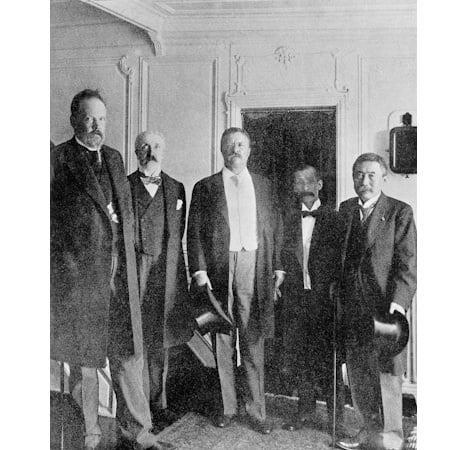
In an unprecedented move for a United States President, Roosevelt summoned the leaders of the “Big Three” football powers—Harvard, Yale, and Princeton—to the White House. This was the 1905 equivalent of the Commissioner of the NFL and the NCAA being called to the Oval Office to answer for the safety of the league.
Roosevelt did not issue a decree; he issued a challenge. He told the coaches and representatives that they must change the rules to eliminate the “dirty” play or he would be forced to ban the sport via executive pressure. This meeting is widely considered the catalyst for the formation of the Intercollegiate Athletic Association of the United States (IAAUS), which would later become the NCAA.
The Technological and Tactical Revolution
The result of TR’s intervention was the 1906 Rulebook, which fundamentally transformed the game. Key changes included:
- The Legalization of the Forward Pass: Before 1906, the ball could be advanced only by running or kicking. Legalizing the pass spread the field, reduced the frequency of massive, body-crushing scrums, and introduced the tactical depth that defines the modern professional game.
- The Neutral Zone: To prevent the immediate, violent collision of lines at the snap.
- Increasing the First Down Yardage: Moving from 5 yards to 10 yards, which encouraged more open-field play and discouraged the “three yards and a cloud of dust” approach that led to repetitive head trauma.
The Case for the “Pioneer” Category
The Pro Football Hall of Fame’s Contributor category is reserved for those who have made “outstanding contributions to professional football in capacities other than playing or coaching.” While Roosevelt’s focus was collegiate, the distinction is a matter of historical continuity.
1. The Pro-College Link
The early professional game, which began in the late 1890s and formalized with the APFA in 1920, was entirely dependent on the collegiate talent pool and the collegiate rulebook. Had Roosevelt allowed football to be banned in 1905, there would have been no professional league. The professional game did not exist in a vacuum; it was the fruit of the tree Roosevelt pruned and saved.
2. The Cultural Legitimacy of the Game
By involving the Presidency, Roosevelt elevated football from a “campus hobby” to a matter of national importance. He established the idea that football was a vital part of the American identity. This cultural status enabled professional football to eventually eclipse baseball as the national pastime.
3. Comparison to Other Inductees
The Hall of Fame has inducted figures like Bert Bell, who helped stabilize the league, and Lamar Hunt, who founded the AFL. While these men built the NFL’s business, Roosevelt preserved the sport itself. If the Hall of Fame can honor those who marketed the game, it must honor the man who ensured there was a game to market.
The Counter-Argument: Was He “Pro” Enough?
Critics might argue that Roosevelt never played professional football nor held a front-office position in the NFL. This is a narrow view of history. The “Pioneer” category exists specifically for figures whose influence transcends the box score.
Roosevelt’s intervention was a “pro” move in the sense that it brought professional-level governance to a disorganized and dangerous sport. He demanded accountability, transparency, and a unified rulebook—the very hallmarks of what would become the NFL.
Conclusion: The Father of the Modern Gridiron
Theodore Roosevelt’s contribution to football is not measured in touchdowns, but in the very fact that touchdowns still exist. His legacy is present in every spiral thrown by a modern quarterback and every safety-focused rule change implemented by the league today.
By nominating Theodore Roosevelt to the Pro Football Hall of Fame, we acknowledge that the game’s greatest protector was not a linebacker, but a President. He was the ultimate “12th man” who stood on the sidelines of history and refused to let a Great American Game die. It is time for Canton to recognize the “Bull Moose” for the pioneer he truly was.
Sources Used and Links
- Theodore Roosevelt Center at Dickinson State University: Football and the Strenuous Life. https://www.theodorerooseveltcenter.org/Learn-About-TR/TR-Encyclopedia/Culture-and-Society/Football
- NCAA.org: The History of the NCAA. https://www.ncaa.org/about/resources/history
- History.com: How Teddy Roosevelt Saved Football. https://www.history.com/news/how-teddy-roosevelt-saved-football
- Pro Football Hall of Fame: Selection Process and Contributor Category. https://www.profootballhof.com/hall-of-famers/selection-process/
- The Library of Congress: The 1905 White House Meeting Records. https://www.loc.gov/collections/theodore-roosevelt-papers/about-this-collection/
- The Chicago Tribune Archives: 1905 Season Casualty Reports. https://www.chicagotribune.com/history/
Disclaimer
Artificial Intelligence Disclosure & Legal Disclaimer
AI Content Policy.
To provide our readers with timely and comprehensive coverage, South Florida Reporter uses artificial intelligence (AI) to assist in producing certain articles and visual content.
Articles: AI may be used to assist in research, structural drafting, or data analysis. All AI-assisted text is reviewed and edited by our team to ensure accuracy and adherence to our editorial standards.
Images: Any imagery generated or significantly altered by AI is clearly marked with a disclaimer or watermark to distinguish it from traditional photography or editorial illustrations.
General Disclaimer
The information contained in South Florida Reporter is for general information purposes only.
South Florida Reporter assumes no responsibility for errors or omissions in the contents of the Service. In no event shall South Florida Reporter be liable for any special, direct, indirect, consequential, or incidental damages or any damages whatsoever, whether in an action of contract, negligence or other tort, arising out of or in connection with the use of the Service or the contents of the Service.
The Company reserves the right to make additions, deletions, or modifications to the contents of the Service at any time without prior notice. The Company does not warrant that the Service is free of viruses or other harmful components.