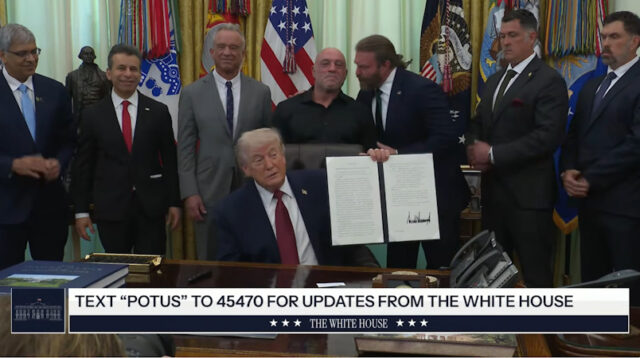
In a move that blends clinical pragmatism with populist reform, President Donald J. Trump signed a landmark executive order this Saturday, April 18, 2026, aimed at dismantling the federal barriers that have long stifled the research and application of psychedelic-assisted therapies. Surrounded by a diverse coalition in the Oval Office—including Health and Human Services (HHS) Secretary Robert F. Kennedy Jr., FDA Commissioner Mary Makary, and high-profile advocates like podcaster Joe Rogan—the President framed the order as a “moral imperative” to address America’s escalating mental health and suicide crises.
The order, titled “Accelerating Medical Treatments for Serious Mental Illness,” represents the most significant shift in federal drug policy since the inception of the War on Drugs. By leveraging the Right to Try Act and creating new fast-track incentives for the FDA, the administration aims to move compounds like psilocybin, MDMA, and ibogaine from the fringes of “counter-culture” medicine into the mainstream of the American healthcare system.
A Scene of Unlikely Alliances
The signing ceremony itself was a testament to the shifting political landscape of 2026. President Trump was joined by veterans who have traveled abroad to seek “underground” treatments for PTSD, alongside former Energy Secretary Rick Perry, who has spent years championing ibogaine research for former SEALs and special operators.
“We have a crisis of the soul in this country,” Trump remarked, holding up the signed document. “Our veterans are coming home from wars only to fight a new war at home—a war against depression, against trauma, against addiction. For too long, the ‘experts’ in Washington said ‘no’ to treatments that actually work. Today, we are saying ‘yes’ to hope and ‘yes’ to life.”

Secretary Kennedy, a central figure in the administration’s “Make America Healthy Again” (MAHA) initiative, echoed this sentiment, noting that the order would finally allow the federal government to catch up to the “groundbreaking” science emerging from states like Texas and Colorado.
The Technical Core: Breaking the Bureaucratic Seal
The executive order is not merely a symbolic gesture; it introduces several high-impact legal mechanisms designed to force the hands of the FDA and the DEA.
1. National Priority Vouchers for Breakthrough Therapies
The order directs the FDA to issue National Priority Vouchers to companies developing psychedelic drugs that have already received “Breakthrough Therapy” designation. These vouchers are essentially “golden tickets” that allow a company to move any future drug through the FDA review process in a matter of weeks rather than months or years. By applying this to psychedelics, the administration expects to see final approvals for compounds like COMP360 (synthetic psilocybin) by the end of 2026.
2. The “Right to Try” Expansion
A centerpiece of the order is the explicit instruction to the FDA and the DEA to establish a pathway for “desperately ill” patients to access investigational psychedelics—specifically ibogaine—under the Right to Try Act. This law, signed during Trump’s first term, allows patients with life-threatening conditions to access experimental treatments that have passed Phase 1 safety trials but are not yet fully approved.
3. Financial Fuel for State Research
Recognizing the success of state-led initiatives, the order allocates $50 million through the Advanced Research Projects Agency for Health (ARPA-H) to match state investments. This is a direct nod to the Texas Ibogaine Research Consortium, which launched in 2025 to study the West African plant derivative’s efficacy in treating severe opioid addiction and PTSD.
4. Mandated Rescheduling Review
Perhaps most significantly for the long-term market, the order instructs the Attorney General to initiate a review of relevant products immediately upon the successful completion of Phase 3 clinical trials. This ensures that once the FDA grants medical approval, the DEA cannot use administrative “foot-dragging” to keep the substances in the highly restrictive Schedule I category.
Grounded in New Science
The order timing follows a series of high-impact clinical results published throughout 2025. A study in Nature Mental Health by Stanford researchers demonstrated that ibogaine, when paired with magnesium, significantly improved “cognitive flexibility” and drastically reduced PTSD symptoms in a cohort of special operations veterans.
Furthermore, 2025 data from the Journal of the American Medical Association (JAMA) showed that a single dose of LSD-based MM120 could ease symptoms of generalized anxiety and depression for up to six months. These “one-and-done” or “episodic” treatment models stand in stark contrast to the daily pill regimen that has defined American psychiatry for decades.
“We are moving away from the ‘forever pill’ model,” said FDA Commissioner Mary Makary during the signing. “The goal is to provide healing, not just symptom management. By removing the research barriers, we are finally letting the data speak for itself.”
The “Veterans First” Strategy
The Department of Veterans Affairs (VA) is tasked under this order to collaborate more deeply with the private sector. Currently, the VA is participating in five major trials across New York, California, and Oregon. The executive order mandates an increase in this participation, effectively turning VA hospitals into hubs for psychedelic-assisted therapy.
For many, this is a long-overdue correction. In 2024, the FDA famously rejected MDMA-assisted therapy for PTSD, citing concerns over trial design. This executive order is widely seen as a direct rebuttal to that decision, signaling that the current administration will not tolerate “unnecessary bureaucratic hurdles” when lives are at stake.
Political and Social Implications
The move aligns with a broader trend of “medical populism” that has seen bipartisan support growing in state legislatures. From Minnesota to New Jersey, lawmakers have begun cosponsoring bills to allow psilocybin use under licensed facilitation. By taking the lead at the federal level, Trump has effectively “outflanked” traditional liberals on a social issue while framing it through the lens of veteran care and deregulation—a classic Trumpian maneuver.
Critics, however, remain cautious. Some public health experts worry that “fast-tracking” powerful psychoactive substances could lead to safety lapses if the therapeutic environment—the “set and setting”—is not strictly regulated. The executive order attempts to address this by requiring HHS and the FDA to generate “real-world evidence” and rigorous safety data through expanded clinical trials.
The Road to 2027
With this order, the floodgates are officially open. Investors in the biotech space are already reacting, with “psychedelic stocks” seeing a surge in pre-market activity. But beyond the markets, the human impact is the primary focus.
As the first “Priority Vouchers” are expected to be issued next week, the timeline for legal, supervised psychedelic therapy in America has been moved up by years. For the 14 million Americans struggling with serious mental illness, the “psychedelic revolution” is no longer a fringe movement or a Silicon Valley secret—it is now official United States policy.
Sources Used and Links:
- The White House (Official Presidential Action): Accelerating Medical Treatments for Serious Mental Illness
- The White House (Fact Sheet): President Donald J. Trump is Accelerating Medical Treatments for Serious Mental Illness
- Marijuana Moment: Trump Signs Order To Accelerate Legal Access To Psychedelics For Patients
- WHQR (NPR Affiliate): Trump signs order fast tracking review of psychedelics for mental health disorders
- The Spokesman-Review (Reuters): White House set to ease restrictions on psychedelic drug used to treat PTSD
- GoodRx Health: Could Legal Psychedelics Be Coming to a Pharmacy Near You?
- The Guardian: Veteran runs psilocybin retreats for PTSD before FDA approval
- Akin Gump (Trump EO Tracker): Accelerating Medical Treatments for Serious Mental Illness
Disclaimer
Artificial Intelligence Disclosure & Legal Disclaimer
AI Content Policy.
To provide our readers with timely and comprehensive coverage, South Florida Reporter uses artificial intelligence (AI) to assist in producing certain articles and visual content.
Articles: AI may be used to assist in research, structural drafting, or data analysis. All AI-assisted text is reviewed and edited by our team to ensure accuracy and adherence to our editorial standards.
Images: Any imagery generated or significantly altered by AI is clearly marked with a disclaimer or watermark to distinguish it from traditional photography or editorial illustrations.
General Disclaimer
The information contained in South Florida Reporter is for general information purposes only.
South Florida Reporter assumes no responsibility for errors or omissions in the contents of the Service. In no event shall South Florida Reporter be liable for any special, direct, indirect, consequential, or incidental damages or any damages whatsoever, whether in an action of contract, negligence or other tort, arising out of or in connection with the use of the Service or the contents of the Service.
The Company reserves the right to make additions, deletions, or modifications to the contents of the Service at any time without prior notice. The Company does not warrant that the Service is free of viruses or other harmful components.