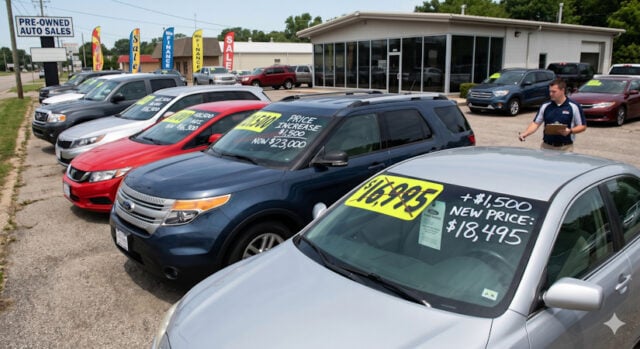
The automotive market has long been a bellwether for the broader American economy, reflecting shifts in consumer confidence, supply chain health, and inflationary pressures. In a development that has caught many market observers off guard, used-vehicle prices have surged sharply and suddenly. According to recent CARFAX seven-day median data, prices for pre-owned vehicles have jumped by a staggering $1,500 since mid-March 2026. This sharp increase follows a more modest $450 or 1.7% rise in February, signaling a rapid acceleration in a market that many hoped was stabilizing.
For the average American consumer, this price hike represents a substantial hurdle to affordable transportation. As the average price of a used vehicle now tops $25,500, the “Bottom Line” perspective from the Car Dealership Guy team suggests that this environment will demand a new level of strategic thinking from both buyers and sellers. As noted in their recent analysis, “A rise in used-vehicle prices will require dealers to be creative in sourcing inventory, looking at all options in a competitive market, from service lanes, trades, online, and auctions, while pricing competitively for retail.”
The Mechanics of the Surge
To understand why prices have surged by $1,500 in such a short window, one must look at the convergence of several macroeconomic and industry-specific factors. The primary driver remains the classic economic principle of supply and demand, but with modern complications.
First, the industry is still grappling with the “inventory lull” created by the COVID-19 pandemic. The shortfall in new vehicle production between 2020 and 2023 means there are fewer late-model used cars entering the market today as off-lease or trade-in units. This “missing generation” of vehicles has created a permanent constriction in the supply of high-demand, lower-mileage certified pre-owned (CPO) options. When supply is capped and demand remains steady or increases, price surges are inevitable.

Furthermore, the surge in mid-March aligns with seasonal trends that have been amplified in 2026. Tax refund season typically brings a wave of buyers into the used car market, many of whom use their refunds as down payments. However, unlike previous years where inventory was sufficient to absorb this influx, the current scarcity has turned the seasonal bump into a price explosion.
The Affordability Crisis and New Car Spillover
A critical factor in the used market’s price spike is the state of the new car market. As new car prices continue to reach historic highs, many traditional new-car buyers are being pushed into the pre-owned segment. This migration increases competition for the best available used units, further driving up prices.
Patrick Olsen of CARFAX highlights this shift, noting that “as new car prices continue to get higher, used cars are being considered by more consumers than one year ago.” This creates a feedback loop: new car prices rise, driving demand for used cars; used car supply is low, so used car prices rise; the gap between new and used shrinks, but the total cost of ownership across the board remains elevated.
The data reveals that 2025 models have depreciated by approximately 12.5%, while 2021 models have seen a 34% drop from their original values. While these numbers suggest that older vehicles are retaining value better than in the pre-pandemic era, the absolute dollar amount required to purchase these vehicles remains a barrier. With the average price at $25,500, a used car is no longer the “budget” alternative it once was.
The EV Resurgence and Gas Price Influence
One of the more surprising sub-trends within this price surge is the renewed demand for electric vehicles (EVs). After a period of cooling interest, EVs have seen a resurgence as national gas prices have topped $4 per gallon. CARFAX data shows that EV prices jumped by $560 in just the past month.
This demand is driven by consumers looking to hedge against volatile fuel costs. As Patrick Olsen points out, “EVs have seen a resurgence with gas prices rising. The demand for EVs is up.” However, the used EV market is even more constrained than the internal combustion engine (ICE) market, as the volume of used EVs remains relatively small. This has led to a situation where used EVs are fetching premiums that were unthinkable just six months ago.
Regional Variances: Where the Value Remains
While the national trend is upward, the surge is not felt equally across all fifty states. For consumers willing to travel or shop across state lines, there are still pockets of relative value. According to history-based value estimates, Florida currently presents the best value for used car shoppers, with listing prices often falling below recommendations based on vehicle history. Texas and California follow as the second and third best states for value.
These regional discrepancies are often the result of local inventory levels and varying state-level economic conditions. In high-volume states like Florida, the sheer density of dealerships and a robust trade-in culture help keep prices slightly more grounded than in more isolated or less populated regions.
Dealer Strategies in a High-Price Environment
For automotive dealers, the $1,500 price surge presents a double-edged sword. While higher retail prices can lead to higher gross profits per unit, the cost of acquiring that inventory—the “cost of goods sold”—has also skyrocketed. This squeeze is forcing dealers to abandon traditional auction-only sourcing models.
As emphasized by the Dealership Guy analysis, dealers are now looking toward “service lanes” as a primary source of inventory. By identifying customers who are bringing in desirable vehicles for maintenance and offering them aggressive trade-in values on the spot, dealers can bypass the high fees and competitive bidding of traditional auctions. Additionally, “street purchases”—where dealers buy cars directly from the public without a trade-in—have become a vital lifeline for maintaining lot variety.
The challenge for dealers is “pricing competitively for retail” while maintaining enough margin to cover overhead in an environment of high interest rates. If a dealer pays too much for a car in April and the market corrects in June, they risk being “underwater” on their inventory.
The Role of Financing and Interest Rates
No discussion of vehicle prices is complete without addressing the cost of money. Interest rates remain at multi-decade highs, which compounds the impact of the $1,500 price surge. When the vehicle price goes up and the interest rate remains high, the monthly payment becomes untenable for many.
Recent industry reports indicate that nearly 20% of new-car buyers are opting for 84-month loans to keep monthly payments manageable. This trend is spilling over into the used market, where 72-month and even 84-month terms are becoming more common for late-model pre-owned vehicles. While this lowers the monthly hurdle, it significantly increases the total interest paid over the life of the loan. In some cases, buyers are paying upwards of $4,000 more in interest than in 2021.
This has also led to a rise in “negative equity.” With prices surging so rapidly, there is a fear that if the market eventually cools, consumers who bought at the peak will owe far more than their cars are worth. Current data suggests that 23% of customers with trade-ins already have negative equity, averaging over $6,100.
Looking Ahead: Will Prices Stabilize?
The $1,500 jump since mid-March is a stark reminder that the “new normal” in the automotive industry is one of volatility. While some analysts believe this is a temporary spike driven by tax season and a sudden jump in gas prices, others see it as the beginning of a sustained period of high prices, driven by underlying supply constraints that cannot be fixed overnight.
The “Bottom Line” for the rest of 2026 is that the market will remain a “seller’s market” for the foreseeable future. Consumers will need to be more diligent than ever, checking vehicle histories and being prepared to act quickly when a fair deal arises. Dealers, conversely, will need to continue their “creative sourcing” to survive.
In conclusion, the $1,500 surge is more than just a number; it reflects a complex, interconnected global economy. From the lasting effects of a pandemic-era manufacturing halt to the current price of a gallon of gasoline, every factor is pushing used vehicle prices higher. Whether the market finds a ceiling soon or continues this upward trajectory will depend on the Federal Reserve’s interest rate decisions and the industry’s ability to finally bridge the supply gap that has plagued it for years.
Sources:
Disclaimer
Artificial Intelligence Disclosure & Legal Disclaimer
AI Content Policy.
To provide our readers with timely and comprehensive coverage, South Florida Reporter uses artificial intelligence (AI) to assist in producing certain articles and visual content.
Articles: AI may be used to assist in research, structural drafting, or data analysis. All AI-assisted text is reviewed and edited by our team to ensure accuracy and adherence to our editorial standards.
Images: Any imagery generated or significantly altered by AI is clearly marked with a disclaimer or watermark to distinguish it from traditional photography or editorial illustrations.
General Disclaimer
The information contained in South Florida Reporter is for general information purposes only.
South Florida Reporter assumes no responsibility for errors or omissions in the contents of the Service. In no event shall South Florida Reporter be liable for any special, direct, indirect, consequential, or incidental damages or any damages whatsoever, whether in an action of contract, negligence or other tort, arising out of or in connection with the use of the Service or the contents of the Service.
The Company reserves the right to make additions, deletions, or modifications to the contents of the Service at any time without prior notice. The Company does not warrant that the Service is free of viruses or other harmful components.