WASHINGTON, D.C. — In a moment described by diplomats as the most significant breakthrough in Middle Eastern diplomacy in over three decades, Secretary of State Marco Rubio hosted direct, face-to-face negotiations between high-level representatives from Israel and Lebanon at the State Department on Tuesday, April 14, 2026. The meeting, which lasted just over two hours, represents a high-stakes gamble by the Trump administration to decouple the ongoing conflict in Lebanon from the wider, devastating 2026 Iran War.
While the world’s attention has been transfixed by the U.S. naval blockade of the Strait of Hormuz and the tactical missile exchanges between Washington and Tehran, Rubio’s diplomatic theater in D.C. sought to address the most volatile proxy front of the war. Sitting across from one another were Israeli Ambassador Yechiel Leiter and Lebanese Ambassador Nada Hamadeh Moawad. It was the first time since the early 1990s that such high-level envoys from the two neighboring states, which technically remain in a state of war, engaged in direct dialogue without the shield of “proximity talks.”
A “Process, Not an Event”
Secretary Rubio opened the session with a tone of cautious realism, aware of the immense historical weight and the immediate military pressure surrounding the table. “This is a process, not an event,” Rubio told a packed press gallery shortly after the delegates entered the mahogany-paneled room. “We understand we are working against decades of history and complexities. But we believe it is worth this endeavor to move forward with a framework where the people of Lebanon can have the future they deserve and the people of Israel can live without fear.”

The primary objective of the talks, according to State Department officials, is to establish a “permanent end” to the influence of Hezbollah, the Iran-backed militant group that has dominated southern Lebanon for forty years. However, the shadow of Iran loomed large over the proceedings. Despite the user’s inquiry regarding “Iran reps,” the Iranian government was not physically present in the Foggy Bottom meeting. Instead, direct negotiations with Tehran are currently being handled on a separate track in Islamabad, Pakistan, where Vice President JD Vance and Special Envoy Steve Witkoff have been meeting with Iranian officials to solidify a fragile two-week ceasefire.
The Context of the 2026 Iran War
To understand the gravity of Rubio’s meeting, one must look at the preceding six weeks. The “Iran War” escalated sharply in early March 2026 after a series of maritime incidents led to a U.S.-led blockade of Iranian ports. Tensions reached a fever pitch on April 8, when Israel conducted a massive aerial bombardment of Beirut, targeting Hezbollah’s central command but resulting in significant civilian displacement.
On the morning of the Washington talks, the Pentagon confirmed that no ships had successfully breached the Hormuz blockade, despite Iranian threats to “scorch the sea.” This economic and military strangulation forced Tehran to the negotiating table in Pakistan, resulting in a temporary truce. Rubio is now attempting to use that pause to settle the “northern front.”
The Military Situation in Lebanon
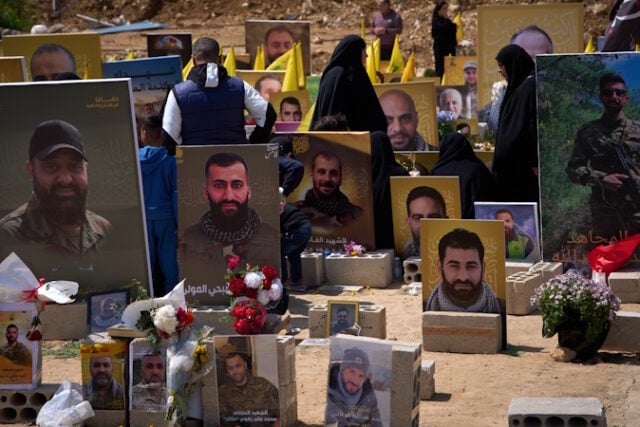
As Rubio spoke in Washington, the sounds of war continued to echo in southern Lebanon. The Israel Defense Forces (IDF) announced that they had surrounded Bint Jbeil, a traditional Hezbollah stronghold, as part of Operation Epic Fury. The IDF reported eliminating over 100 militants in close-quarters combat on Tuesday alone.
This duality—diplomacy in the West and heavy combat in the East—is the defining feature of Rubio’s strategy. Israel maintains that the U.S.-Iran ceasefire does not apply to Hezbollah. “Israel is at war with Hezbollah, not the state of Lebanon,” a senior administration official noted. The goal of the D.C. meeting was to empower the Lebanese government to reclaim sovereignty over its territory, effectively asking Beirut to choose between regional integration and its alliance with the “Axis of Resistance.”
The Lebanese Dilemma
For Ambassador Moawad, the meeting was a tightrope walk. The Lebanese government is under immense pressure from Hezbollah’s political wing, which remains a powerful force in Beirut. Naim Qassem, the leader of Hezbollah following the deaths of previous commanders in earlier strikes, dismissed the Washington talks as “futile” and urged the government to focus on “confronting Zionist aggression.”
Reports indicate that Lebanese Prime Minister Joseph Aoun had to cancel his own trip to Washington due to security concerns and the threat of a domestic coup by pro-Iran factions. However, the humanitarian toll—over 2,000 dead and 1.2 million displaced—has reached a point where even Hezbollah’s allies are seeking an exit strategy. The “10-point plan” currently being discussed includes:
- Immediate Disarmament: The phased removal of Hezbollah’s heavy weaponry from south of the Litani River.
- Sovereign Control: The deployment of the Lebanese Armed Forces (LAF) to the border with U.S. and G7 funding.
- Economic Rescue: A multi-billion-dollar reconstruction package contingent on the exclusion of Iranian influence.
The Historical Parallel: 1983 vs. 2026
Analysts are drawing frequent comparisons to the May 17 Agreement of 1983, which followed Israel’s invasion of Lebanon. That agreement eventually collapsed under the weight of Syrian and Iranian interference. Rubio’s team is determined to avoid that fate by ensuring this “Washington Framework” is tied directly to the broader U.S.-Iran settlement being brokered in Islamabad.
By involving the IMF and the G7, Rubio is attempting to build a “wall of international consensus” that makes the cost of returning to war prohibitive for Beirut. However, the success of this strategy hinges on the Islamabad track. If JD Vance and the Iranian representatives cannot agree on the reopening of the Strait of Hormuz or the lifting of sanctions, the Lebanon-Israel talks will likely dissolve into another cycle of border skirmishes.
Global Implications
The stakes of Rubio’s meeting extend far beyond the Levant. Global oil markets have been in a state of shock, with prices surging as the “Iran War” threatened to shut down 20% of the world’s oil supply. The announcement of direct talks in Washington provided a brief moment of relief for the Dow Jones Industrial Average, which jumped 400 points as traders bet on a de-escalation.
The European Union, represented by Ursula von der Leyen, has warned that no peace is possible while “Lebanon is in flames.” The EU has pledged support for the Rubio-led initiative, though some member states remain skeptical of the Trump administration’s “maximum pressure” tactics.
Challenges Ahead: The Shadow of the IRGC
The greatest threat to Rubio’s diplomatic push remains the Islamic Revolutionary Guard Corps (IRGC). Despite the official ceasefire, IRGC-linked groups in Iraq and Yemen have continued to launch sporadic drone attacks against U.S. assets. If Tehran feels that Rubio is successfully peeling Lebanon away from its orbit, it may use its proxies to “torpedo” the peace process through high-profile assassinations or renewed rocket barrages into northern Israel.
Israeli Ambassador Leiter was clear in his post-meeting remarks: “We are reaching for peace with our neighbors, but our hand remains on the sword. We will not allow the Iranian regime to use Lebanon as a launchpad for genocide while they talk of peace in Pakistan.”
Conclusion: A Fragile Hope
As the first day of the Washington talks concluded, no formal treaty was signed, but the joint statement agreeing to “launch sustained direct negotiations” is itself a milestone. Secretary Rubio has positioned himself as the primary architect of a new Middle Eastern order, one that seeks to isolate the Iranian regime by resolving the regional grievances it has historically exploited.
The coming days will be critical. The world will be watching to see if the ceasefire holds and if the ambassadors can move from “productive discussions” to a binding agreement. For the millions of civilians caught in the crossfire of the 2026 Iran War, Rubio’s table at the State Department represents the only viable path back from the brink of a total regional collapse.
Sources Used and Links:
- Foundation for Defense of Democracies (FDD): Israel and Lebanon Hold Direct Talks in Washington as War With Hezbollah Continues
- Associated Press (AP): Lebanon and Israel hold first direct diplomatic talks in decades in Washington
- Washington Post: Lebanese, Israeli diplomats hold rare face-to-face meeting in Washington
- Washington Examiner: Rubio: ‘Historic’ Israel-Lebanon talks meant to create ‘permanent end’ to Hezbollah influence
- Military.com: US Steps in to Host First Israel-Lebanon Talks
- Al Jazeera: Israel and Lebanon hold rare talks in Washington, DC, amid Iran war
- CBS News: Iran war continues with U.S. blockade of ports; Lebanon and Israel hold direct talks
- Al-Monitor: First round of Lebanon-Israel talks concludes in Washington: What to know
- Anadolu Agency: Rubio to join Israel-Lebanon talks at State Department
- Wikipedia: 2026 Iran war ceasefire
- Carnegie Endowment for International Peace: The United States and Iran Have Agreed to a Two-Week Ceasefire
Disclaimer
Artificial Intelligence Disclosure & Legal Disclaimer
AI Content Policy.
To provide our readers with timely and comprehensive coverage, South Florida Reporter uses artificial intelligence (AI) to assist in producing certain articles and visual content.
Articles: AI may be used to assist in research, structural drafting, or data analysis. All AI-assisted text is reviewed and edited by our team to ensure accuracy and adherence to our editorial standards.
Images: Any imagery generated or significantly altered by AI is clearly marked with a disclaimer or watermark to distinguish it from traditional photography or editorial illustrations.
General Disclaimer
The information contained in South Florida Reporter is for general information purposes only.
South Florida Reporter assumes no responsibility for errors or omissions in the contents of the Service. In no event shall South Florida Reporter be liable for any special, direct, indirect, consequential, or incidental damages or any damages whatsoever, whether in an action of contract, negligence or other tort, arising out of or in connection with the use of the Service or the contents of the Service.
The Company reserves the right to make additions, deletions, or modifications to the contents of the Service at any time without prior notice. The Company does not warrant that the Service is free of viruses or other harmful components.