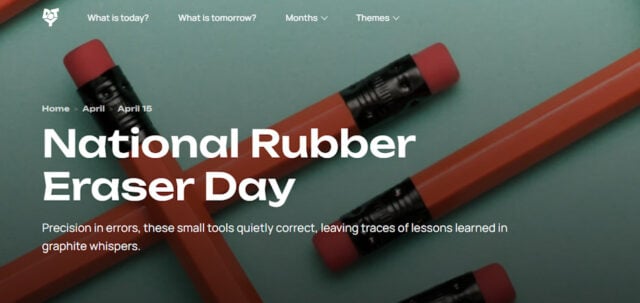
Correcting mistakes since 1770, National Rubber Eraser Day on April 15th commemorates the date the invention began making written errors disappear.
- 2000 BC – Scribes in ancient Mesopotamia correct mistakes on clay tablets by scraping off wet clay and smoothing the surface, an early example of “erasing” written records.
- 1st Century – In the Roman world, people wrote with a stylus on wax tablets and erased by smoothing the wax with the flat end of the stylus so the surface could be reused.
- Pre-1770 – Europeans commonly used soft bread crumbs, pumice, and even milk-soaked bread to rub out graphite and some ink marks from paper.
- 1770 – Joseph Priestly found a vegetable gum to remove pencil marks. He dubbed the substance “rubber.” It wasn’t widely accepted. Priestly is the same guy who discovered oxygen in 1774.
- 1770 – Edward Nairne developed the first rubber eraser. Nairne claimed to have come upon his invention accidentally: He inadvertently picked up a piece of rubber instead of breadcrumbs, he said, thereby realizing rubber’s erasing properties.
- 1839 – Charles Goodyear discovers vulcanization in 1839 and receives a U.S. patent in 1844 for treating natural rubber with sulfur and heat, greatly improving its stability and making rubber erasers practical and long-lasting.
- 1858 – Hyman Lipman (Philadelphia, Pa.) patented the pencil with an eraser at the end.
- 1932 – The electric eraser was invented in 1932 by Arthur Dremel of Racine, Wisconsin, USA.
- Erasers were once called lead eaters.
- An eraser by any other name? Originally, what we now call an eraser was referred to as a “rubber” because the tree resin it was made of “rubbed out” pencil marks. In Great Britain, they still use the original term.
- An eraser isn’t called an eraser by eraser manufacturers, either. Their name for the little erasers on pencil ends – “plugs!”
- What is an Indian rubber eraser? It has two parts — red for black or colored pencil markings and blue for erasing ink
- More and more of today’s erasers are made from something other than rubber! While some of the “pink” erasers you find on pencils are made from synthetic rubber blended with pumice (a grit that enhances its ability to erase), an increasing number of erasers are made from vinyl. Vinyl is a type of durable, flexible plastic.
- Even to this day, most pencils sold in Europe are eraser-less!
- One of the ingredients in erasers is a substance called pumice. The type of pumice used was primarily pink or red.
- The name ‘rubber’ comes from its rubbing action
- The Eberhard Faber Pencil Company brought the pink eraser to the world when it affixed the signature pink eraser to its pencils. Eventually, the company produced the pink pearl, a rectangular eraser that is still made today.
- In the United Kingdom, erasers are still known as rubbers.
- With erasers, you should be able to take the graphite off in 2 strokes
- Erasers are used for EVERYTHING:
- According to Guinness World Records, the world’s largest eraser collection contains 19,571 erasers. The collector, Petra Engles of Germany, has been collecting erasers for more than 25 years.
Sources:
Pencils

Disclaimer
Artificial Intelligence Disclosure & Legal Disclaimer
AI Content Policy.
To provide our readers with timely and comprehensive coverage, South Florida Reporter uses artificial intelligence (AI) to assist in producing certain articles and visual content.
Articles: AI may be used to assist in research, structural drafting, or data analysis. All AI-assisted text is reviewed and edited by our team to ensure accuracy and adherence to our editorial standards.
Images: Any imagery generated or significantly altered by AI is clearly marked with a disclaimer or watermark to distinguish it from traditional photography or editorial illustrations.
General Disclaimer
The information contained in South Florida Reporter is for general information purposes only.
South Florida Reporter assumes no responsibility for errors or omissions in the contents of the Service. In no event shall South Florida Reporter be liable for any special, direct, indirect, consequential, or incidental damages or any damages whatsoever, whether in an action of contract, negligence or other tort, arising out of or in connection with the use of the Service or the contents of the Service.
The Company reserves the right to make additions, deletions, or modifications to the contents of the Service at any time without prior notice. The Company does not warrant that the Service is free of viruses or other harmful components.