The Great Grocery Divide: Why Dinner is Cheaper, but the Entrée is Not
As the calendar turned to April 2026, American shoppers found a rare reason for optimism in the grocery aisles—provided they weren’t looking for a steak. According to the March Consumer Price Index (CPI) report released by the Bureau of Labor Statistics (BLS) on April 10, food-at-home inflation has finally dipped below the 2% threshold, marking a significant milestone in the post-pandemic economic recovery. However, this stabilization is unevenly distributed, creating a “tale of two aisles” in which staples like eggs and milk are plummeting in price while beef and other proteins are reaching record highs.
The Numbers Behind the Cooling
The BLS reported that food-at-home prices rose at just a 1.9% annual clip in March 2026. This is a sharp deceleration from the 2.4% rate recorded in February and represents the first time grocery inflation has been under 2% since late 2025. This cooling comes even as the “All Items” CPI rose 3.3%, largely driven by a massive spike in gasoline and energy costs.
For the average consumer, the relief is most visible in the dairy and breakfast aisles:
- Eggs: Prices plummeted by nearly 45% year-over-year in March, the steepest decline of any category.
- Dairy: Fresh whole milk prices fell almost 3%, while cheese and related products dropped by roughly 2%.
- Vegetables: While some produce like tomatoes (+22%) and lettuce (+14%) surged due to seasonal and weather factors, potatoes fell by 4.4%.
The Searing Heat in the Meat Aisle
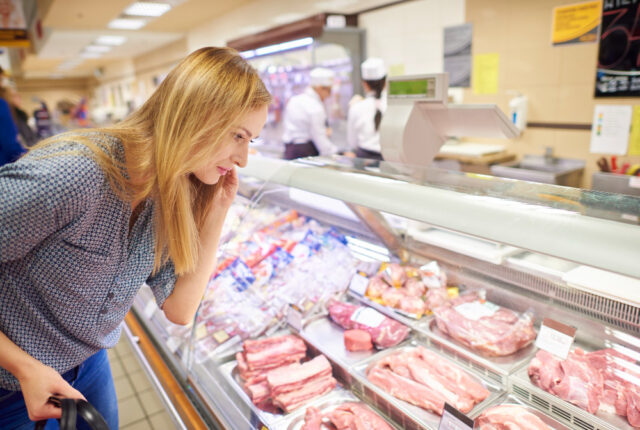
While the overall grocery bill might be stabilizing, the cost of the main course is moving in the opposite direction. Beef and veal prices were up more than 12% year-over-year in March, with uncooked beef steaks clocking in at a staggering 15% increase.

Industry experts point to a “perfect storm” of factors that have sent meat prices soaring while other goods stabilize. The primary driver is a catastrophic contraction in the U.S. cattle herd, which has reached an 87-million-head low—the smallest the nation has seen in 75 years.
The 75-Year Low: A Supply Crisis Decades in the Making
The current beef crisis isn’t a fluke; it’s the result of a multi-year drought across major cattle-producing regions in the Midwest and South. Years of dry weather decimated grazing lands and sent hay prices to record levels. Faced with the inability to feed their animals, ranchers were forced to sell off “replacement heifers”—the young cows intended to grow the herd.
Because the cattle biological cycle is slow (10–12 years from expansion to contraction), rebuilding the herd is a multi-year commitment. Experts at the Texas Farm Bureau note that even if weather conditions remain perfect starting today, the market won’t see a significant increase in beef supply until 2027 or 2028.
The Energy and Logistics Tax
Adding fuel to the fire—literally—is the cost of moving meat from ranch to table. While food production costs at the farm level have shown signs of easing, transportation costs have skyrocketed. Gasoline prices were up by more than 21% in March 2026, driven by global energy constraints. For the meat industry, which relies on temperature-controlled trucking and long-distance logistics, these fuel costs are directly passed through to the retail price tag.
Shifting Strategies: How Retailers and Consumers are Coping
The divergence in prices is fundamentally changing how Americans shop and how grocery giants like Kroger, Aldi, and Walmart operate.
The Rise of the “Private Label Powerhouse”
With national-brand meat products reaching prohibitive price points, retailers are leaning into their private-label offerings. Store brands, once viewed as “budget” alternatives, are now being marketed as premium-quality options at a 20–30% discount compared to national names. Industry forecasts suggest private label sales will hit $280 billion in 2026, accounting for over 21% of total grocery revenue.
The “Chicken Pivot”
In both grocery stores and restaurants, there is a visible migration away from beef. Poultry, while also experiencing price growth, remains significantly more affordable.
- Retail: Sales of rotisserie chickens and bulk poultry have surged as families swap out Sunday roasts for chicken-based meals.
- Restaurants: Fast-food giants like McDonald’s and Burger King have ramped up their chicken offerings. McDonald’s is currently testing a new “McCrispy Strips” line with various dry rubs and sauces to offset the pain of rising beef costs, which saw a 20% internal inflation rate for some chains last year.
Government Intervention: Tariffs and Imports
In an attempt to provide immediate relief, the federal government has taken unprecedented steps in early 2026. President Trump recently signed a proclamation increasing the tariff-rate quota for lean beef trimmings. This allows for an additional 80,000 metric tons of beef from Argentina to enter the U.S. tariff-free. While this is primarily used for ground beef production rather than high-end steaks, officials hope it will stabilize the “burger market” for middle-class families.
The Road Ahead: 2026 and Beyond
As we move through the second quarter of 2026, the outlook remains mixed. While the cooling of general grocery inflation is a welcome sign for the Federal Reserve and the American consumer, the structural issues in the livestock industry suggest that “steak night” will remain a luxury for the foreseeable future.
USDA projections for the remainder of 2026 suggest:
- Beef: Prices are expected to rise another 6.9% before the end of the year.
- Pork: Production is expected to increase by 2.5%, but strong export demand from Mexico and Asia will likely keep domestic prices from falling significantly, with a projected 2.1% increase.
- Climate Impact: Continued investment in “resilient agriculture” will be necessary to prevent the next drought from triggering a similar collapse in supply.
Conclusion
The 1.9% grocery inflation rate is a victory for the economy at large, but it feels like a hollow one for the shopper standing at the butcher counter. Until the U.S. cattle herd can be rebuilt and energy costs find a stable floor, the gap between the cost of a gallon of milk and a pound of ground chuck will likely continue to widen. For now, the American dinner plate is becoming increasingly creative, favoring poultry, plant-based proteins, and private-label staples as the nation waits for the meat market to finally chill.
Sources Used and Links
- U.S. Bureau of Labor Statistics: Consumer Price Index – March 2026 https://www.bls.gov/cpi/
- Grocery Dive: Grocery price growth cools as overall inflation surges https://www.grocerydive.com/news/grocery-inflation-march-2026-produce-coffee-meat-eggs/817184/
- The Digest Online: Why Beef Prices Are Soaring in 2026: Shortages and High Demand https://thedigestonline.com/dining/beef-prices-rising-2026/
- USDA Economic Research Service: Hogs & Pork – Market Outlook March 2026 https://www.ers.usda.gov/topics/animal-products/hogs-pork/market-outlook
- Restaurant Dive: Beef costs exceed burger prices, pressuring QSRs https://www.restaurantdive.com/news/Datassential-burger-prices-up-14-percent-two-years/814466/
- TheStreet: McDonald’s menu adds new chicken choices as beef prices rise https://www.thestreet.com/restaurants/mcdonalds-makes-a-big-menu-shift-as-beef-prices-rise
- Climate Central: Climate Change and Food Prices https://www.climatecentral.org/climate-matters/climate-change-and-food-prices
- National Hog Farmer: Export demand expected to push U.S. pork prices higher https://www.nationalhogfarmer.com/market-news/export-demand-expected-to-push-u-s-pork-prices-higher
Disclaimer
Artificial Intelligence Disclosure & Legal Disclaimer
AI Content Policy.
To provide our readers with timely and comprehensive coverage, South Florida Reporter uses artificial intelligence (AI) to assist in producing certain articles and visual content.
Articles: AI may be used to assist in research, structural drafting, or data analysis. All AI-assisted text is reviewed and edited by our team to ensure accuracy and adherence to our editorial standards.
Images: Any imagery generated or significantly altered by AI is clearly marked with a disclaimer or watermark to distinguish it from traditional photography or editorial illustrations.
General Disclaimer
The information contained in South Florida Reporter is for general information purposes only.
South Florida Reporter assumes no responsibility for errors or omissions in the contents of the Service. In no event shall South Florida Reporter be liable for any special, direct, indirect, consequential, or incidental damages or any damages whatsoever, whether in an action of contract, negligence or other tort, arising out of or in connection with the use of the Service or the contents of the Service.
The Company reserves the right to make additions, deletions, or modifications to the contents of the Service at any time without prior notice. The Company does not warrant that the Service is free of viruses or other harmful components.