
Colorado has the nation’s lowest obesity rate, yet one in four residents still meets the medical definition. If you’re battling weight-related disease, choosing the right bariatric surgeon can reset your health trajectory. Sleeve gastrectomy isn’t just stomach-shrinking surgery—it can cut overall cancer incidence by 32 percent and cancer-related deaths by 48 percent, according to JAMA-level research. It also helps patients shed 60–80 percent of excess weight within a year, restoring energy, mobility, and confidence.
Outcomes, however, depend on the hands that hold the stapler. We audited accreditation records, leak rates, readmissions, patient surveys, and case volumes to build this 2026 honor roll. In the next few minutes, you’ll see our scoring method, a side-by-side surgeon scorecard, and concise profiles that make your shortlist—and your questions—crystal-clear.
Ready? Let’s meet Colorado’s best.
How we built the short-list
First, we narrowed the field. Only surgeons who operate in an MBSAQIP-accredited Comprehensive Center are qualified, because that seal confirms audited case volume, safety protocols, and outcomes. We also verified each surgeon’s board certification and ran Colorado Medical Board checks to confirm clean licenses.

Next, we scored every qualified surgeon on a 100-point framework: surgical volume (30 percent), patient-safety outcomes (25 percent), satisfaction and support (20 percent), credentials and leadership (15 percent), and measured innovation (10 percent).
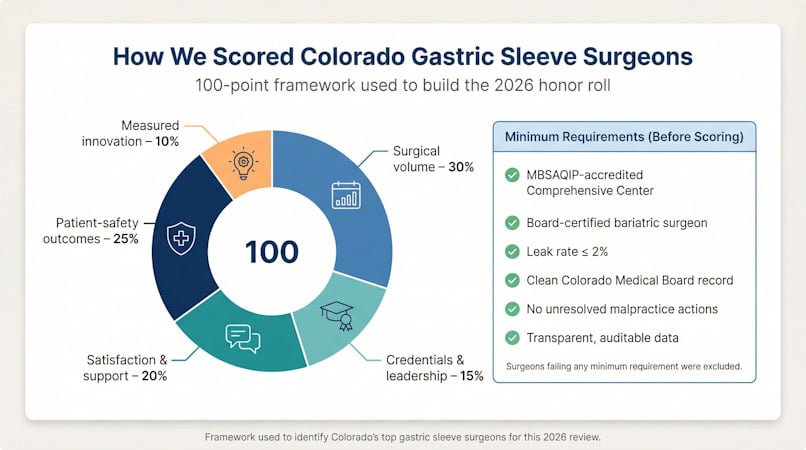
Volume sharpens teamwork, while low leak rates, minimal readmissions, and a zero-mortality streak prove skill under pressure. Reviews show whether patients feel heard after anesthesia fades. Credentials and active research signal mastery, and adopting robotics or single-incision techniques points to a forward-looking practice.
We disqualified any surgeon with a leak rate above two percent, unresolved malpractice actions, or opaque data. The five remaining specialists outperform state and national benchmarks across multiple dimensions. They are the surgeons we would trust with a loved one—and now, you can evaluate them with the same confidence.
Colorado’s top sleeve surgeons at a glance
Step into Dr. Long’s clinic, and the vibe feels more like a health club lobby than a hospital waiting room. That upbeat energy starts with the surgeon himself. He blends a data-driven mindset with an encouraging bedside style that turns nerves into optimism.
The numbers support the mood. Dr. Long has performed well over 1,000 bariatric operations, completing 150–200 sleeve procedures each year. His leak rate stays below 1 percent—about half the national average—and the program has recorded zero operative deaths in recent years. The operation itself usually takes 60–90 minutes, and most patients stay just one night in the hospital—benchmarks outlined in the clinic’s guide to Denver gastric sleeve surgery. Reviewing that walkthrough before your consult turns abstract safety numbers into a concrete timeline you can plan around.
Technique is part of the edge. Most sleeves are done robotically, allowing millimeter-level precision and smaller scars with less pain. Yet technology never outweighs teamwork. Every patient attends required nutrition and mindset sessions before surgery, then joins structured support groups afterward. These guardrails explain the center’s five-year data that show durable weight loss rather than the common regain curve.
Location matters too. Lone Tree sits south of Denver, sparing metro patients downtown traffic and cutting drive time for Colorado Springs residents. Free parking, late-day clinic slots, and virtual follow-ups keep travel to a minimum.
Cost transparency completes the picture. Major insurers—including Anthem, Cigna, United, and Aetna—are in-network, and the self-pay package is competitively priced at $ 12,250. Dedicated insurance coordinators handle authorizations so you can focus on preparation, not paperwork.
Pair elite surgical skill with genuine partnership and you get Colorado’s safest, most personable sleeve experience. If you want robotic precision delivered with human warmth, Dr. Joshua Long is at the top of the list.
How to vet any Colorado bariatric surgeon before you sign the consent
Picking from our top five is smart, yet personal due diligence still matters. A quick search will not cover every risk. Follow this five-step checklist so you arrive at your consult better informed than many primary-care doctors.
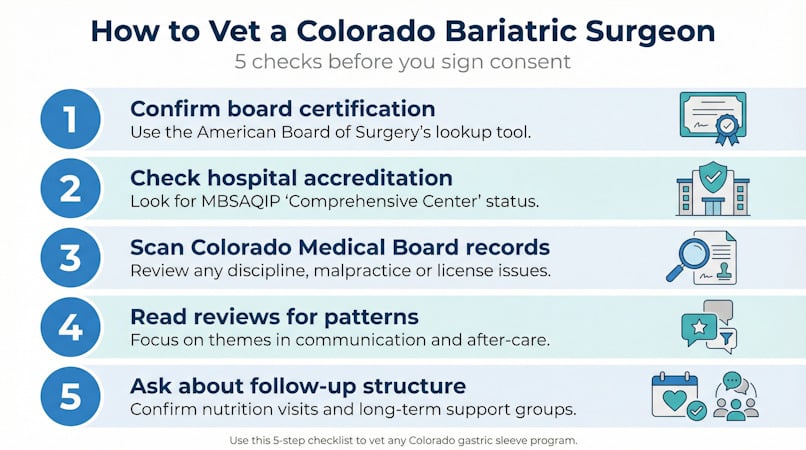
- Confirm board certification. Visit the American Board of Surgery’s free lookup tool and enter the surgeon’s name. Active certification proves rigorous exams and ongoing education. No certificate, no surgery.
- Check hospital accreditation. Surgeons operate where they hold privileges. Ensure the hospital is listed in the MBSAQIP directory as a Comprehensive Center. Accreditation signals audited safety protocols, specialized equipment, and outcomes that beat national benchmarks.
- Scan Colorado Medical Board records. In two minutes, you can view any disciplinary actions, malpractice judgments, or license lapses. A spotless record builds trust; a flagged one warrants a frank conversation.
- Read reviews for patterns, not stars. Ignore one-off complaints about parking fees. Instead, look for repeating themes—clear communication, responsive staff, robust after-care. Consistency tells the real story.
- Ask about follow-up structure. Great programs schedule nutrition and support-group visits months (and years) after surgery. If the answer feels vague or rushed, keep shopping. Long-term support often separates lasting success from regain stories.
Complete this checklist, and you will enter surgery with eyes wide open and the odds firmly in your favor.
Weight-loss landscape 2024–2025: five trends shaping your decision
- GLP-1 drugs join, not replace, surgery. Weekly injections such as Wegovy and Zepbound make headlines, yet head-to-head studies show that surgery delivers larger, longer-lasting weight loss, along with greater reductions in diabetes and cancer risk. Many programs now blend the two: a short GLP-1 “pre-hab” to shrink liver fat, surgery for the main effect, then low-dose maintenance if weight edges upward.
- Insurance hoops are shrinking. Major Colorado carriers have removed the six-month supervised diet rule from most plans. Approvals that once took half a year now clear in six to eight weeks when paperwork is tight. Self-funded employers follow suit because actuarial tables prove surgery lowers long-term costs.
- Self-pay packages undercut medical tourism. Mexican sleeve deals still appear on social feeds, yet local centers offer transparent bundles as low as 11,800 dollars—often within a thousand of Tijuana once flights and hotels are factored in. Staying in state means easier follow-up and clear legal recourse if problems arise.
- Telehealth turns miles into minutes. Post-pandemic rules allow dietitians, psychologists, and surgeons to bill for virtual visits at the same rate as for in-person visits. Rural Coloradans now handle most milestones from a laptop, traveling to Denver only for surgery and a two-week wound check.
- Enhanced recovery pushes toward same-day discharge. Robotics, long-acting nerve blocks, and carbohydrate pre-loading shorten stays. Some healthy, lower-BMI patients already leave the hospital the evening of surgery; one-night stays are now the norm for others. Faster recovery lowers infection risk and reduces time off work.
Frequently asked questions
How much will a gastric sleeve cost me in Colorado?
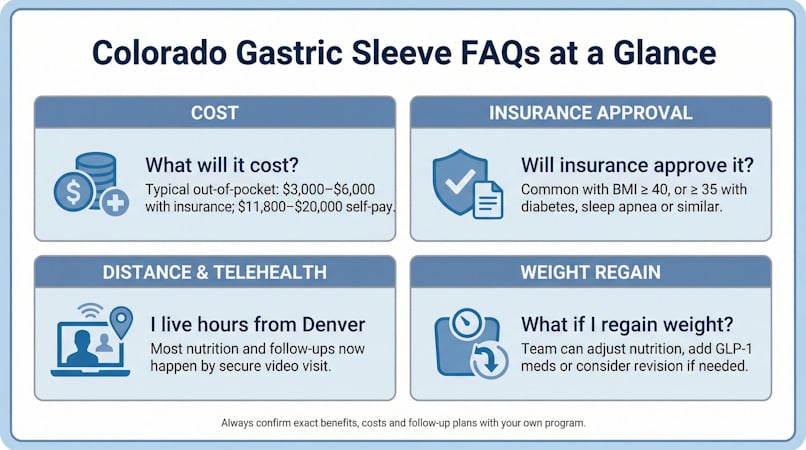
With insurance, most readers pay their deductible plus coinsurance, typically 3,000–6,000 dollars. Self-pay bundles run 11,800–20,000 dollars, depending on hospital add-ons. Programs such as Dr. Brown’s and Dr. Snyder’s sit at the low end because they negotiate flat-rate hospital fees.
Will my insurer actually approve surgery?
If your body mass index is forty or higher—or thirty-five with diabetes, sleep apnoea, or another serious condition—approvals are common and faster than in previous years. Double-check plan details, gather a letter of medical necessity from your primary doctor, and rely on the surgeon’s insurance team; they overturn many initial denials on appeal.
I live four hours from Denver. How do I handle follow-ups?
Telehealth bridges most gaps. You will travel for surgery and a two-week wound check, then switch to video visits. Local labs draw your blood and send results to the surgeon. Many rural patients make only one in-person trip after month three.
What if I regain weight?
Early regain often signals gaps in nutrition, activity, or stress management—issues best addressed with your care team. Later regain can be tempered with low-dose GLP-1 medication or, in rare cases, a sleeve-to-bypass revision. The key is staying engaged in follow-up so adjustments happen before pounds return.
Conclusion
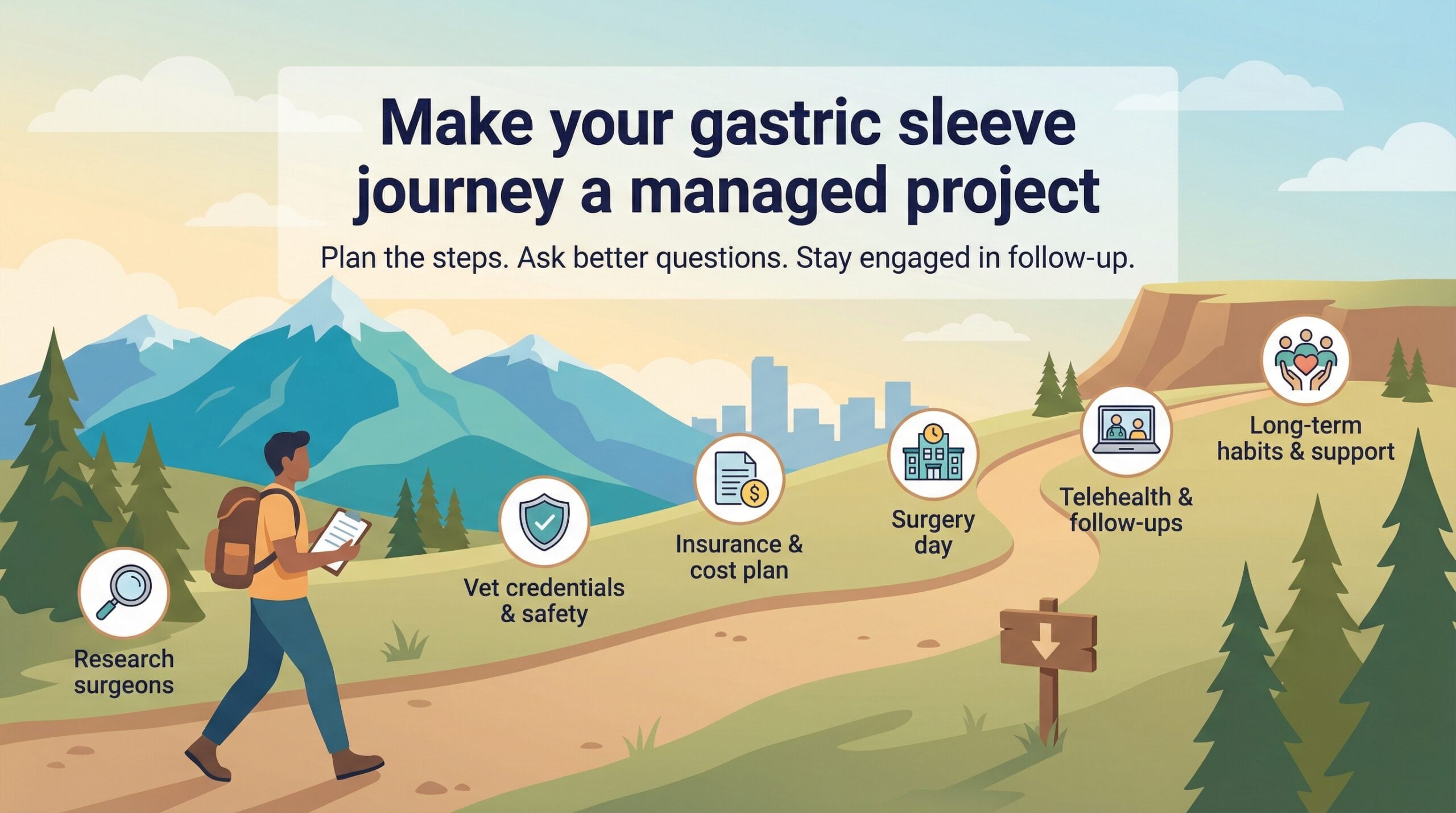
Stay alert to these shifts. They can shorten your timeline, cut your out-of-pocket cost, and make the journey feel less like major surgery and more like a well-managed project.
Disclaimer
Artificial Intelligence Disclosure & Legal Disclaimer
AI Content Policy.
To provide our readers with timely and comprehensive coverage, South Florida Reporter uses artificial intelligence (AI) to assist in producing certain articles and visual content.
Articles: AI may be used to assist in research, structural drafting, or data analysis. All AI-assisted text is reviewed and edited by our team to ensure accuracy and adherence to our editorial standards.
Images: Any imagery generated or significantly altered by AI is clearly marked with a disclaimer or watermark to distinguish it from traditional photography or editorial illustrations.
General Disclaimer
The information contained in South Florida Reporter is for general information purposes only.
South Florida Reporter assumes no responsibility for errors or omissions in the contents of the Service. In no event shall South Florida Reporter be liable for any special, direct, indirect, consequential, or incidental damages or any damages whatsoever, whether in an action of contract, negligence or other tort, arising out of or in connection with the use of the Service or the contents of the Service.
The Company reserves the right to make additions, deletions, or modifications to the contents of the Service at any time without prior notice. The Company does not warrant that the Service is free of viruses or other harmful components.