The gears of government often turn slowly, but in Broward County, a recent proposal to acquire land for Port Everglades has raised alarms for its startling speed and price tag. At the center of the controversy is a 4.5-acre car lot in Dania Beach that a private developer purchased just four months ago as part of a larger parcel. Now, the county is moving to buy back less than half of that land for a price that nearly covers the developer’s entire original investment—a move that has local watchdogs and investigative journalists asking: Why is the public paying a premium for a private flip?
According to a detailed report by the Florida Bulldog, an independent investigative news outlet, Broward County’s administration was prepared to greenlight a $15.75 million purchase of a 4.5-acre site located at the western boundary of Port Everglades. The deal, identified as Agenda Item #26-377, was slated for a vote by the Broward County Commission on April 14, 2026. However, the item was abruptly pulled from the agenda on Monday after journalists began digging into the financial discrepancies and the lack of stated justification for the purchase.
The Anatomy of the Deal
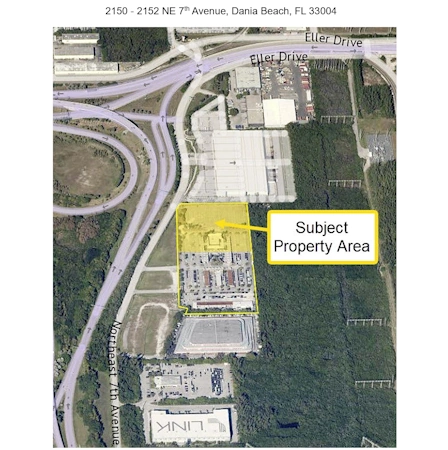
The history of the property at 2150 NE 7th Ave in Dania Beach is brief but lucrative for its current owner. In December 2025, a newly formed entity called 2150 NE 7 Ave LLC, managed by local investor Scott Daiagi, purchased a 9.69-acre site for $21 million. The land, which was owned by Hertz Car Rental for decades, sits in a strategic location south of I-595 and east of US 1.
The proposed transaction with the county involves only the northern 4.5 acres of that 9.69-acre parcel. If approved, the county would pay $15.75 million for the 4.5-acre slice—meaning Daiagi’s company would retain 5.19 acres (which is currently leased back to Hertz through 2044) while recouping 75 percent of its original total purchase price from the county’s coffers.

The financial optics are further complicated by the Broward Property Appraiser’s valuations. The appraiser’s office lists the “just value” of the entire 9.69-acre parcel at approximately $10.8 million. Yet, the county is proposing to pay $15.75 million for less than half of it. When accounting for closing costs, the total burden on the Port Everglades Capital Fund reaches $17 million.
Missing Explanations and Placeholder Links
Perhaps most concerning to observers is the lack of transparency surrounding the necessity of the purchase. Agenda item #26-377 contained no formal explanation as to why the land is needed now or what specific port operations it would serve. Furthermore, the Florida Bulldog noted that the link intended to provide the purchase agreement online contained only a “placeholder” note, leaving the public and even some county staff in the dark regarding the fine print of the contract.
When questioned about the deal, the seller himself appeared surprised by the county’s eagerness. Scott Daiagi, who also serves as the president of Discount Truck Parking USA, told the Florida Bulldog that he did not initiate the sale. “They approached me,” Daiagi said. “It’s not my business to ask [why].”
The push for the acquisition reportedly originated within Port Everglades’ leadership. Port Director Joseph Morris, who took the helm in July 2024, has been cited as the primary driver behind the proposal. However, when reached for comment, Morris was unavailable. Port spokeswoman Joy Oglesby provided only a vague justification, stating the land is required for “multiple uses,” without elaborating on what those uses might be or why this specific, high-priced lot was chosen over more cost-effective alternatives.
The Port Everglades Economic Engine
To understand the stakes of this transaction, one must look at the unique financial structure of Port Everglades. Unlike many county departments that rely on general property taxes, the port operates as a self-supporting “enterprise fund.” This means it generates its own revenue through cruise parking, petroleum shipments, and containerized cargo fees.
In fiscal year 2024, Port Everglades saw a significant financial windfall, with operating revenues hitting $215.5 million—an 18.1 percent increase over the previous year. Because these funds do not come directly from the property tax millage, there is often less public scrutiny regarding how they are spent. However, as watchdog groups point out, every dollar spent on an overvalued land flip is a dollar that cannot be used for critical infrastructure improvements, environmental mitigation, or debt reduction.
The $17 million required for the car lot would be drawn from the Port Everglades Capital Fund. The deal is being pitched to commissioners by Leonard Vialpando, the director of the county’s Public Works and Environmental Sciences department. While the item has been delayed, it is expected to return to the commission floor as early as next week, potentially with additional justifications added to the record to address the “10 percent rule”—a county guideline that requires extra scrutiny when purchase prices exceed the average of independent appraisals by more than 10 percent.
The Role of Watchdog Journalism
The stalling of this deal highlights the critical role of independent investigative reporting in South Florida. The Florida Bulldog, founded by veteran journalist Dan Christensen, has a long history of exposing irregularities in local government. From the corruption investigation that led to the imprisonment of Sheriff Ken Jenne in 2007 to the exposure of hidden court records, the outlet serves as a necessary check on power in a region often plagued by “pay-to-play” politics.
In this instance, the Florida Bulldog’s reporting focused on the “why” and “how much” of a deal that seemed to defy market logic. By comparing the December purchase price with the April asking price, the report highlighted a pattern of land speculation in which private investors can profit handsomely from government expansion projects.
The 4.5-acre lot in question is ideally situated for the port’s western expansion, but the timing of the county’s interest raises questions about why the county did not attempt to purchase the land directly from Hertz before Daiagi’s company stepped in. If the port’s need was known as far back as 2024, the failure to secure the land at its previous market value represents a significant lapse in fiscal stewardship.
Environmental and Strategic Concerns
Beyond the price tag, the “multiple uses” mentioned by the port administration remain a point of curiosity. Port Everglades is currently undergoing a multi-year master plan that includes deepening and widening channels to accommodate larger neo-Panamax ships. Land on the western boundary is typically used for logistics, staging, and parking.
However, the site’s proximity to residential areas in Dania Beach and the sensitive environmental corridors surrounding the airport and port means that any new development must undergo rigorous permitting. By purchasing the land at a premium before these uses are even defined, the county risks overpaying for property that may face future zoning or environmental hurdles.
A Pattern of “Lopsided” Transactions?
The Dania Beach car lot deal is not an isolated incident in the history of South Florida land acquisitions. Investigative reports frequently uncover instances where “amiable, wealthy investors” (as the Bulldog described Daiagi) manage to position themselves between a retiring corporate owner (like Hertz) and a cash-flush government agency (like the Port).
In this case, the fact that Daiagi’s company leased half the land back to Hertz for 20 years suggests that the investor had a long-term plan for the site, only to have the county offer an even more profitable short-term exit. If the county commission votes to move forward with the $15.75 million price tag, it will effectively be validating a 75 percent return on investment for a private entity in just 120 days.
What Comes Next?
As the Broward County Commission prepares for its next session, all eyes will be on Item #26-377. Commissioners will have to decide whether the strategic value of the 4.5 acres justifies the departure from the Property Appraiser’s valuation and the apparent “flip” profit being handed to 2150 NE 7 Ave LLC.
For the residents of Broward County, the story is a reminder that even “self-supporting” agencies like Port Everglades are ultimately accountable to the public. Whether the funds come from container fees or property taxes, the expectation remains the same: transparency, fairness, and fiscal responsibility.
The Florida Bulldog has vowed to continue monitoring the situation, particularly the contents of the purchase agreement once the “placeholder” is replaced with actual text. For now, the car lot remains a symbol of the high-stakes game of South Florida real estate, where the line between savvy investing and public exploitation is often as thin as a property line.
As this story develops, it serves as a testament to the fact that when the “Bulldog” starts barking, the government often finds a reason to take a second look at the books.
Sources and Links:
- Florida Bulldog: “Why does Broward want to buy a car lot for millions more than its assessed value?” by Dan Christensen, April 14, 2026.
- Broward County Commission Agenda: Item #26-377 (April 2026).
- Broward Property Appraiser’s Office Records: Parcel 2150 NE 7 Ave, Dania Beach.
- Port Everglades Financial Statements: Fiscal Year 2024.
Disclaimer
Artificial Intelligence Disclosure & Legal Disclaimer
AI Content Policy.
To provide our readers with timely and comprehensive coverage, South Florida Reporter uses artificial intelligence (AI) to assist in producing certain articles and visual content.
Articles: AI may be used to assist in research, structural drafting, or data analysis. All AI-assisted text is reviewed and edited by our team to ensure accuracy and adherence to our editorial standards.
Images: Any imagery generated or significantly altered by AI is clearly marked with a disclaimer or watermark to distinguish it from traditional photography or editorial illustrations.
General Disclaimer
The information contained in South Florida Reporter is for general information purposes only.
South Florida Reporter assumes no responsibility for errors or omissions in the contents of the Service. In no event shall South Florida Reporter be liable for any special, direct, indirect, consequential, or incidental damages or any damages whatsoever, whether in an action of contract, negligence or other tort, arising out of or in connection with the use of the Service or the contents of the Service.
The Company reserves the right to make additions, deletions, or modifications to the contents of the Service at any time without prior notice. The Company does not warrant that the Service is free of viruses or other harmful components.