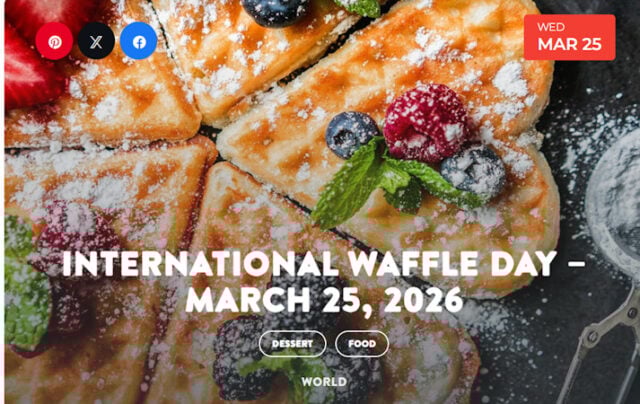
International Waffle Day is on March 25 and celebrates waffles, their history, and a surprising religious holiday. A holiday that is best celebrated by eating waffles is our kind of holiday. Unsurprisingly the day has become a bit of a hit. It was originally celebrated in Sweden but now eager stomachs all over the world embrace International Waffle Day. Plug in your waffle maker and tuck into some mouth-watering treats.
- 9th Century – Waffles are preceded in the early Middle Ages, around the 9th–10th centuries, by the emergence of oublies. They typically depicted imagery of Jesus and his crucifixion, trivial Biblical scenes or simple, emblematic designs.
- 13th Century – Surviving irons from the 13th to 16th centuries show crosses, coats of arms, and biblical scenes pressed into the batter, reflecting how waffles and wafers were tied to religious festivals and public celebrations rather than everyday breakfast.
- 14th Century – One of the earliest written waffle recipes appears in the late 1300s in the French text “Le Ménagier de Paris,” a guidebook compiled for a young wife. It describes a batter of flour, eggs, and wine cooked between hot irons, and even suggests varying the thickness and flavorings, showing that by the late Middle Ages, waffles were already a flexible, customizable food in European home kitchens.
- 1400s – The oublie becomes the waffle in the 1400s, when a craftsman had the idea of forging some cooking plates or “irons” that reproduced the characteristic pattern of honeycombs.
- 1600s – Waffles come to Sweden, and the similar-sounding Våffeldagen and Vårfrudagen unite the two holidays.
- 1600s – Travelers’ accounts from the 1600s describe street vendors selling hot waffles in the colony and social gatherings called “waffle frolics,” where hosts served stacks of waffles with syrup, showing that the dish quickly became embedded in early American food culture.
- 17th Century – Waffles reached North America with Dutch settlers in the 17th century, particularly in New Netherland, the colony that included present-day New York.
- 1725 – The word “waffle” first appeared in the English language in 1725.
- 1839 -Belgian Waffles were first known as “Brussels” Waffles and were invented in 1839.
- 1869 – The design, recorded in Patent No. 94,043, marked an important step toward convenient, standardized waffle-making in American kitchens long before electric waffle irons appeared.
- 1869 – The alternative Waffle Day (on August 24th) began in the USA and honors the anniversary of the patenting of the first US waffle iron invented by Cornelius Swarthout in 1869 in Troy, New York and is celebrated on 24th August.
- 1953 – Eggo Waffles were first introduced in the supermarket freezer sections.
- 1960s – By the 1960s, Eggo’s slogan, “L’eggo my Eggo,” helped cement waffles as an American breakfast icon.
- 1964 – A convenient food for eating on the go, Belgian waffles were officially introduced to the American people at the World’s Fair in 1964.
- 2000s – International Waffle Day is a worldwide phenomenon in which people make or eat waffles and share their love on social media.
- 2007 – Patrick Bertoletti ate 29 Waffles in ten minutes in 2007, beating fellow eating champion, Joey Chestnut in the World Waffle Eating Championships.
- International Waffle Day originated in Sweden.
- Vårfrudagen, a Swedish name for “Our Lady’s Day” sounds (in Swedish) like Våffel-dagen (waffle day).
- Waffles are descended from the flat cakes baked in ancient Greece. These cakes were prepared with cheese and herbs and cooked between two metal plates.
- The verb waffle means to be indecisive, and it comes from the Scottish term “waff,” which means “to yelp like a puppy.”
- The noun waffle, meaning the excellent gridded breakfast food, comes from the Old German wefan, which meant to weave something into the shape of a honeycomb.
- Thomas Jefferson’s Belgian cook brought one of the first waffle irons to the US.
- The word “waffle” is from the Dutch, meaning “wafer”.
- Belgian waffles were known originally as Brussels waffles
- Parry Gripp created a song called “Do You Like Waffles” because of his love of waffles.
- Waffles inspired Nike’s first pair of sneakers.
- The founders of Eggo Waffles were originally mayonnaise moguls.
- In Scandinavian countries, heart-shaped waffles symbolize love and warmth, often served with fresh berries or cream.
- In Japan, taiyaki waffles are thought to bring good fortune, especially during New Year’s. These cultural symbols give waffles a deeper, more personal meaning for some.
- A shortage of cups and a surplus of waffles inspired the ice cream cone.
- Arguably, the most famous waffle outlet in the United States is the Southern chain Waffle House. Since opening 71 years ago (1955), they’ve served just over 1,765,031,384 WAFFLES, or 124,000,000 a year.
Sources:

News9
Disclaimer
Artificial Intelligence Disclosure & Legal Disclaimer
AI Content Policy.
To provide our readers with timely and comprehensive coverage, South Florida Reporter uses artificial intelligence (AI) to assist in producing certain articles and visual content.
Articles: AI may be used to assist in research, structural drafting, or data analysis. All AI-assisted text is reviewed and edited by our team to ensure accuracy and adherence to our editorial standards.
Images: Any imagery generated or significantly altered by AI is clearly marked with a disclaimer or watermark to distinguish it from traditional photography or editorial illustrations.
General Disclaimer
The information contained in South Florida Reporter is for general information purposes only.
South Florida Reporter assumes no responsibility for errors or omissions in the contents of the Service. In no event shall South Florida Reporter be liable for any special, direct, indirect, consequential, or incidental damages or any damages whatsoever, whether in an action of contract, negligence or other tort, arising out of or in connection with the use of the Service or the contents of the Service.
The Company reserves the right to make additions, deletions, or modifications to the contents of the Service at any time without prior notice. The Company does not warrant that the Service is free of viruses or other harmful components.