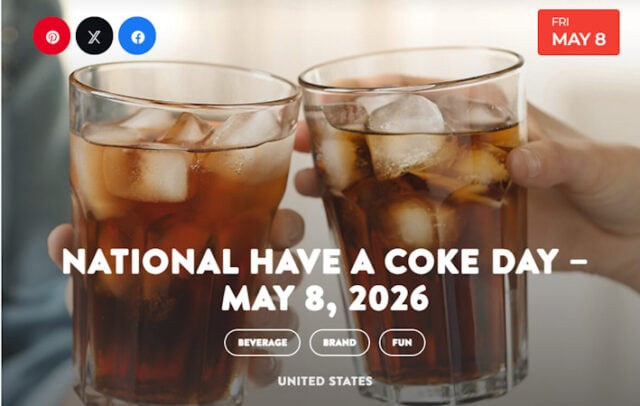
Coca-Cola was born on May 8, 1886, at Jacobs’ Pharmacy in Atlanta, Georgia, when Dr. John Stith Pemberton sold the first glass of this fizzy drink.
- 1886 – John Pemberton invented Coca-Cola at Pemberton’s Eagle Drug and Chemical House in Columbus, Georgia, intending it as a patent medicine.
- Though U.S. pharmacist John S. Pemberton invented Coca-Cola in 1886, his bookkeeper, Frank Robinson, invented the name, and his flowering script is still used today.
- May 8, 1886 – Coca-Cola goes on sale for the first time as a tonic during the temperance movement.
- Coca-Cola’s first slogan in 1886 was “Delicious and Refreshing.” It emphasized the drink’s appeal as both a luxury and a thirst-quencher.
- 1892 – The first bottling of Coca-Cola occurred at the Biedenharn Candy Company in Vicksburg, Mississippi.
- 1894 – The first outdoor wall advertisement that promoted the Coca-Cola drink was painted in Cartersville, Georgia
- 19th Century – Coca-Cola invented coupons in the late 19th century, using “tickets” that could be redeemed for free servings.
- 19th Century – Coca-Cola, the most popular carbonated drink in the world, was originally patented as a medicine when it was invented.
- 1914 – The longest-running commercial Coca-Cola soda fountain anywhere was Atlanta’s Fleeman’s Pharmacy. The pharmacy closed its doors in 1995 after 81 years.
- 1916 – The unique classic Coca-Cola glass bottle, with its contoured shape, hits the market.
- 1922 – Polar bears first appeared in Coca-Cola ads in 1922, symbolizing the brand’s connection to winter festivities.
- 1923 – Coca-Cola invented the six-pack.
- 1928 – Coca-Cola was the first commercial sponsor of the Olympic Games in 1928.
- 1939 – During World War II, Coca-Cola built bottling plants near battlefronts to supply American soldiers with their favorite drink. This not only boosted troop morale but also introduced Coca-Cola to global markets. As a result, the drink became a symbol of home and freedom, cementing its iconic status.
- 1944 – The original filing date for Coke as a registered trademark of the Coca-Cola Company in the United States is March 27, 1944.
- 1944 – July 12, the one-billionth gallon of Coca-Cola syrup was manufactured by the Coca-Cola Company.
- 1950 – Coca-Cola becomes the first product featured on a Time magazine cover.
- 1955 – Cans of Coke first appeared.
- 1971 – Coca-Cola airs one of its most iconic ads in the history of advertising — the ‘I’d Like To Buy The World A Coke’ commercial. This evolved into a full song, recorded as “I’d Like to Teach the World to Sing.”
- 1985 – Coca-Cola became the first soft drink consumed in space. NASA worked with the company to design a can that is zero-gravity-friendly.
- 1993 – The modern version of the polar bears gained fame in the 1993 “Always Coca-Cola” campaign. These ads, featuring playful polar bears, became a holiday favorite.
- 2008 – Coca-Cola’s portfolio features more than 160 low-calorie and no-calorie drinks, including Coke Zero and Powerade Zero
- 2010 – Coca-Cola launched the “happiness machine” campaign. Special vending machines dispensed surprises like free Cokes, flowers, or oversized sandwiches.
- Coca-Cola was meant to be an alternative painkiller to morphine.
- It was then bought out by businessman Asa Griggs Candler. Candler’s marketing tactics led Coke to its dominance of the world soft-drink market throughout the 20th century.
- Coca-Cola was first marketed as a nerve tonic that “relieves exhaustion.’
- Only two countries in the world do not sell Coca-Cola: North Korea and Cuba.
- A can of Coke will sink in water, whereas a can of Diet Coke will float.
- For Coca-Cola to continue operating in its current form, the company has a special arrangement with the Drug Enforcement Administration (DEA) that allows it to import dried coca leaves from Peru (and, to a lesser degree, from Bolivia) in large quantities.
- Coca-Cola Freestyle (the touch screen drink machines with a bunch of options) are designed by Pininfarina. Pininfarina is the design house that designs Ferraris.
- Coca-Cola has so many drink varieties that it would take a person drinking one a day for 9.6 years to try them all. The math behind this claim is based on the company’s historical portfolio of approximately 3,500 unique beverage products.
- A Soviet Union Marshal commissioned a colorless Coca-Cola resembling vodka because he liked the taste, so that he could drink Coke without offending Joseph Stalin
- A glass of Coca-Cola stayed at 5 cents for over 70 years. From 1886 to 1959, a 6.5 glass or bottle of Coca-Cola was just 5 cents.
- The logo is red because of old tax laws. John Stith Pemberton, who created Coke in 1886, had originally billed the soda as a “temperance” drink, or an alternative to alcohol. And because alcohol was heavily taxed in the 19th century, Coca-Cola wanted to make sure its (non-alcoholic) drink wasn’t subject to those taxes. “We began painting our barrels red so that tax agents could distinguish them from alcohol during transport,” a Coca-Cola spokesperson told Business Insider. The bright color is still an easy way for fans to recognize Coke cans and bottles today.
- Mexico is the world’s top consumer of Coke products. The average person in Mexico drinks 745 servings of Coke a year, according to the company; In the United States, that number is 401.
- AMERICANS LIKE TO PAIR WITH THEIR COCA-COLA:
- #1: Burgers (24%)
- #1: Burgers (24%)
Sources:

Disclaimer
Artificial Intelligence Disclosure & Legal Disclaimer
AI Content Policy.
To provide our readers with timely and comprehensive coverage, South Florida Reporter uses artificial intelligence (AI) to assist in producing certain articles and visual content.
Articles: AI may be used to assist in research, structural drafting, or data analysis. All AI-assisted text is reviewed and edited by our team to ensure accuracy and adherence to our editorial standards.
Images: Any imagery generated or significantly altered by AI is clearly marked with a disclaimer or watermark to distinguish it from traditional photography or editorial illustrations.
General Disclaimer
The information contained in South Florida Reporter is for general information purposes only.
South Florida Reporter assumes no responsibility for errors or omissions in the contents of the Service. In no event shall South Florida Reporter be liable for any special, direct, indirect, consequential, or incidental damages or any damages whatsoever, whether in an action of contract, negligence or other tort, arising out of or in connection with the use of the Service or the contents of the Service.
The Company reserves the right to make additions, deletions, or modifications to the contents of the Service at any time without prior notice. The Company does not warrant that the Service is free of viruses or other harmful components.