The geopolitical landscape of 2026 shifted violently this weekend as President Donald Trump, operating from his winter residence in Florida, issued a final 48-hour ultimatum to the Islamic Republic of Iran. The demand is simple: fully and unconditionally reopen the Strait of Hormuz to international shipping or face the “obliteration” of the nation’s power grid. This escalation follows a stunning and unprecedented military development: an Iranian attempt to strike the joint U.S.-U.K. base at Diego Garcia, a remote atoll in the central Indian Ocean previously thought to be well beyond the reach of Tehran’s conventional arsenal.
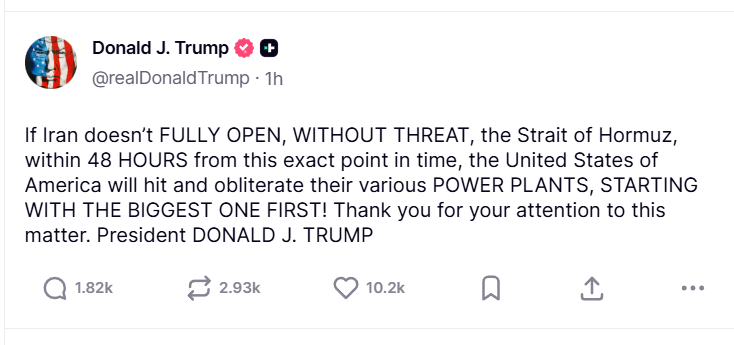
The ultimatum, delivered via Truth Social on Saturday evening, March 21, 2026, marks the most precarious moment in the month-long conflict that has already claimed thousands of lives and sent global energy markets into a tailspin. “If Iran doesn’t FULLY OPEN, WITHOUT THREAT, the Strait of Hormuz, within 48 HOURS from this exact point in time, the United States of America will hit and obliterate their various POWER PLANTS, STARTING WITH THE BIGGEST ONE FIRST!” the President wrote, signaling an end to the “winding down” rhetoric he had floated only twenty-four hours earlier.
U.S. forces remain centered on very clear military objectives in eliminating Iran’s ability to project power against Americans, and against its neighbors. pic.twitter.com/OXIKUjukHj
— U.S. Central Command (@CENTCOM) March 21, 2026

The Attack on Diego Garcia: A New Era of Iranian Reach
The catalyst for this sudden hardening of the American stance was a long-range missile operation conducted by Iran late Friday. According to Pentagon officials and reports from The Wall Street Journal, Tehran launched two intermediate-range ballistic missiles (IRBMs) targeted at the Diego Garcia military installation.
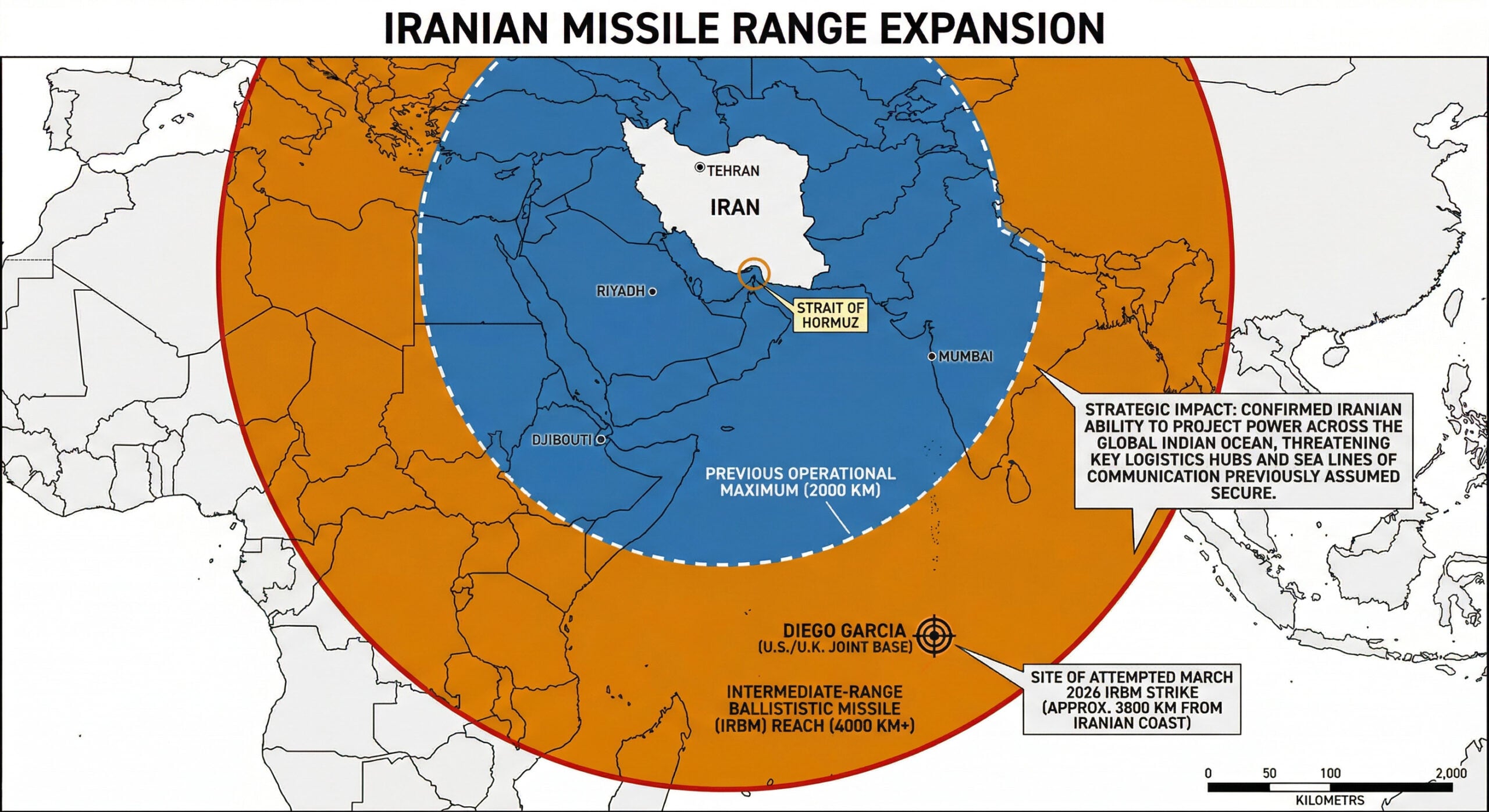
For decades, Diego Garcia—a critical logistics hub hosting B-2 stealth bombers and nuclear-powered submarines—was considered a safe “stepping stone” for U.S. power projection, insulated by nearly 4,000 kilometers (2,500 miles) of open water from the Iranian coastline. Iran’s Foreign Minister, Abbas Araghchi, had maintained as recently as February 2026 that Tehran’s missile program was strictly defensive and capped at a 2,000-kilometer range.
The Friday strikes shattered that assumption. While one missile suffered a catastrophic mid-flight failure, the second was engaged by a Standard Missile-3 (SM-3) interceptor launched from a U.S. Navy destroyer. Military analysts are still debating whether the interception was successful or if the missile simply missed its target, but the intent was clear: Iran can now hit the heart of the Indian Ocean.
The Strategic Importance of Distance The attack on Diego Garcia is significant because it confirms that Iran has operationalized intermediate-range technology. A 4,000-kilometer strike capability does more than threaten a remote island; it places European capitals like Berlin, Paris, and Rome within direct range of Iranian soil. By targeting a base that supports “Operation Epic Fury,” Iran has signaled that no U.S. asset in the Eastern Hemisphere is truly out of bounds.
The 48-Hour Clock: Target Tehran’s Grid
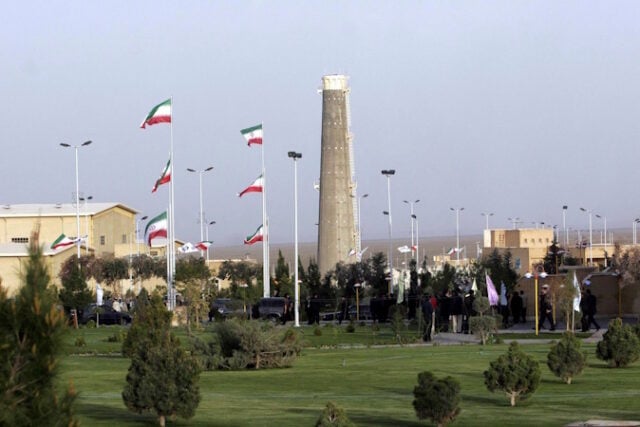
The President’s threat to target power plants focuses on Iran’s most vulnerable domestic infrastructure. Military planners suggest that the “biggest one first” likely refers to the Damavand Combined Cycle Power Plant near Tehran, which produces over 2,800 MW of power, or the nuclear facility at Bushehr.
This ultimatum comes as the U.S. faces internal pressure over soaring oil prices. With the Strait of Hormuz effectively closed to any vessel perceived as hostile to Tehran, and Iran attempting to levy “transit fees” on neutral shipping, the global economy is gasping for air. Trump’s “maximum pressure” 2.0 has moved from economic sanctions to the precipice of total infrastructure warfare.
A Widening War
The conflict, which began in late February with joint U.S.-Israeli strikes on Iranian gas fields and missile production facilities, has rapidly expanded. In the last 24 hours alone:
- Israel under Fire: Iranian missiles struck the southern Israeli communities of Dimona and Arad. Dimona is home to Israel’s primary nuclear research center. While the IDF reported dozens of injuries, the psychological impact of missiles landing near “Little India” (Dimona) has unified the Israeli cabinet in its call for further escalation.
- British Involvement: Prime Minister Keir Starmer has faced intense criticism at home after authorizing the U.S. to use British bases—including RAF Fairford and Diego Garcia—for “defensive” strikes against Iranian missile sites. Tehran responded by warning that Starmer is “putting British lives in danger.”
- The Chagos Factor: The attack on Diego Garcia has also reignited the debate over the Chagos Islands sovereignty deal. President Trump had previously criticized the U.K.’s decision to hand the archipelago to Mauritius as a “woke” move that threatened the security of the airbase.
The Technological Leap: From Space to War
How did Iran achieve this 4,000-kilometer reach so suddenly? Experts at the Royal United Services Institute (RUSI) suggest the use of the Simorgh space launch vehicle or a highly modified Khorramshahr-4 ballistic missile. These systems, which utilize liquid-fueled stages and maneuverable re-entry vehicles, are designed specifically to bypass sophisticated missile defense systems like the SM-3.
The realization that Tehran possesses IRBMs has forced a complete recalibration of Western defense postures. If the 48-hour window closes without a diplomatic breakthrough, the U.S. is prepared to deploy additional carrier strike groups to the region, while Iran has warned it will “retaliate against all U.S. energy infrastructure in the Middle East.”
Conclusion: The Final Hours
As of Saturday night, the clock is ticking. The Joint Maritime Information Center has raised the threat level in the Persian Gulf to “Critical.” Global leaders are calling for restraint, but with the U.S. President demanding a “Full Opening” and Iran proving it can strike across oceans, the world watches the 48-hour countdown with bated breath.
Sources Used and Links
- Britannica: Did Iran fire missiles at Diego Garcia in 2026?
- The Economic Times: Trump issues 48-hour ultimatum to Iran over Strait of Hormuz
- Hindustan Times: Iran Diego Garcia attack: Missile range in focus
- Indian Express: Tehran’s longest-range missile attack yet: Why Diego Garcia matters
- Iran International: Iran targeted Diego Garcia base with ballistic missiles – WSJ
- Jerusalem Post: Donald Trump threatens to strike Iran power plants over Hormuz ultimatum
- Livemint: Trump gives 48-hour ultimatum: Which Iranian energy sites could US target?
- The Guardian: Middle East crisis live: Trump says US considering ‘winding down’ war; Iran fired missiles at UK-US base
- The New Arab: Trump hands Iran 48-hour ultimatum to open Strait of Hormuz
- Anadolu Ajansı: Iran threatens to target US, Israeli infrastructure amid Trump’s ultimatum
- Military.com: What to Know About Diego Garcia After Iran Targets the Base
- Gulf News: Iran fired missiles at Diego Garcia joint US-UK base: report
Disclaimer
Artificial Intelligence Disclosure & Legal Disclaimer
AI Content Policy.
To provide our readers with timely and comprehensive coverage, South Florida Reporter uses artificial intelligence (AI) to assist in producing certain articles and visual content.
Articles: AI may be used to assist in research, structural drafting, or data analysis. All AI-assisted text is reviewed and edited by our team to ensure accuracy and adherence to our editorial standards.
Images: Any imagery generated or significantly altered by AI is clearly marked with a disclaimer or watermark to distinguish it from traditional photography or editorial illustrations.
General Disclaimer
The information contained in South Florida Reporter is for general information purposes only.
South Florida Reporter assumes no responsibility for errors or omissions in the contents of the Service. In no event shall South Florida Reporter be liable for any special, direct, indirect, consequential, or incidental damages or any damages whatsoever, whether in an action of contract, negligence or other tort, arising out of or in connection with the use of the Service or the contents of the Service.
The Company reserves the right to make additions, deletions, or modifications to the contents of the Service at any time without prior notice. The Company does not warrant that the Service is free of viruses or other harmful components.