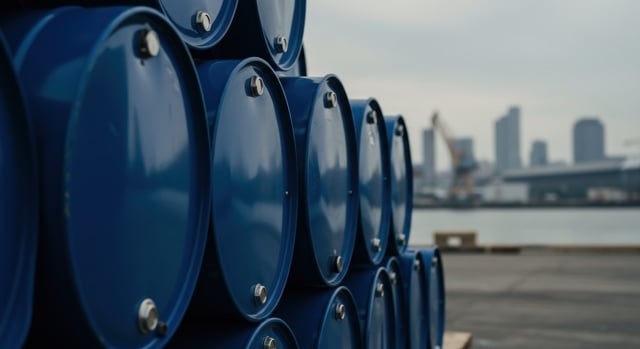
On March 11, 2026, the global energy market reached a fever pitch as the United States, in a dramatic reversal of its previous policy, announced the release of 172 million barrels of crude oil from the Strategic Petroleum Reserve (SPR). This move, coordinated with the International Energy Agency (IEA), is the centerpiece of a massive 400-million-barrel international intervention designed to stop the bleeding in a global economy currently reeling from the war in the Middle East and the effective closure of the Strait of Hormuz.
The announcement comes at a moment of extreme geopolitical volatility. As of this Wednesday evening, Brent crude has been swinging wildly between $95 and $120 per barrel, reflecting a world in which one-fifth of global oil supply has essentially been “locked” behind a maritime chokepoint. With the U.S. and Israel engaged in an ongoing military campaign against Iran—now entering its second week—the energy landscape has become the primary theater of economic warfare.
The Great Release: Breaking Down the Numbers
The 172-million-barrel U.S. contribution is the largest single-nation release in history, surpassing even the historic drawdowns of 2022. According to U.S. Energy Secretary Chris Wright, the delivery will begin as early as next week and be distributed over a 120-day period.

The strategy behind the 120-day window is calculated. Rather than a one-time “shock” to the system, the Department of Energy (DOE) aims to provide a consistent daily stream of approximately 1.43 million barrels per day to domestic refineries. This steady supply is intended to offset the immediate physical shortages caused by the cessation of tankers arriving from the Persian Gulf.
| Country/Entity | Barrel Commitment (Millions) | Percentage of Total |
| United States | 172.0 | 43% |
| Japan | 80.0 | 20% |
| United Kingdom | 13.5 | 3.4% |
| Other IEA Members | 134.5 | 33.6% |
| Total Global Release | 400.0 | 100% |
Japan’s contribution of 80 million barrels is particularly significant. As a nation that imports nearly 90% of its crude through the Strait of Hormuz, the Japanese government is moving with even more urgency than the U.S., with Prime Minister Sanae Takaichi indicating that Japan will begin its own independent drawdown by March 16th.
The Chokepoint: Why the World is Running Dry
To understand why such a massive release is necessary, one must look at the Strait of Hormuz. This narrow passage between Oman and Iran is the jugular vein of the global energy industry. In a “normal” year, roughly 20 million barrels of oil and 10.8 billion cubic feet of liquefied natural gas (LNG) pass through it every single day.
Since the outbreak of hostilities on February 28, 2026, the Strait has fallen silent. Reports from the region indicate that Iran has begun laying mines in the two-mile-wide shipping lanes, while drone strikes have targeted at least four commercial tankers. Maritime insurers have largely cancelled cover for vessels attempting the transit, leading to an 80% drop in traffic.
“The oil-market challenges we are facing are unprecedented in scale,” said IEA Executive Director Fatih Birol. “This is a major action aiming to alleviate the immediate impacts of the disruption, but the most important thing for a return to stability is the reopening of global trade routes.”
While the 400-million-barrel release sounds astronomical, it serves as a temporary bridge. At the current disruption rate of 20 million barrels per day, the entire global release covers only about 20 days of total lost supply. The hope is that by flooding the market with reserves, governments can prevent a total economic collapse while military and diplomatic efforts work to clear the Strait.
Pain at the Pump: What This Means for You
For the average consumer, the “oil crisis” isn’t an abstract geopolitical concept; it’s a number on a neon sign at the corner gas station. As of March 11, the U.S. national average for a gallon of regular gasoline has climbed to $3.58, a 20% jump in just two weeks.
The effect of the SPR release on gas prices is expected to be a dampening one, though not necessarily a “reset” to pre-war levels. Analysts from AAA and GasBuddy suggest that without this release, prices would likely have breached the $4.25 mark nationally by April. With the 172 million barrels hitting the market:
- Immediate Term: Price growth is expected to slow, potentially plateauing the national average between $3.60 and $3.80.
- Regional Disparity: States like California, which relies heavily on imports and has seen prices hit $5.34, may see less relief than Gulf Coast states like Louisiana ($3.20), where local refining capacity is closer to the SPR discharge sites at Big Hill and Bryan Mound.
- Diesel and Logistics: Diesel prices have surged to $4.83, a 28% increase. Since diesel powers the global shipping and trucking industries, this “fuel tax” on the supply chain is already reflected in the prices of groceries and consumer goods.
The Political Pivot
The 2026 oil crisis has forced the Trump administration to make a significant political pivot. Throughout his campaign and early second term, President Trump frequently criticized previous administrations for “depleting” the national reserve. However, the reality of $120 oil and a potential $5-per-gallon national average has altered the calculus.
During an interview on Wednesday with WKRC Local 12, President Trump confirmed the move, stating, “Right now we’ll reduce it a little bit, and that brings the prices down… and then we’ll fill it up.” The administration has already announced plans to replace 200 million barrels within the next year, though critics point out that buying oil back at today’s high prices could be a costly endeavor for the Treasury.
The current SPR level stands at roughly 415 million barrels. A 172-million-barrel drawdown will leave the reserve at its lowest level since the early 1980s. This highlights the severity of the 2026 crisis: the U.S. is essentially using its “energy insurance policy” to buy time.
The Long-Term Forecast: How Long Will This Last?
How long this crisis lasts is entirely dependent on the duration of the conflict in Iran. The IEA and DOE have outlined a 120-day delivery schedule, suggesting that the “bridge” provided by the reserves is intended to last through July 2026.
However, if the war drags into the autumn, the global economy faces a “second wave” of energy shocks. Most analysts agree that the reserves can only sustain the current price floor for about three to four months. If the Strait of Hormuz remains closed beyond that point, we could see crude prices move toward the $150 mark, as the world’s “spare capacity” will have been exhausted.
Conclusion: A Fragile Balance
The release of 172 million barrels is a historic gamble. It is a powerful tool to fight inflation and provide immediate relief to households, but it leaves the nation’s strategic defenses thinner than they have been in half a century. As tankers remain anchored and refineries in the Gulf region face production cuts due to a lack of storage, the world watches the Middle East.
For now, the message from Washington and Paris is clear: they are willing to use every barrel at their disposal to keep the global economy from stalling. But as any driver knows, you can only run on the reserve tank for so long before you have to find a way back to the pump.
Sources Used and Links
- WFAA News: US to release 172 million barrels from Strategic Petroleum Reserve
- RTHK World News: US to release 172 million barrels of oil from reserve
- IEA Official Statement: IEA Member countries to carry out largest ever oil stock release
- The Guardian: White House worries as gas prices jump amid ongoing US-Israel war on Iran
- Rigzone: IEA to Release Record 400MM Barrels From Oil Reserves
- Columbia University Energy Policy: Iran Conflict Brief: What It Will Take to Open Up the Strait of Hormuz
- Northeastern Global News: With war in Iran, experts predict higher gas prices and inflation
- KHOU 11 News: US to release 172 million barrels of oil from Strategic Petroleum Reserve in Texas and Louisiana
Disclaimer
Artificial Intelligence Disclosure & Legal Disclaimer
AI Content Policy.
To provide our readers with timely and comprehensive coverage, South Florida Reporter uses artificial intelligence (AI) to assist in producing certain articles and visual content.
Articles: AI may be used to assist in research, structural drafting, or data analysis. All AI-assisted text is reviewed and edited by our team to ensure accuracy and adherence to our editorial standards.
Images: Any imagery generated or significantly altered by AI is clearly marked with a disclaimer or watermark to distinguish it from traditional photography or editorial illustrations.
General Disclaimer
The information contained in South Florida Reporter is for general information purposes only.
South Florida Reporter assumes no responsibility for errors or omissions in the contents of the Service. In no event shall South Florida Reporter be liable for any special, direct, indirect, consequential, or incidental damages or any damages whatsoever, whether in an action of contract, negligence or other tort, arising out of or in connection with the use of the Service or the contents of the Service.
The Company reserves the right to make additions, deletions, or modifications to the contents of the Service at any time without prior notice. The Company does not warrant that the Service is free of viruses or other harmful components.