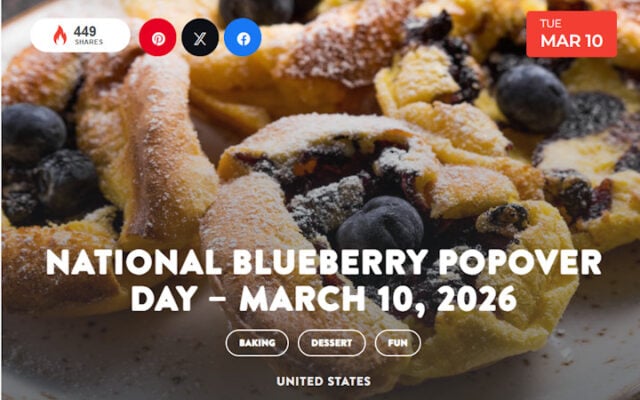
What better way to start March 10th then with National Blueberry Popover Day? Popovers are airy rolls that puff up when baked, popping over the edge of the tin. They are light and crispy on the outside while the insides are warm and often hollow. They can be filled with custards, creams and fruits for a sweet treat, especially blueberries.
- 17th Century – The popover is an American twist on a Yorkshire pudding. Reportedly popular with settlers in Portland, Oregon, the treat was known as a Portland popover. Culinary records date the Yorkshire pudding from the 17th Century.
- 1737 – The anonymous English cookbook The Whole Duty of a Woman includes an early recipe for “a dripping pudding,” a simple flour-and-egg batter cooked under roasting meat, which anticipates later Yorkshire pudding and popover-style dishes.
- 1747 – In The Art of Cookery Made Plain and Easy, English author Hannah Glasse publishes a recipe titled “Yorkshire pudding,” helping standardize the savory baked batter that later inspires similar light, hollow breads in America.
- 1830s – Blueberry highbush cultivars are introduced into Europe.
- 1850 – The oldest known reference to popovers in a letter of E.E. Stuart.
- 1876 – The first cookbook with a popover recipe was Practical Cooking by M.N. Henderson.
- 1911 – USDA botanist Frederick V. Coville publishes “Experiments in Blueberry Culture,” outlining the soil, climate, and breeding requirements needed to cultivate highbush blueberries reliably instead of relying only on wild foraging.
- 1916 – New Jersey grower Elizabeth Coleman White partners with Frederick V. Coville to release named varieties of highbush blueberries, marking the start of a dependable commercial blueberry industry that supplies fruit for bakers nationwide.
- 20th Century – Highbush blueberries are first cultivated in New Jersey.
- The name “popover” comes from the fact that the batter swells or “pops” over the top of the muffin tin while baking
- Unlike many breads and cakes that rely on yeast or chemical leaveners, classic popovers rise almost entirely on steam.
- The deep blue and purple hue of blueberries comes from anthocyanins, a group of water‑soluble pigments concentrated in the skin.
- In one study of over 93,000 women, those consuming the most anthocyanins from berries had a significantly reduced risk of myocardial infarction compared with those eating the least, even after adjusting for overall diet and lifestyle.
- Controlled trials suggest that blueberry consumption can benefit certain aspects of cognitive function in older adults.
- Cooks often run into trouble when the oven and pan are not fully preheated, the batter is too cold or too thick, or the oven door is opened early in baking. Inadequate heat or opening the door lets steam escape before the structure sets, causing popovers to deflate.
- Blueberries are relatively low in calories and provide dietary fiber, vitamin C, vitamin K, and manganese, along with a high concentration of polyphenol antioxidants, particularly anthocyanins that give them their deep blue color.
- Research links regular berry consumption with markers of better heart and metabolic health.
- According to recent research, blueberries may alter genes that regulate fat metabolism and storage, hence reducing belly fat and cholesterol levels.
- Native Americans used blueberry juice to treat coughs and other illnesses.
- Robert Frost, an American poet, loved them so much that he composed a poem about them.
- Blueberries are one of the few naturally occurring foods that have a true blue color.
- Blueberries offer many health benefits. They are packed with antioxidants and are high in potassium and vitamin C, thus helping lower the risk of heart disease and diabetes, among others.
- They also help maintain eye health, regulate blood sugar, and alleviate gastrointestinal issues.
Sources:

Disclaimer
Artificial Intelligence Disclosure & Legal Disclaimer
AI Content Policy.
To provide our readers with timely and comprehensive coverage, South Florida Reporter uses artificial intelligence (AI) to assist in producing certain articles and visual content.
Articles: AI may be used to assist in research, structural drafting, or data analysis. All AI-assisted text is reviewed and edited by our team to ensure accuracy and adherence to our editorial standards.
Images: Any imagery generated or significantly altered by AI is clearly marked with a disclaimer or watermark to distinguish it from traditional photography or editorial illustrations.
General Disclaimer
The information contained in South Florida Reporter is for general information purposes only.
South Florida Reporter assumes no responsibility for errors or omissions in the contents of the Service. In no event shall South Florida Reporter be liable for any special, direct, indirect, consequential, or incidental damages or any damages whatsoever, whether in an action of contract, negligence or other tort, arising out of or in connection with the use of the Service or the contents of the Service.
The Company reserves the right to make additions, deletions, or modifications to the contents of the Service at any time without prior notice. The Company does not warrant that the Service is free of viruses or other harmful components.