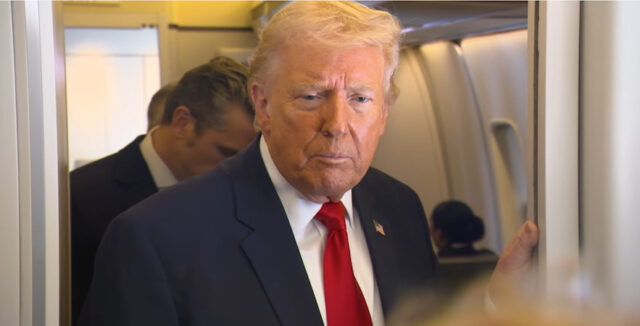
ABOARD AIR FORCE ONE — Following a somber visit to Dover Air Force Base to witness the “dignified transfer” of six American service members killed in the opening salvos of the war in Iran, President Donald Trump took to the skies, offering a defiant and uncompromising vision for the conflict’s endgame. Speaking to reporters in a candid, high-altitude press gaggle, Trump dismissed concerns over rising energy costs, revealed a strategic refusal to involve Kurdish allies in the ground fight, and signaled that the time for “settlements” with Tehran has passed.
The President’s remarks come just over a week into “Operation Epic Fury,” a joint U.S.-Israeli campaign that has fundamentally reshaped the Middle East landscape in a matter of days. With the reported death of Supreme Leader Ayatollah Ali Khamenei in a precision strike and the Iranian Navy largely “at the bottom of the sea,” the administration is now pivoting from tactical destruction to a demand for total political capitulation.
“If They Rise, They Rise”: The Oil Gamble
As global markets react to the instability in the Persian Gulf, oil prices have surged by approximately 16%, pushing the American national average for gasoline to $3.25 per gallon. While his political opponents warn of an inflationary spiral ahead of the midterm elections, Trump remained unfazed.

“I don’t have any concern about it,” the President told reporters when pressed on the spike at the pump. “They’ll drop very rapidly when this is over. And if they rise, they rise, but this is far more important than having gasoline prices go up a little bit.”
Trump insisted that the U.S. retains “total dominance” over the Strait of Hormuz, mocking Iran’s ability to disrupt global shipping. He reiterated his refusal to tap into the Strategic Petroleum Reserve (SPR), characterizing the current market volatility as a “short-term excursion” that would eventually lead to lower prices than before the war began. White House energy advisers have reportedly been scrambling behind the scenes, but the President’s message was clear: the mission in Tehran takes precedence over the price of a gallon in Peoria.
Satellite Footage Shows Destruction at Iran Missile Bases After Airstrikes
The Witkoff Report: Diplomacy is Dead
Central to the President’s hardening stance are the reports from his Special Envoy, Steve Witkoff. Alongside Jared Kushner, Witkoff had engaged in high-stakes, indirect negotiations in Geneva and Oman just weeks prior to the commencement of hostilities. According to Witkoff, the Iranian leadership was never serious about a “fair deal” regarding their nuclear enrichment and ballistic missile programs.
“They told me and Jared, ‘We’re not going to give you diplomatically what you couldn’t take militarily,’” Witkoff recently stated, recounting the final breakdown in communication.
Trump echoed this sentiment on Air Force One, telling the press corps, “We’re not looking to settle. They’d like to settle now, but we’re not looking to settle.” He described the remaining Iranian leadership as “not very amenable” and suggested that the U.S. would only accept an “unconditional surrender.” When asked what that looked like, Trump was characteristically blunt: “It’s where they cry uncle or when they can’t fight any longer.”
The Kurdish Question: “Complicated Enough”
One of the more surprising strategic revelations from the flight was the President’s firm stance on the Kurds. Despite reports that the CIA and regional allies had been preparing Kurdish-Iranian dissident groups for a cross-border invasion from northern Iraq, Trump has personally vetoed the move.
“I don’t want the Kurds to go into Iran,” Trump said. “They’re willing to go in, they’re great fighters, but I’ve told them I don’t want them in. The war is complicated enough without getting the Kurds involved.”
Strategic analysts suggest this move is intended to prevent further destabilization in Iraq and Turkey, where Kurdish military movements often spark secondary conflicts. By keeping the “excursion” limited to U.S. and Israeli air power and potential U.S. ground elements, the administration hopes to avoid a “forever war” scenario that draws in every ethnic faction in the region.
Russian Intel and the “Inaccurate” Enemy
The President also addressed burgeoning intelligence reports suggesting that Russia has been providing Tehran with real-time data on U.S. troop locations and naval assets to facilitate retaliatory strikes. While Defense Secretary Pete Hegseth and other officials have confirmed the U.S. is “tracking everything” and that Russia’s involvement is “not making a difference,” Trump was more dismissive of Moscow’s role.
He asserted that there were “no indications” that Moscow was providing meaningful support and instead blamed Iran’s “inaccurate” munitions for recent strikes on civilian infrastructure, including a tragic hit on a girls’ elementary school in southern Iran. Despite internal U.S. analyses suggesting the strike may have been a stray American or Israeli missile, Trump insisted, “That was done by Iran. They have no accuracy whatsoever.”
Picking the Next Leader
As the current Iranian government collapses under the weight of hundreds of strikes, Trump hinted that the U.S. is already looking toward a post-war Tehran. He expressed a desire to have a significant hand in “picking who the next leader will be” to ensure the country does not return to its “evil empire” status.
“We had some in mind,” Trump said of potential transitional leaders. “Some of them are dead. Now we have another group. We’ll see what happens.”
With no firm timeline for the end of operations—shifting from an initial “four-week” estimate to a “whatever it takes” stance—the war in Iran remains a high-stakes gamble for the Trump administration. As the President’s plane touched down in Washington, the message was unmistakable: the U.S. is no longer looking for a deal; it is looking for a victory.
Sources and Links
- PBS News: New wave of strikes hit Tehran as Netanyahu vows ‘many surprises’
- The Guardian: Trump offers vague description of ‘unconditional surrender’
- House of Commons Library: US-Israel strikes on Iran: February/March 2026 Research Briefing
- CBS News: Russia providing intelligence to Iran about U.S. positions, sources say
- Reuters/India Today: If gas prices rise, they rise: Trump shrugs off fuel spike
- The Times of Israel: Trump: I don’t want the Kurds to go into Iran; the war is complicated enough
Disclaimer
Artificial Intelligence Disclosure & Legal Disclaimer
AI Content Policy.
To provide our readers with timely and comprehensive coverage, South Florida Reporter uses artificial intelligence (AI) to assist in producing certain articles and visual content.
Articles: AI may be used to assist in research, structural drafting, or data analysis. All AI-assisted text is reviewed and edited by our team to ensure accuracy and adherence to our editorial standards.
Images: Any imagery generated or significantly altered by AI is clearly marked with a disclaimer or watermark to distinguish it from traditional photography or editorial illustrations.
General Disclaimer
The information contained in South Florida Reporter is for general information purposes only.
South Florida Reporter assumes no responsibility for errors or omissions in the contents of the Service. In no event shall South Florida Reporter be liable for any special, direct, indirect, consequential, or incidental damages or any damages whatsoever, whether in an action of contract, negligence or other tort, arising out of or in connection with the use of the Service or the contents of the Service.
The Company reserves the right to make additions, deletions, or modifications to the contents of the Service at any time without prior notice. The Company does not warrant that the Service is free of viruses or other harmful components.