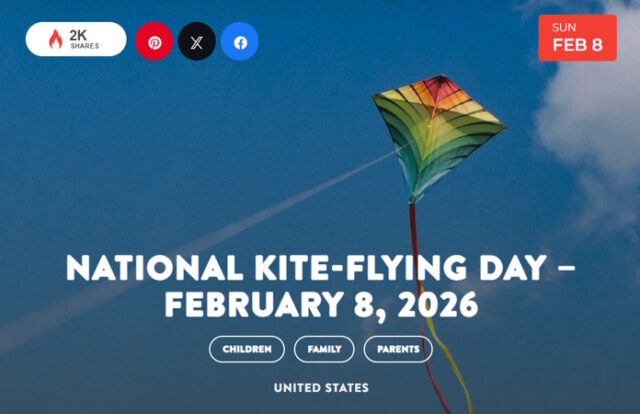
Observed annually on February 8th, National Kite Flying Day is marked by kite flying enthusiasts across the country.
- 470 BC – Kites date back to China in 470 B.C. China is full of lore and history of the origins of the kite. Some stories also tell of kites invented to spy on their enemies or send messages.
- 1200s – The Italian explorer brought a Chinese kite back to Italy.
- 1752 – Benjamin Franklin used a kite to prove that lightning was electricity.
- 1773 – The oldest-known surviving kite is an example of a “French pear-top” design, dating back at least 250 years. It was discovered by a carpenter during renovations of a property in Leiden, Netherlands, in 1985 and is inscribed with the initials “RB and TB 1773”. source
- 1760 – Kite flying was banned in Japan because too many people preferred to fly kites rather than work.
- 1800s – Kites were used throughout this century for scientific research.
- 1861 – Kites were used in the American Civil War to deliver letters and newspapers.
- 1939 – In the Second World War, the RAF issued pilots with a ‘rescue kit’ comprising a dinghy and a folding box kite called a Gibson Girl, which enabled them to send an SOS message from a portable transmitter with the kite line acting as the aerial.
- 1966 – Kite flying was banned in China during the Cultural Revolution; anyone found flying a kite was jailed for up to three years, and their kites were destroyed.
- 2003 – Author Khaled Hosseini publishes one of the most popular novels of the modern era, The Kite Runner.
- 2005 – The most kite surfing world championships won by a woman is nine and was achieved by Kristin Boese (Germany) between 2005 to 2008. This record includes both the PKRA and KPWT federations. source
- The kite is a heavier-than-air craft tethered to wing surfaces that react to the air as it drags around them and lifts them.
- Kite Flying Day was created to remind us of the freedom we feel when guiding a kite through the currents of air.
- There is also evidence that people in the South Sea Islands used kites for fishing around the same time as people in China.
- Early kites were constructed from bamboo or sturdy reeds for framing. Leaves, silk, or paper made ideal sails. Vines or braided fibers completed the line or tether. While kites were initially used as tools, they were also used ceremonially.
- Kites were used to send messages to the heavens or to lift offerings to the gods; they held a symbolic place in the culture.
- Kites are popular both as hobbies and outdoor fun. They range from simple diamond kites to more complicated box kites and giant sled kites.
- Stunt kites, also known as sport kites, are designed so the operator can maneuver the kite into dips, twists, and dives with dramatic effect.
- The airplane is a development of the kite
- The world record for the longest kite flight is 180 hours.
- Large kites were banned in East Germany because of the possibility of lifting people over the Berlin Wall.
- Kite fighting has been a recreational pastime in Thailand for centuries, played with “male” and “female” kites on vast open fields where each side competes to capture the other’s kites.
- The smallest kite in the world that flies is 5mm (point 20 inches) high.
- The largest kite in the world is called the Megabite and measures 180 ft by 72 ft.
- The longest kite in the world is 1034 meters (3,394 ft).
- The fastest recorded speed of a kite is over 120 mph (193 km/h).
- The highest altitude by a single kite was 16,009 ft, which was achieved by Robert Moore (Australia) in Cobar, New South Wales, Australia, on 23 September 2014
- Over 50 million kites are sold in the USA every year.
- A Japanese kite-maker reportedly flew 11,284 kites on a single line — the largest number recorded thus far.
- When the Japanese were building some of the early temples and shrines they used large kites to lift tiles and other materials to the workmen on the roof.
- More adults in the world fly kites than children.
- People were flying kites 1,000 years before paper was invented.
- Over 50 million kites are sold in the USA every year.
- The largest kite museum is the Weifang World Kite Museum in Weifang City, Shandong, China. The museum houses some 2000 exhibits dedicated to the history, craft, and culture of kite-making and kite-flying. The museum’s roof is covered in turquoise tiles and is said to resemble a traditional dragon-headed centipede kite, a design long associated with the Weifang area.
- The Washington State International Kite Festival hosts the largest gathering of kites in August of each year.
Sources:

Disclaimer
Artificial Intelligence Disclosure & Legal Disclaimer
AI Content Policy.
To provide our readers with timely and comprehensive coverage, South Florida Reporter uses artificial intelligence (AI) to assist in producing certain articles and visual content.
Articles: AI may be used to assist in research, structural drafting, or data analysis. All AI-assisted text is reviewed and edited by our team to ensure accuracy and adherence to our editorial standards.
Images: Any imagery generated or significantly altered by AI is clearly marked with a disclaimer or watermark to distinguish it from traditional photography or editorial illustrations.
General Disclaimer
The information contained in South Florida Reporter is for general information purposes only.
South Florida Reporter assumes no responsibility for errors or omissions in the contents of the Service. In no event shall South Florida Reporter be liable for any special, direct, indirect, consequential, or incidental damages or any damages whatsoever, whether in an action of contract, negligence or other tort, arising out of or in connection with the use of the Service or the contents of the Service.
The Company reserves the right to make additions, deletions, or modifications to the contents of the Service at any time without prior notice. The Company does not warrant that the Service is free of viruses or other harmful components.