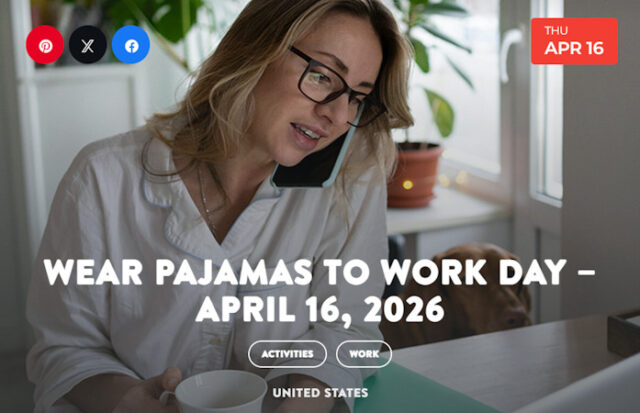
Timed appropriately for the day after Tax Day, Wear Pajamas to Work Day on April 16 helps us relieve some financial stress. We’re not sure who made Wear Pajamas to Work Day a thing, but it’s becoming nationally and virally popular. Even celebrities have been spotted rocking sleepwear while out and about.
- 1700s – Pajama glamour. Masquerade ball attendees, actresses, and “ladies of the evening” began incorporating pajama trousers into their wardrobes, while more “respectable” women continued to look down on such fashion.
- 1870 – British colonials adopt loose “pyjama” trousers from South and West Asia and introduce them to Britain as fashionable indoor and sleepwear, helping establish pajamas as a staple of Western nightclothes.
- 19th Century – Nightcaps were popular for bedwear in the 19th century. They were intended to keep people’s heads warm, but their long, pointy shape made them long enough to wear as a scarf without being too long to pose a choking hazard.
- 1911 – Pajamas went mainstream. French couturier Paul Poiret was one of the first to create pajama outfits intended for use beyond sleeping, a step toward their widespread acceptance.
- 1920s – Beachwear. Gabrielle “Coco” Chanel popularized beach pajamas. By the end of the decade, many women wore these outfits on their summer beach vacations.
- 1922 – In the United States, men’s clothing manufacturers and style writers begin promoting softer, less formal suits for office wear, laying early groundwork for the later shift from rigid business dress to more relaxed codes.
- 1930s – Myrna Loy and William Powell as Nick and Nora Charles in the highly successful “Thin Man” movie series were often seen sipping martinis while dressed in fashionable sleepwear.
- 1931 – For some, the pajama had some exotic connotations associated with it, and this made the garment objectionable in some people’s eyes. There was a pro-nightshirt campaign in 1931, which argued that “the pajama is a foreign importation that is helping to bring about the decadence of good old American institutions.”
- 1934 – The film It Happened One Night, a romantic comedy starring Claudette Colbert and Clark Gable, is sometimes credited with starting the trend toward women wanting men’s-style sleeping suits. In one scene, Ms. Colbert is seen wearing a pair of pajamas borrowed from the character played by Gable.
- 1940s – During the 1940s, women began wearing “shorty” pajamas. Consisting of a smock top with frills at the hems, sleeves, and leg openings, shorties were the forerunners of Baby Doll pajamas.
- Pre-1950- It was common for pajamas to have a drop seat to make it easy to use the bathroom.
- 1960s – Babydoll pajamas were quite the rage in girls’ and young women’s sleepwear.
- 1960s – Postwar textile innovation and mass production make colorful nylon and silk blend pajamas widely affordable, turning sleepwear and loungewear into highly designed fashion items rather than purely functional garments.
- 1966 – Playboy founder Hugh Hefner becomes famous for conducting business in public in silk pajamas and robes, symbolizing a glamorous merging of leisurewear and work life that challenges traditional office attire norms.
- 1975 – Safety factor. Federal rules required children’s sleepwear up to size 14 to meet a minimal flammability standard.
- 1990s – American companies adopt “Casual Friday,” relaxing suit-and-tie requirements on Fridays and signaling a broader cultural shift toward comfort and informality in the workplace.
- 2000s – Posh pajamas. In an era of more informal dress, designers like Ralph Lauren and Giorgio Armani brought pajama-style clothing outside of the bedroom and into daytime and evening wear.
- 2004 – The U.S. Office of Personnel Management reports substantial growth in federal telework participation, normalizing the idea of doing office work from home, often in more relaxed clothing like loungewear or pajamas.
- 2015 – According to Guinness World Records, the largest gathering of people wearing pajamas took place in Shantou, China where 1,879 people from the Guangdong Hongxing Industrial Co. wore their pajamas on October 9, 2015. One of the requirements was that they wear a one-piece pajama.
- 2020 – Global COVID-19 lockdowns trigger a massive shift to home-based work, with surveys and media reports documenting widespread adoption of pajama bottoms and loungewear during video meetings, cementing PJs as informal work attire.
- The word “pajama” comes from the Indian word “piejamah,” which described loose pants that were tied at the waist. The comfy trousers were admired by British colonials as the perfect thing to wear when napping in the afternoon, and it wasn’t long before the outfit was deemed perfect for any time spent asleep.
- Footed Pajamas Aren’t Always For Kids. They started as something designed for adults. The first versions were made when people began sewing socks to the bottom of their pajama pants. It wasn’t just to keep their feet warm; it was to prevent bugs like termites from nibbling on their toes.
- While stores sell tons of pajamas these days, sleeping in your birthday suit is still popular. For example, in the UK, 47 percent of men sleep in absolutely nothing (while only 17 percent of British women go nude at night). Americans, on the other hand, are just slightly more conservative. About 31 percent of men in the United States sleep naked, and 14 percent of women go nude.
- Coco Chanel introduced loungewear pajamas in the ’20s and revolutionized women’s pajamas. After that, they became an acceptable and fashionable alternative to the traditional long nightshirt.
- Some people in Japan go out wearing something they call a Kigurumi, which is a word for pajamas that look like a giant stuffed animal.
Sources:

Disclaimer
Artificial Intelligence Disclosure & Legal Disclaimer
AI Content Policy.
To provide our readers with timely and comprehensive coverage, South Florida Reporter uses artificial intelligence (AI) to assist in producing certain articles and visual content.
Articles: AI may be used to assist in research, structural drafting, or data analysis. All AI-assisted text is reviewed and edited by our team to ensure accuracy and adherence to our editorial standards.
Images: Any imagery generated or significantly altered by AI is clearly marked with a disclaimer or watermark to distinguish it from traditional photography or editorial illustrations.
General Disclaimer
The information contained in South Florida Reporter is for general information purposes only.
South Florida Reporter assumes no responsibility for errors or omissions in the contents of the Service. In no event shall South Florida Reporter be liable for any special, direct, indirect, consequential, or incidental damages or any damages whatsoever, whether in an action of contract, negligence or other tort, arising out of or in connection with the use of the Service or the contents of the Service.
The Company reserves the right to make additions, deletions, or modifications to the contents of the Service at any time without prior notice. The Company does not warrant that the Service is free of viruses or other harmful components.