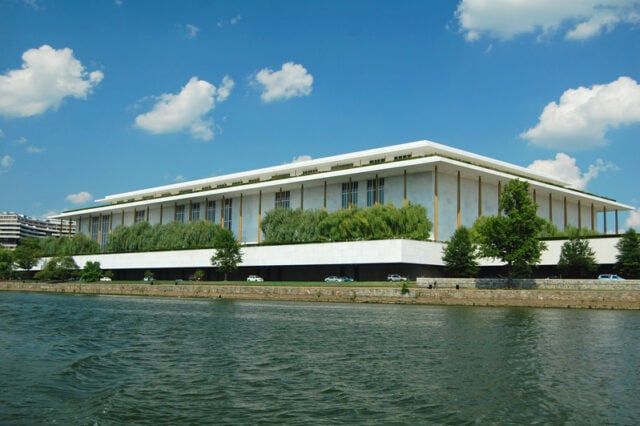
WASHINGTON, D.C. — President Donald Trump announced Sunday that the John F. Kennedy Center for the Performing Arts—which he and his handpicked board recently rebranded as the “Trump-Kennedy Center”—will cease all entertainment operations for approximately two years to undergo a “complete rebuilding.”
The shutdown is scheduled to begin on July 4, 2026, a date chosen to coincide with the 250th anniversary of the United States. According to the President, the decision follows a year-long review by contractors and consultants aimed at transforming the 55-year-old facility into what he described as a “World Class Bastion of Arts, Music, and Entertainment.”
A Move Toward “Grandeur”
In a lengthy post on Truth Social, President Trump argued that a total shutdown is more efficient than a partial closure.
“I have determined that The Trump Kennedy Center, if temporarily closed for Construction, Revitalization, and Complete Rebuilding, can be, without question, the finest Performing Arts Facility of its kind, anywhere in the World,” the President wrote. “If we don’t close, the quality of Construction will not be nearly as good, and the time to completion… will be much longer.”
The President characterized the current state of the building as “tired, broken, and dilapidated,” citing structural and financial issues that he attributed to years of “bad management.” He claimed that financing for the massive project is already “fully in place,” though specific details regarding the budget and the source of the funding—whether federal or private—were not immediately provided.

Political and Cultural Friction
The announcement comes amid a period of unprecedented turmoil for the institution. Since returning to office in 2025, the President has exerted significant control over the center, replacing most of its board of trustees with close allies and being named chairman of the board himself.
The center’s shift in leadership and the addition of the President’s name to the facade have sparked a wave of high-profile departures. Prominent artists including composer Philip Glass, soprano Renée Fleming, and banjoist Béla Fleck have canceled scheduled performances or resigned advisory roles, citing ideological conflicts. Just last month, the Washington National Opera announced it would move its performances away from the center.
While the President’s supporters view the renovation as a necessary modernization of a national landmark, critics argue the shutdown is a convenient way to “reset” the institution following the mass exodus of traditional programming. Richard Grenell, the center’s president, has stated the venue will pivot toward “commonsense programming” that focuses on profitability and avoids “woke” themes.
Impact on the Arts Landscape
The Kennedy Center historically hosts more than 2,000 events annually. A two-year hiatus represents a seismic shift for the D.C. cultural landscape, displacing resident groups such as the National Symphony Orchestra.
While the President stated the plan is “subject to board approval,” the board is currently composed of his appointees, making approval all but certain. Construction is expected to begin immediately following the July 4th celebrations, with a “Grand Reopening” targeted for the summer of 2028.
Sources and Links
- CBS News: Kennedy Center to close for construction for 2 years, Trump says
- The Washington Post: Trump plans to close Kennedy Center for about two years, starting in July
- The Guardian: Kennedy Center will halt entertainment operations for two years, Trump says
- Associated Press: Kennedy Center will close for 2 years for renovations in July, Trump says
- Washington Examiner: Kennedy Center to close for two years for renovations, Trump says
- Playbill: Kennedy Center to Close for Two Years Following Artistic Cancellations
Disclaimer
Artificial Intelligence Disclosure & Legal Disclaimer
AI Content Policy.
To provide our readers with timely and comprehensive coverage, South Florida Reporter uses artificial intelligence (AI) to assist in producing certain articles and visual content.
Articles: AI may be used to assist in research, structural drafting, or data analysis. All AI-assisted text is reviewed and edited by our team to ensure accuracy and adherence to our editorial standards.
Images: Any imagery generated or significantly altered by AI is clearly marked with a disclaimer or watermark to distinguish it from traditional photography or editorial illustrations.
General Disclaimer
The information contained in South Florida Reporter is for general information purposes only.
South Florida Reporter assumes no responsibility for errors or omissions in the contents of the Service. In no event shall South Florida Reporter be liable for any special, direct, indirect, consequential, or incidental damages or any damages whatsoever, whether in an action of contract, negligence or other tort, arising out of or in connection with the use of the Service or the contents of the Service.
The Company reserves the right to make additions, deletions, or modifications to the contents of the Service at any time without prior notice. The Company does not warrant that the Service is free of viruses or other harmful components.