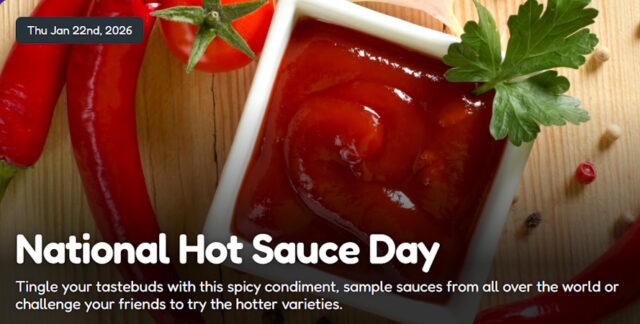
Some people can’t live without hot sauce, made from chili peppers and other ingredients. Spicy sauce lovers will put it on everything from eggs to sandwiches to steak. National Hot Sauce Day, on January 22, is an excellent opportunity to show your appreciation for your favorite hot sauce. They come in a variety of styles, usually based on regionally available ingredients. They’re also a staple in the culinary cultures of many countries throughout the world.
- 1492 – It is believed that Christopher Columbus may be one of the first explorers from Europe to taste chiles. He names them “peppers” because of their spicy flavor which is similar to the black peppercorns he was looking for.
- 16th Century – In South and Central America, there is evidence of chili peppers being used for cooking as early as 6,000 years ago, but they never reached Europe until the 16th century, when Portuguese and Spanish explorers began sending all sorts of unusual foods from the New World back home.
- 1807 – The first hot sauce to be available in a bottle appeared in shops in the state of Massachusetts in the year 1807, and then suddenly, hot sauce was everywhere, and being added to everything.
- 1849 – Colonel Maunsell White, a local banker, grew the first recorded crop of Tabasco chiles.
- 1868 – Tabasco sauce is one of the earliest brands to have come into existence that still exists today, being bottled and sold for the first time in 1868.
- 1964 – One of the quintessential carriers for spicy, peppery sauce, Buffalo Wings take shape in Buffalo, New York, when a restaurant owner makes a late-night snack for her son and his friends.
- 1980 – A refugee from Vietnam, David Tran, starts a company in California and names his hot sauce after a city in Thailand: Sri Racha. The sauce contains not only chili peppers but also garlic and sugar. The hot sauce becomes almost an instant hit.
- 1980 – Old El Paso, which would become a major player in the U.S. hot sauce market, made its debut.
- 1992 – Salsa replaced ketchup as America’s number one condiment.
- 1994 – As a sign of hot sauce’s popularity in the American market, the Campbell Soup Company bought Pace, a maker of Mexican-style sauce, for $1.1 billion.
- 1998 – The Super Bowl featured the now famous commercial of a man showering his pizza with Tabasco, getting bit by a mosquito, and smiling as the mosquito bursts into flames.
- The hottest pepper in the world is often considered to be the Carolina Reaper, with a Scoville rating of 2,000,000 (the average jalapeno pepper ranking at only 3,500 Scoville Heat Units)!
- In the Caribbean, the most commonly used peppers for making hot sauces are habañero and Scotch Bonnet which makes for some very hot sauce.
- In Africa, the favored hot sauce can vary by country. Harissa is an example from Tunisia that is made from a base of red birdseye chili peppers and seasoned with cumin and coriander.
- Hot sauce in Chinese cuisine is more commonly called chili sauce and is more likely to be a thick paste than a thin sauce. Chinese hot sauce also differs from other regional sauces because many varieties involve brine solutions or pickling as part of the cooking process.
- Different Chinese dishes use different types of chili sauce. Chili oil, which is made from dried chilies and steeped in oil, is one example. Guilin chili sauce, which is made with fermented soybeans, is another.
- In Thailand, many dishes incorporate raw chilies rather than hot sauce but hot sauce made from chilies is still a popular condiment. Sriracha sauce, which has gained popularity in American cuisine, is from Thailand.
- Hot sauce in Thailand may also be found as a dipping sauce and Thai sweet chili sauce is popular around the world.
- The United Kingdom is home to two of the hottest peppers in the world, the Naga Viper and the Infinity chili which means it is also home to two of the most naturally hot sauces in the world.
- In Mexico, hot sauce is often made from chipotle peppers. Unlike other places where the heat seems to be the most important aspect, Mexican sauces focus more on the flavor of the chili pepper.
- American hot sauces most commonly use cayenne, chipotle, habañero, and jalapeño peppers as the base and source of heat. There are several regional varieties, including Louisiana-style, such as Tabasco sauce, which uses red chili peppers and vinegar, and New Mexico-style, which uses red or green chili peppers and a roux base and is made without vinegar.
- You’ve probably pronounced it wrong: Sriracha is the popular hot sauce made by Huy Fong Foods and characterized by the rooster emblazoned on its bottles. What you may not know is that it isn’t pronounced sree-ra-cha. The correct pronunciation is actually see-roach-a (or /sɪˈrɑːtʃɑː/).
- Over 54% of households currently buy hot sauce as a condiment, and Sriracha is in 9% of those households.
- The burning feeling that makes chile peppers so appealing to pyro-egomaniacs comes from a collection of compounds called capsaicinoids.
- Mexico alone grows more than 140 varieties of chile peppers.
- When hot sauce is consumed, a common reaction by the body is to sweat, particularly on the forehead. The scientific term for this reaction is gustatory perspiration.
- Chile peppers are cholesterol-free, low in sodium and calories, rich in Vitamins A and C, and a good source of folic acid, potassium and Vitamin E
- Capsaicin gives chile peppers their heat and is concentrated in the veins of the fruit.
- Is your mouth on fire? Don’t drink water! Capsaicin, an oil, does not mix with water but instead spreads to more parts of the mouth.
- The ancient Mayans rubbed chile peppers on their gums to cure toothaches.
- Two of the founding fathers of our country, George Washington and Thomas Jefferson, are both known to have grown chile peppers.
- In 2024, “How Stuff Works” rated the Top Ten Hot Sauces (to learn more) :
- No. 1: Pure Evil, 13 million SHUs – Forget traditional hot sauce; this flavorless 13-million-SHU additive delivers extreme, pure capsaicin heat that redefines the Scoville scale.
- No. 2: Regret Hot Sauce, 12 million SHUs
- No. 3: Mad Dog 357, No. 9 Plutonium, 9 million SHUs
- No. 4: The Source Hot Sauce, 7.1 million SHUs
- No. 5 (Tied): The End Hot Sauce, 6 million SHUs
- No. 5 (Tied): Bumblef**ked Hot Sauce, 6 million SHUs
- No. 5 (Tied): Get Bitten Black Mamba 6, 6 million SHUs
- No. 8 (Tied): Meet Your Maker Hot Sauce, 5 million SHUs
- No. 8 (Tied): Mad Dog 357 Pepper Extract, 5 million SHUs
- No. 8 (Tied): Z Nothing Beyond Extremely Hot Sauce, 5 million SHUs
- No. 8 (Tied): Mad Dog 44 Magnum, 5 million SHUs
- No. 12: The Hottest Hot Sauce in the Universe, The 2nd Dimension, 3.5 million SHUs
- No. 13 (Tied): The Last Dab XXX, 3 million SHUs
- No. 13 (Tied): LD50, 3 million SHUs
- No. 15 (Tied): Reaper Squeezin’s, 2.2 million SHUs
- No. 15 (Tied): Wicked Reaper, 2.2 million SHUs
- No. 17: Stinger Scorpion Pepper Sauce, 2 million SHUs
Sources:

Disclaimer
Artificial Intelligence Disclosure & Legal Disclaimer
AI Content Policy.
To provide our readers with timely and comprehensive coverage, South Florida Reporter uses artificial intelligence (AI) to assist in producing certain articles and visual content.
Articles: AI may be used to assist in research, structural drafting, or data analysis. All AI-assisted text is reviewed and edited by our team to ensure accuracy and adherence to our editorial standards.
Images: Any imagery generated or significantly altered by AI is clearly marked with a disclaimer or watermark to distinguish it from traditional photography or editorial illustrations.
General Disclaimer
The information contained in South Florida Reporter is for general information purposes only.
South Florida Reporter assumes no responsibility for errors or omissions in the contents of the Service. In no event shall South Florida Reporter be liable for any special, direct, indirect, consequential, or incidental damages or any damages whatsoever, whether in an action of contract, negligence or other tort, arising out of or in connection with the use of the Service or the contents of the Service.
The Company reserves the right to make additions, deletions, or modifications to the contents of the Service at any time without prior notice. The Company does not warrant that the Service is free of viruses or other harmful components.