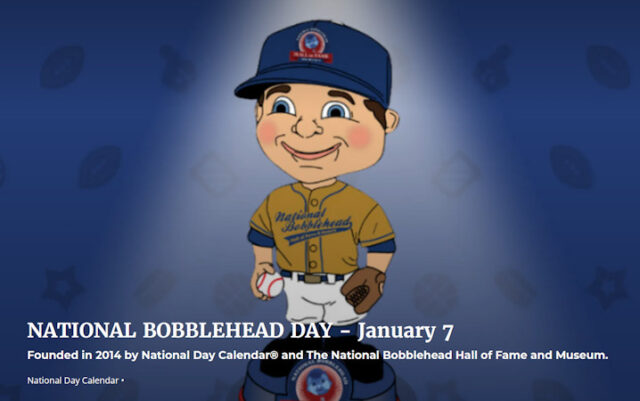
Each year on January 7th, National Bobblehead Day is a day of celebration for all spring-connected head bobbing figurines.
- 1700s – Called “temple nodders,” the earliest known bobbleheads are modeled after Buddha and other religious figures.
- 1760s – Bobbleheads are believed to have originated in China, and they first arrived in Europe around the 1760s. In contrast, a depiction of two Chinese people appears in the background of the 1765 painting Queen Charlotte in Her Dressing Room by Johann Zoffany.
- 1800s – Created in China in the early 1800s, a pair of bobbleheads resembling a husband and wife sold at an auction in 2010 for $35,925, according to the Bobblehead Hall of Fame.
- 1842 – Writer Nikolai Gogol first referenced bobblehead dolls in 1842 in the Russian short story “The Overcoat.” He described the main character, Akaky, as having a neck, which was “like the neck of plaster cats which wag their heads.”
- 1901 – Antique ceramic bobbleheads of animals were produced in Germany, measuring 6 to 8 inches.
- 1920s – The first sports bobblehead featured a generic basketball player.
- 1950s – Early bobbleheads, known as bobbers or nodders, developed in Germany. They took root in U.S. pop culture in the 1950s and ’60s.
- 1960 – The first paper-mâché and ceramic generic and player specific bobbleheads were made. Roberto Clemente, Mickey Mantle, Roger Maris, and Willie Mays were the first non-mascot bobbleheads created. The uniforms were different but all shared the same face.
- 1960s – Bobbleheads resurged in the late 1990s when professional sports teams began using them as promotional items. Today, as both toys and collectibles, bobbleheads continue to amuse and captivate us.
- 1964 – While replicas have been made, the original 1964 set of Beatles bobbleheads is selling for up to $800 online. This was one of the first sets of bobbleheads modeled after humans that weren’t athletes, and the fact that Beatlemaniacs would purchase anything related to their four favorite guys made them an instant hit.
- 1999 – When did bobbleheads as we know them today become a sports phenomenon? As it turns out, a celebration of the 40th anniversary of Candlestick Park in May 1999, when the San Francisco Giants gave away Willie Mays bobbleheads, is generally recognized as the first bobblehead event at any American sporting venue.
- 2002 – The National Bobblehead Hall of Fame and Museum collection starts when Brad Novak, Co-Founder & President of the National Bobblehead Hall of Fame and Museum, begins getting bobbleheads as a member of the Rockford RiverHawks’ staff.
- The Museum features over 6,500 unique bobbleheads, dozens of exhibits and a store featuring merchandise and over 500 bobbleheads available for purchase.
- 2012 – Bobbleheads were used as a romantic gesture! They were gifted by the Bachelorette contestant Chris Bukowski to Emily Maynard. He was eliminated later, but they still had enough points to keep him for a while.
- 2014 – The National Bobblehead Hall of Fame and Museum submitted National Bobblehead Day in December 2014. The museum opened in 2016 in Milwaukee, Wisconsin, and houses the world’s most extensive collection of bobbleheads.
- 2014 – 0.99 Million Bobbleheads found their way into the homes of Baseball fans as promotional gifts by the MLB.
- 2015 – One of two surviving Bobbleheads representing the 1961-1962 New York Yankees sold for almost $60,000 in 2015.
- 2016 – As of April 2016, the most enormous bobblehead officially recognized by the Guinness World Records was 4.69 meters (15.4 feet) tall, depicting a St. Bernard dog, the mascot of the Applied Underwriters insurance company in Orlando.
- 2016 – Bobbleheads were thrust into controversy when Robert Blaha, a 2016 Colorado candidate for US Senate, reportedly spent $1,137 on Bobblehead replicas of other pertinent politicians. Not only did he use them in his commercial, but he also took them on the road as he hit the campaign trail!
- 2020 – A movie entirely based on the “lives” of bobbleheads was released on the 8th of December, 2020. The film was titled “Bobbleheads: The Movie.”
- For over 100 years, bobbleheads have entertained and fascinated fans and collectors.
- A ‘bobblehead’ is also called a ‘bobbing head’, ‘wobbler’, ‘nodder’, ‘nodding doll’ and ‘nodding head’.
- Teams now give away nearly 4 million bobbleheads annually to fans at games.
Sources

Disclaimer
Artificial Intelligence Disclosure & Legal Disclaimer
AI Content Policy.
To provide our readers with timely and comprehensive coverage, South Florida Reporter uses artificial intelligence (AI) to assist in producing certain articles and visual content.
Articles: AI may be used to assist in research, structural drafting, or data analysis. All AI-assisted text is reviewed and edited by our team to ensure accuracy and adherence to our editorial standards.
Images: Any imagery generated or significantly altered by AI is clearly marked with a disclaimer or watermark to distinguish it from traditional photography or editorial illustrations.
General Disclaimer
The information contained in South Florida Reporter is for general information purposes only.
South Florida Reporter assumes no responsibility for errors or omissions in the contents of the Service. In no event shall South Florida Reporter be liable for any special, direct, indirect, consequential, or incidental damages or any damages whatsoever, whether in an action of contract, negligence or other tort, arising out of or in connection with the use of the Service or the contents of the Service.
The Company reserves the right to make additions, deletions, or modifications to the contents of the Service at any time without prior notice. The Company does not warrant that the Service is free of viruses or other harmful components.