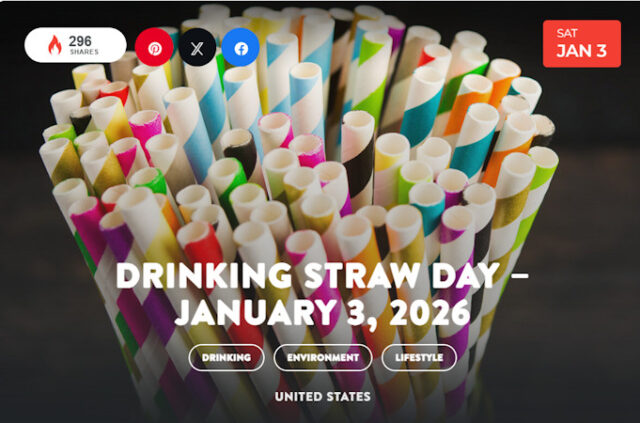
On January 3rd National Drinking Straw Day commemorates the date in 1888 that Marvin C. Stone received the patent for the paper drinking straw. Since then, a variety of drinking straws are used.
- 3000 BC – Discovered in a Sumerian tomb from roughly 3,000 B.C., the straw was made of gold and the precious stone, lapis lazuli.
- 16th Century – The Argentines used a similar metallic device called a bombilla. Used for hundreds of years, the bombilla acted as both a straw and a sieve.
- 1800s – In the 1800s, people were using raw pieces of rye grass as straws to drink spirits and cocktails. Traditional rye straws had a fatal flaw though, leaving a musty, unpleasant flavor in the drink.
- 1888 – The United States Patent Office granted Mavin G. Stone a patent for a paper drinking straw after disliking the rye straw aftertaste—patent # US375962 A on January 3, 1888.
- 1937 – Joseph Friedman files for a bendable straw patent after watching his daughter struggle to drink with a straight paper straw.
- 1960s – With the rise of the fast-food industry, the paper drinking straw is replaced by the low-cost plastic straw.
- 1984 – The 1980s saw the era of whimsical plastic straws. Erik Lipson, owner of Fun-Time International, invented the Crazy Glasses in 1984, an addition to the iconic Krazy Straw. The straw was shaped like a pair of glasses, and the novelty item quickly became popular.
- 2011 – February 2011 Milo Cress, age 9, shocks the world with his estimate of 500 million straws per day used in the United States alone.
- 2015 – In 2015, a difficult-to-watch internet video surfaced of a sea turtle having a plastic straw removed from its nostril. The video shows animal rescue workers painfully removing a 10-12 cm plastic straw out of the turtle’s nose. As of today, the video has 109 million views.
- 2017 – August 2017 Lonely Whale kicks off their digital campaign for A Strawless Ocean, highlighting various celebrities taking the pledge to #StopSucking. The campaign helps educate the public and push for regulations on single-use plastic.
- 2018 – February 2018 Queen Elizabeth bans plastic straws and bottles from all royal estates, cafes and gift shops.
- 2018 – May 2018 Vancouver becomes the first major Canadian city to ban single-use plastic.
- 2018 – May 2018 16-year-old Girl Scout Shelby O’Neil convinces Alaska Airlines to eliminate plastic straws and stirrers. The airlines, which used 22 million plastic stir straws and citrus picks each year, now plans to use products made from white birch and bamboo.
- 2018 – In early July 2018, Seattle became the largest U.S. city to ban plastic straws.
- 2019 – January 2019, Governor Jerry Brown enacts a “straw upon request” policy in the state of California. Most cities in the state have phased out plastic straws in favor of compostable, paper-based alternatives. Washington, D.C., also bans single-use plastic straws.
- 2019 – In 2019, the European Union voted to ban all single-use plastic, including plastic cutlery, straws and stirrers. The ban took effect in 2021.
- 2021 – Canada bans all single-use plastics, as does Mexico City.
- 2022 – New Jersey rolls out a single-use plastic ban, starting with plastic straws. Single-use plastic carryout bags and Styrofoam cups, plates, and containers will be banned in the state beginning May 4, 2022.
- 2050 – At the current rate, 2050 is the year in which the weight of plastic in the ocean will exceed the weight of all the fish in the seas.
- Today, manufacturers make a variety of reusable straws. From stainless steel and glass to bamboo and silicone, they not only save money and the environment, but they are also fun to use. They come in a variety of creative shapes and colors.
- 35,000. That’s the number of plastic straws the average American uses in a lifetime.
- Every single day, Americans toss 500 million plastic straws in the trash. That’s enough to fill 125 school buses, or circle the Earth 2.5 times!
- Top Ten in the Ocean. According to the Ocean Conservancy, plastic straws are in the top ten marine debris items (here’s looking at you, cig butts and single-use shopping bags in positions #1 and #2!)
- Discarded straws aren’t biodegradable. Instead, they break down into small particles called microplastics. These plastic fragments stay in the environment forever and are harmful to all its inhabitants.
- Bon Appétit Management, a food service company with 1,000 U.S. locations, announced in 2018 that it would phase out plastic straws.
- Alaska Airlines was one of the first airlines to phase out plastic straws and stirrers, in part thanks to an environmentally conscious Girl Scout.
- Hospitals were among the first to embrace bendable straws, because they allowed patients to drink while lying in bed.
- Some Straw alternatives:
- Metal: Made of stainless steel, aluminum, or even titanium, metal straws have become a popular alternative. They draw some criticism—for having a metallic taste, conducting heat from a hot drink, and clanking against the teeth—but they’re durable to transport and reuse.
- Paper: Paper drinking straws, which date from 1888. They become mushy and can leave a taste or fibers in drinks.
- Silicone: This material provides a popular soft alternative to metal reusable straws. One company has developed a silicone straw with an extra environmental twist: When burned, it turns into biologically inert ash.
- Glass: Though glass straws may be more breakable and thus less portable than reusable straws of other materials, they hold up well to washing and reuse.
- Hard plastic: Reusable straws made from rigid plastic are portable, easy to clean, and reasonably durable.
- Bamboo: This natural material can be sustainably produced and is a plant-based alternative to fabricated straws. Bamboo straws are reusable but can be hard to clean thoroughly and may absorb flavors.
Sources:

Wholesome Culture
Disclaimer
Artificial Intelligence Disclosure & Legal Disclaimer
AI Content Policy.
To provide our readers with timely and comprehensive coverage, South Florida Reporter uses artificial intelligence (AI) to assist in producing certain articles and visual content.
Articles: AI may be used to assist in research, structural drafting, or data analysis. All AI-assisted text is reviewed and edited by our team to ensure accuracy and adherence to our editorial standards.
Images: Any imagery generated or significantly altered by AI is clearly marked with a disclaimer or watermark to distinguish it from traditional photography or editorial illustrations.
General Disclaimer
The information contained in South Florida Reporter is for general information purposes only.
South Florida Reporter assumes no responsibility for errors or omissions in the contents of the Service. In no event shall South Florida Reporter be liable for any special, direct, indirect, consequential, or incidental damages or any damages whatsoever, whether in an action of contract, negligence or other tort, arising out of or in connection with the use of the Service or the contents of the Service.
The Company reserves the right to make additions, deletions, or modifications to the contents of the Service at any time without prior notice. The Company does not warrant that the Service is free of viruses or other harmful components.