By Tom Marquardt And Patrick Darr
We once hesitated to try port—a drink we pictured in smoky dens, sipped by pompous gentlemen with weighty ideas. After a heavy meal our tired palates rarely welcomed its sweetness, and we’d rather spare ourselves the hangover that would surely result from a well-fortified nightcap. But a recent trip to Portugal’s Douro Valley—where we saw the steep, rocky vineyards and learned every step of port production—gave us new respect for one of wine’s most historic elixirs.
Though wine has been made in the Douro since Roman times, port as we know it dates to the late 1600s. To keep wine stable on the voyage to England, vintners added brandy during fermentation, creating the fortified, rich, sweet wine we now call port. Today, a neutral grape spirit with around 22 percent alcohol is added during fermentation. This stops fermentation and yields 19-22% alcohol by volume.
If you visit Porto, begin at World of Wine in Vila Nova de Gaia, just across the river. This sprawling museum covers port, corks, glassware, Portuguese rosé and the broader winemaking story. We spent eight hours tasting and lunching without once feeling bored and came away with a solid grounding before touring an actual lodge.

For a deeper look, we went to Graham’s 1890 Lodge, where the Vinum restaurant offers an exceptional lunch and spectacular views. Graham’s is part of the Symington Family portfolio—which also includes Cockburn’s, Dow’s and Warre’s—and remains the only major British port group still independently family-owned. They are also the largest vineyard operators in the Upper Douro.
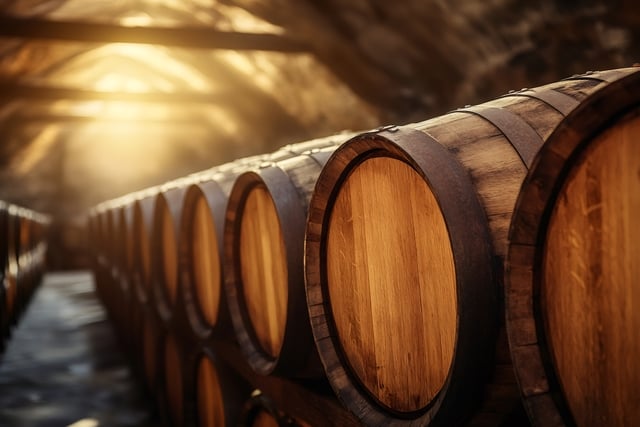
Perched on a hill opposite Porto, Graham’s is one of several lodges designed for aging port in the cooler, maritime climate, which is better than that in the Upper Douro. Historically, grapes grown on the hot, terraced quintas were crushed on site, then sent downriver in flat-bottomed rabelos to Gaia for maturation. During our cellar tour, we saw rows of barrels holding vintage port, LBV, aged tawnies, single-harvest tawnies, and more.
Graham’s still employs its own coopers, who maintain some 3,500 seasoned oak barrels—several over a century old. The firm began in 1820 when William and John Graham accepted 27 barrels of port as payment on a textile debt. Enthralled by the wine, they launched Graham’s Lodge. In 1970, the Symingtons acquired the business.
We later took the train along the Douro to Quinta do Bomfim, where Symington crafts Dow port. The steep vineyards underscore the challenges of each harvest. At Bomfim, you can taste the family’s ports and dine at the Michelin-starred restaurant Bomfim 1896, led by chef Pedro Lemos.
Graham’s draws its grapes from four principal estates: Quinta dos Malvedos (its flagship property), Quinta do Tua, Quinta da Vila Velha and Quinta do Vale de Malhadas.
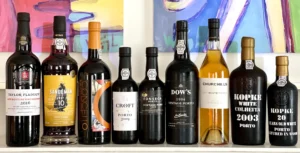
Port falls into five categories:
- Ruby: fruity, youthful wines from blended vintages aged 2–3 years in large tanks.
- Tawny: matured 3–9 years in small casks, with amber-brown color and almond-caramel complexity. Standard tawnies are a blend from multiple vintages, but a colheita is from grapes all harvested in a single vintage. A “20-year-old” tawny port isn’t a single-vintage wine that’s been aging for 20 years, but rather a master blender’s blend of various tawnies whose collective time in oak casks averages 20 years. The goal isn’t to bottle time itself, but to create a reliable signature—a liquid tapestry where the oxidation, concentration, and wood integration characteristic of extended aging appear consistently from one bottle to the next. The older the tawny, the more complex and less fruity is gets.
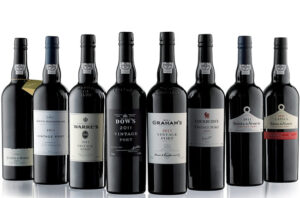
- Vintage: produced only in exceptional years, aged 2–3 years in oak before decades in bottle. Although the producer declares a vintage year, the decision has to be ratified by a regulatory body after its panel tastes the wine.
- White port (a delicious cocktail making the rounds is white port and tonic, which we highly recommend as a refreshing drink).
- Rosé port
Over three decades of wine writing, we’ve enjoyed Graham’s 1948, 1966, 1970, and 1977 vintage ports and numerous newer vintages.
Tawny ports undergo a special process: each year the wine is racked, barrels are selected and blended into a large vat while individual casks are refurbished, then the wine returns to its own barrel for another year’s aging. This “angel’s share” evaporation runs about 2.5 percent per year—roughly 22 percent lost by ten years, 4 percent by twenty. The age on the bottle (10-year-old, for instance) indicates the wine’s average age as determined by an official and often controversial tasting panel.
We highly recommend Graham’s 10-Year-Old and 20-Year-Old tawnies. The 10-year offers nutty, honeyed aromas and dried-fruit flavors; the 20-year adds spice, rich sweetness and impeccable balance. Unlike vintage ports, tawnies stay fresh for up to 8 weeks after opening, and Graham’s even bottles examples aged up to 80 years.
Tawny ports can be enjoyed slightly chilled as a dessert, and they also complement cheeses, nuts, and sweet desserts, such as apple pie.
Wine picks
Combio do Vesuvio DOC Douro 2022 ($25). We tasted a lot of the wines from Quinta do Vesuvio when we recently visited Portugal. While there are many pricey wines from this property, this blend of touriga nacional, touriga franca, tinta roriz and tinta barroca is a steal. Ready to drink, it has vibrant strawberry aromas and rich plum flavors with hints of rosemary and spice.
Auteur Sonoma Coast Chardonnay 2023 ($45). This understated wine gives you much to think about as you’re sipping it. It’s not overblown or over-oaked but rather balanced with a sleek profile and fresh citrus and apple notes.
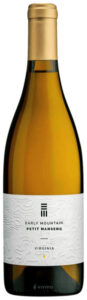
Early Mountain Petit Manseng Virginia 2022 ($65). We wish this wine was less expensive because we would buy a case. So goes the struggle to make great wine from an unusual grape in small quantities. Petit manseng is a popular grape variety in Virginia and for good reason. It produces a wine with a lively personality. Peach and pear notes with hints of various herbs.
Disclaimer
Artificial Intelligence Disclosure & Legal Disclaimer
AI Content Policy.
To provide our readers with timely and comprehensive coverage, South Florida Reporter uses artificial intelligence (AI) to assist in producing certain articles and visual content.
Articles: AI may be used to assist in research, structural drafting, or data analysis. All AI-assisted text is reviewed and edited by our team to ensure accuracy and adherence to our editorial standards.
Images: Any imagery generated or significantly altered by AI is clearly marked with a disclaimer or watermark to distinguish it from traditional photography or editorial illustrations.
General Disclaimer
The information contained in South Florida Reporter is for general information purposes only.
South Florida Reporter assumes no responsibility for errors or omissions in the contents of the Service. In no event shall South Florida Reporter be liable for any special, direct, indirect, consequential, or incidental damages or any damages whatsoever, whether in an action of contract, negligence or other tort, arising out of or in connection with the use of the Service or the contents of the Service.
The Company reserves the right to make additions, deletions, or modifications to the contents of the Service at any time without prior notice. The Company does not warrant that the Service is free of viruses or other harmful components.